Why the feds aren’t closing the door on non-essential businesses

Advertisement

Advertise with us

OTTAWA - While Canada's response to the COVID-19 outbreak has taken off drastically in the last week, some have found it lopsided across the country.

Read this article for free:


By clicking the button above, an account will be created and you will begin to receive some of our recommended newsletters. You may opt out of any newsletter by visiting your Email and Communication Preferences page or by clicking "unsubscribe" at the bottom of any email.

or

Already have an account? Log in here »

To continue reading, please subscribe:

Digital Subscription

One year of digital access for only $1.44 a week*

  • Enjoy unlimited reading on winnipegfreepress.com
  • Read the E-Edition, our digital replica newspaper
  • Access News Break, our award-winning app
  • Play interactive puzzles

*Billed as $5.77 plus GST every four weeks. After 52 weeks, price increases to the regular rate of $19.95 plus GST every four weeks. Offer available to new and qualified returning subscribers only. Cancel any time.

To continue reading, please subscribe:

Add Free Press access to your Brandon Sun subscription for only an additional

$1 for the first 4 weeks*

  • Enjoy unlimited reading on winnipegfreepress.com
  • Read the E-Edition, our digital replica newspaper
  • Access News Break, our award-winning app
  • Play interactive puzzles
Start now

*Your next Brandon Sun subscription payment will increase by $1.00 and you will be charged $17.95 plus GST for four weeks. After four weeks, your payment will increase to $24.95 plus GST every four weeks.

Hey there, time traveller!
This article was published 18/03/2020 (2417 days ago), so information in it may no longer be current.

OTTAWA – While Canada’s response to the COVID-19 outbreak has taken off drastically in the last week, some have found it lopsided across the country.

In Ontario and Alberta, dine-in restaurants and bars are closed by provincial decree, while Quebec has shut down bars but ordered restaurants to limit the number of customers.

Other provinces have made no such order.
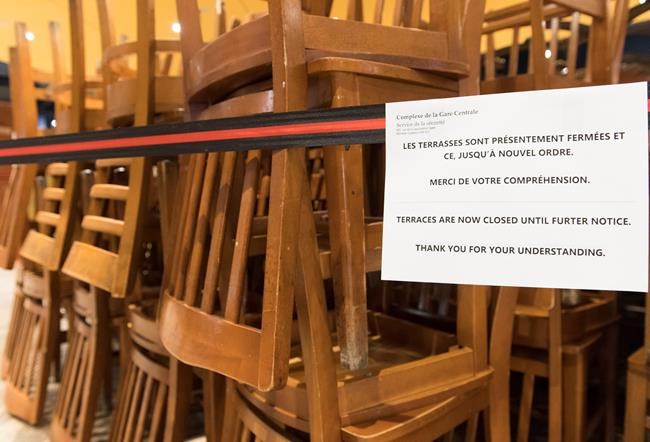
A sign notifying customers of a closed terrace is shown at food court in Montreal, Wednesday, March 18, 2020, as COVID-19 cases rise in Canada and around the world. THE CANADIAN PRESS/Graham Hughes

Even in a single city like Ottawa, there’s variation between which businesses have stayed open and which have shuttered to the public.

Businesses need more federal direction to avoid confusion, the Canadian Chamber of Commerce said Wednesday.

“One of the things businesses are looking for is more coherence,” said Perrin Beatty, president of the Canadian Chamber of Commerce.

Right now in Canada, the Public Health Agency of Canada and federal health minister provide advice to the provinces, but each province and territory is ultimately responsible for making its own decisions.

Beatty said the situation can be particularly vexing for companies that operate across jurisdictions.

“As rate of infection is growing, the same rules increasingly should apply across the board,” he said.

For some, without specific advice from the federal government, it can be a difficult financial proposition to voluntarily shut their doors, he said.

Federal authorities say that have been co-ordinating with provincial counterparts, but that local context is important.

“We very much recognize … that there are specific conditions in specific cities, specific provinces,” said Deputy Prime Minister Chrystia Freeland.

“That’s why we have public health officers also at the provincial and the city level.”

The provinces’ decisions about whether to close non-essential businesses comes down to the reality on the ground, including the number of cases of COVID-19 in the region and whether the area is seeing community transmission.

Chief public health officer Dr. Theresa Tam said it may also come down to a particular health system’s ability to deal with an outbreak. A weaker health system may take a more cautious approach, for example, she said.

Beatty suggested a national message might still be more helpful, even if it leaves room for exceptions. At least then the information would be coming from one source, he explained.

He did complement the federal government though on its open lines of communication with the business community.

And to some extent, he said it will be up to businesses to do the right thing for their customers and employees.

This report by The Canadian Press was first published March 18, 2020.

Report Error Submit a Tip

More Stories

A timeline of the WE Charity controversy

The Canadian Press 9 minute read Wednesday, Aug. 19, 2020

OTTAWA - A timeline of events regarding the Canada Student Service Grant program, based on public documents, events and statements from cabinet ministers, government officials, and WE Charity:

March 6, 2020: WE Charity staff prepare a concept paper on service learning for public servants at Employment and Social Development Canada.

April 5: Finance Minister Bill Morneau and Prime Minister Justin Trudeau talk over the phone about how to help students whose summer job and volunteer opportunities were vanishing due to the COVID-19 pandemic. Finance Department officials are tasked with considering options the next morning.

April 7: Small Business Minister Mary Ng and WE co-founder Craig Kielburger have an introductory phone call in which Ng asks WE to send what it calls a ``pre-established proposal'' to help young people launch businesses.

Neo-Nazi group members plotted to kill Free Press reporter

5 minute read Preview

Neo-Nazi group members plotted to kill Free Press reporter

5 minute read Wednesday, Aug. 10, 2022

Disturbing details of a plan to kill a Free Press reporter who had infiltrated a white nationalist hate group were revealed for the first time Wednesday.

Read
Wednesday, Aug. 10, 2022

Fawcett promises growth in second term as Brandon mayor

Alex Lambert 2 minute read Preview

Fawcett promises growth in second term as Brandon mayor

Alex Lambert 2 minute read 9:39 AM CDT

BRANDON — Jeff Fawcett promises “incredible opportunities” for Brandon over the next four years.

The incumbent was handily re-elected for a second term as Brandon mayor Wednesday evening, receiving 54 per cent of the vote. He defeated his only challenger, former councillor and MLA Len Isleifson, by 907 votes.

“The next four years presents incredible opportunities for our city,” Fawcett told supporters after the victory. “We’ll continue to support responsible growth, strengthening our neighbourhoods, investing in infrastructure, supporting local businesses, and ensuring Brandon remains a place where families and future generations can thrive.”

Isleifson, a Brandon councillor from 2010 to 2014 and Brandon East Tory MLA from 2016 to 2023, called the result disappointing but said he wouldn’t change anything about his campaign.

Read
9:39 AM CDT

Newspaper websites display fewer stories, more curation

5 minute read Tuesday, Feb. 10, 2026

A city subcommittee was provided with a routine update on the status of an ongoing administrative process Thursday, in accordance with standard reporting procedures.

Fact Check

1 minute read Thursday, Nov. 30, 2023

Fact Check

Having problems with the form?Contact Us Directly |

Trump touts USMCA win in state of the union

James McCarten, The Canadian Press 6 minute read Preview

Trump touts USMCA win in state of the union

James McCarten, The Canadian Press 6 minute read Tuesday, Feb. 4, 2020

WASHINGTON - President Donald Trump declared his scorched-earth political style an unmitigated success Tuesday in a fiercely partisan, made-for-TV state of the union speech that made it clear he expects to be back in the White House next year on the strength of the U.S. economy and his trade deals with Canada, Mexico and China.

Trump, addressing a joint session of Congress in the very chamber where House Democrats voted to impeach him less than two months ago, became only the second president in American history — Bill Clinton was the first — to deliver a state of the union while standing trial in the Senate.

Unrepentant, he pointedly refused to shake the offered hand of House Speaker Nancy Pelosi on the dais before singing the praises of what he billed as "the great American comeback," pointing to strong job growth, a soaring stock market and low unemployment as evidence of his leadership. And when he was done, Pelosi ripped up the speech in full view of the television cameras.

"America's enemies are on the run, America's fortunes are on the rise, and America's future is blazing bright. The years of economic decay are over," Trump declared, taking full credit for the country's "roaring economy," including what he billed as seven million new jobs and the lowest jobless rate in half a century — a "blue-collar boom" that he's counting on to help his re-election chances in November.

Read
Tuesday, Feb. 4, 2020