A primer on the Coastal GasLink pipeline

Advertisement

Advertise with us

VANCOUVER - Protests continue across the country as the RCMP enforce an injunction requiring opponents of the Coastal GasLink pipeline to clear the way for construction in northern British Columbia. Here is a look at the project and its history:

Read this article for free:


or

Already have an account? Log in here »

To continue reading, please subscribe:

Subscribe and receive a limited-edition Free Press branded hat or tote.

Digital Subscription

One year of digital access for only $205*

  • Enjoy unlimited reading on winnipegfreepress.com
  • Read the E-Edition, our digital replica newspaper
  • Access News Break, our award-winning app
  • Play interactive puzzles

*First annual payment billed as $205.00 + GST for one year. This annual subscription will automatically renew at $233.00 + GST every 52 weeks (10% off the regular annual price of $259.35). Offer available to new and qualified returning subscribers only. Cancel any time.

To continue reading, please subscribe:

Add Free Press access to your Brandon Sun subscription for only an additional

$1 for the first 4 weeks*

  • Enjoy unlimited reading on winnipegfreepress.com
  • Read the E-Edition, our digital replica newspaper
  • Access News Break, our award-winning app
  • Play interactive puzzles
Start now

*Your next Brandon Sun subscription payment will increase by $1.00 and you will be charged $17.95 plus GST for four weeks. After four weeks, your payment will increase to $24.95 plus GST every four weeks.

Hey there, time traveller!
This article was published 10/02/2020 (2406 days ago), so information in it may no longer be current.

VANCOUVER – Protests continue across the country as the RCMP enforce an injunction requiring opponents of the Coastal GasLink pipeline to clear the way for construction in northern British Columbia. Here is a look at the project and its history:

The project: B.C. Premier John Horgan announced provincial support for the project on Oct. 2, 2018. He said LNG Canada’s decision to build a $40-billion liquefied natural gas plant in Kitimat was similar to the moon landing for the province. To get natural gas to the export plant, Coastal GasLink Ltd. is building a 670-kilometre pipeline from the Dawson Creek area in northern B.C. at an estimated cost of $6.6 billion. At the peak point of construction, the plant and the pipeline will employ about 10,000 people. About 900 workers will be needed at the plant during the first phase of its operations.

The route: Planning for the route included the establishment of a “conceptual corridor” through B.C. in 2012 that the company said included consultations with First Nations, local governments and landowners. The final route approved by the BC Oil and Gas Commission runs southwest from outside Dawson Creek before heading west near Vanderhoof to Kitimat.
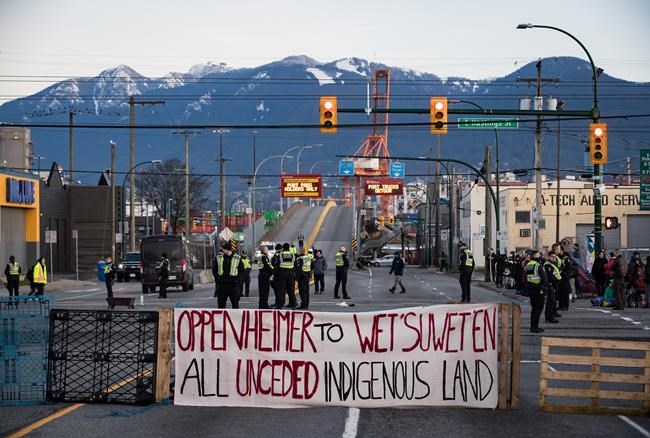
Police officers stand on the road after clearing the intersection of protesters that were blocking an entrance to the port during a demonstration in solidarity with Wet'suwet'en hereditary chiefs opposed to construction of a natural gas pipeline across their traditional territories, in Vancouver, on Monday February 10, 2020. THE CANADIAN PRESS/Darryl Dyck

First Nations: The dispute has highlighted a debate over whether hereditary chiefs should have more power under Canadian law. The Indian Act established band councils, made up of elected chiefs and councillors, who have authority over reserve lands. Hereditary chiefs are part of a traditional form of Indigenous governance that legal experts say the courts have grappled with how to recognize.

IndigenousSupport: The pipeline has support from 20 elected band councils along the route. All of them have signed benefit agreements with Coastal GasLink. Chief Coun. Crystal Smith of the Haisla Nation in Kitimat said last month that the project will help the community become less reliant on federal funding. The Haisla Nation is also in discussions for equity stakes in the project, which Smith said would create revenue that the community could decide to invest in housing, health or education, in contrast with federal money that comes with restrictions on how it can be used.

Indigenous Opposition: Five Wet’suwet’en hereditary clan chiefs say the pipeline cannot proceed without their consent. Their supporters at a camp near Houston have been blocking construction in violation of a court injunction, which the RCMP began enforcing last week. The hereditary chiefs say they have authority over the broader 22,000 square kilometres of traditional territory that the pipeline would partially cross, while the elected band councils only administer smaller reserves.

Protests and Injunctions: The RCMP arrested 14 people when it began enforcing a court injunction on a forest service road near Houston on Jan. 7, 2019, requiring people obstructing construction of the pipeline to clear the way for the company. The arrests led to dozens of rallies across the country in support of the hereditary chiefs. After talks failed to find a solution to the dispute last week, the RCMP began enforcing a separate court injunction on Thursday and arrested six people, followed by additional arrests in the days that followed. The RCMP’s enforcement of the injunction has sparked protests across the country, including blocking train routes in Quebec and Ontario. Vancouver police say 33 people were arrested on Monday as they enforced an injunction preventing blockades at entrances to the Port of Vancouver and the DeltaPort container terminal.

This report by The Canadian Press was first published Feb. 10. 2020.

Report Error Submit a Tip

More Stories

Is Trump about to poke Quebec’s political beehive?

Peter McKenna 5 minute read Preview

Is Trump about to poke Quebec’s political beehive?

Peter McKenna 5 minute read 2:00 AM CDT

When was the last time that a U.S. president seriously stirred the hornet’s nest of Quebec politics?

My best recollection is former U.S. president Bill Clinton. During the 1994 Quebec referendum campaign, Clinton made clear that the U.S. wholly endorsed a united and strong federal Canada — as opposed to a dismembered one. He went on to add that an independent Quebec would have no guarantee of joining the North American Free Trade Agreement as a full-fledged member.

Today, we see U.S. President Donald Trump inserting himself — unwittingly or wittingly — into the electoral and sovereignty politics of Quebec. It’s pretty clear that the resurgent Coalition Avenir Québec government is trying to make the Oct. 5 provincial election about anything other than its own governmental record and more about Trump’s economic coercion against Canada. Of course, the Parti Québécois, the odds-on-favourite, wants to make the electoral contest a referendum on the CAQ and its party leader, Christine Fréchette.

But what if Trump really wanted to make his presence felt in Quebec’s political life? How much influence could he have on shaping political outcomes in Quebec? How much of an “X factor” could he be?

Read
2:00 AM CDT

Multiple factors add up to difficult harvest

Laura Rance-Unger 4 minute read Preview

Multiple factors add up to difficult harvest

Laura Rance-Unger 4 minute read 2:00 AM CDT

Earlier this month, farmers sent agriculture publications some heartbreaking photos showing how heavy rains across the Prairies had pummelled a promising harvest.

An idled combine up to its axles in a flooded Saskatchewan field, straw bales surrounded by water and field equipment stranded on the far side of a washed-out section told the obvious story.

The Sept. 6-7 event was just the latest in a series of heavy rainfall events that have plagued this year’s growing season. Similar deluges hit different regions July 15-17, Aug. 14, and Aug. 31 — some of which were accompanied by tornadoes.

“What’s made this season challenging is the intensity of these rainfalls,” said Manitoba Agriculture ag meteorology specialist Alison Sass as she reviewed the summer’s weather patterns on an extension webinar.

Read
2:00 AM CDT

Banjo Bowl a big deal for new and returning faces

Ken Wiebe 7 minute read Preview

Banjo Bowl a big deal for new and returning faces

Ken Wiebe 7 minute read Yesterday at 6:16 PM CDT

Kenneth Womack never doubted this day would come.

For all of the twists and turns along this journey, Womack believed in himself and the work he’s been putting in on the road to becoming a professional football player.

So, as the Winnipeg Blue Bombers receiver gets set to make his CFL on Saturday afternoon against the Saskatchewan Roughriders in the Banjo Bowl, you can be sure he’s going to take a moment to savour the experience while doing his best to make it feel like any other game he’s played previously.

“Once I run out the tunnel, it’s all going to sink in,” Womack said after Friday’s walkthrough.

Read
Yesterday at 6:16 PM CDT

9 to 5:

Tory McNally 8 minute read Preview

9 to 5:

Tory McNally 8 minute read 2:00 AM CDT

I watched the 1980 comedy 9 to 5 for the first time this week.

I know: I’m an HR consultant. I’ve been doing this work for 13 years, I write about workplaces for a living, and somehow I had never actually watched the movie that gave us one of the most recognizable workplace songs of all time.

I knew the premise, of course. I knew American music icon Dolly Parton was in it. I knew there was a terrible boss and three women who eventually decided they had enough.

I expected a funny, somewhat dated movie about three women getting revenge on an awful boss. What I didn’t expect was to spend the next two hours thinking about how much has changed in the workplace since 1980 — and how much really hasn’t.

Read
2:00 AM CDT

Debut adult novel proves a twisty, satisfying cozy mystery

Reviewed by Anita Daher 4 minute read Preview

Debut adult novel proves a twisty, satisfying cozy mystery

Reviewed by Anita Daher 4 minute read 2:00 AM CDT

The Mystic and the Missing Girl by Toronto author Vikki VanSickle is a metaphysical mystery with identity and self-acceptance at its core. It leans into the “cosy” category, despite a spatter of salty language.

VanSickle is a writing instructor and TV commentator, and is best-known for her books for children and teens, including the award-winning The Winnowing.

The 1998 disappearance of 17-year-old Ginny Evans haunts the Ontario town of Stanfield. The girl’s mother clings to hope that Ginny ran away to escape her abusive father, and is living a safe and happy life elsewhere.

Others believe she was murdered — but not dumped in a nearby lake, as the recently deceased and long-maligned “Hannah the Mystic” once suggested.

Read
2:00 AM CDT

’Vile acts’: Teen, 17, accused of mowing down geese in parking lots

Erik Pindera 4 minute read Preview

’Vile acts’: Teen, 17, accused of mowing down geese in parking lots

Erik Pindera 4 minute read Tuesday, Apr. 28, 2026

Police have arrested a 17-year-old boy accused of using his vehicle to kill four Canada geese and injure another in three separate incidents on Saturday night.

Winnipeg Police Service investigators believe the teen, while driving a white 2024 Subaru Solterra, intentionally ran over five geese in three different south Winnipeg parking lots in short succession, said police spokesman Const. Claude Chancy.

“It’s not good to see,” Chancy said of the unusual animal cruelty case. “You can understand how people are angered by such vile acts.”

In the first incident, a sleeping goose was run over and injured shortly before 10 p.m. in a parking lot on Henlow Bay, off Scurfield Boulevard. Chancy said he did not know what happened to the goose after it was injured.

Read
Tuesday, Apr. 28, 2026