A look at how workplaces can prepare for possible coronavirus outbreak

Advertisement

Advertise with us

TORONTO - Companies wary of what an infectious outbreak could do to their workforce and bottom line are revisiting contingency plans as the new coronavirus continues to spread.

Read this article for free:


or

Already have an account? Log in here »

To continue reading, please subscribe:

Subscribe and receive a limited-edition Free Press branded hat or tote.

Digital Subscription

One year of digital access for only $205*

  • Enjoy unlimited reading on winnipegfreepress.com
  • Read the E-Edition, our digital replica newspaper
  • Access News Break, our award-winning app
  • Play interactive puzzles

*First annual payment billed as $205.00 + GST for one year. This annual subscription will automatically renew at $233.00 + GST every 52 weeks (10% off the regular annual price of $259.35). Offer available to new and qualified returning subscribers only. Cancel any time.

To continue reading, please subscribe:

Add Free Press access to your Brandon Sun subscription for only an additional

$1 for the first 4 weeks*

  • Enjoy unlimited reading on winnipegfreepress.com
  • Read the E-Edition, our digital replica newspaper
  • Access News Break, our award-winning app
  • Play interactive puzzles
Start now

*Your next Brandon Sun subscription payment will increase by $1.00 and you will be charged $17.95 plus GST for four weeks. After four weeks, your payment will increase to $24.95 plus GST every four weeks.

Hey there, time traveller!
This article was published 10/02/2020 (2429 days ago), so information in it may no longer be current.

TORONTO – Companies wary of what an infectious outbreak could do to their workforce and bottom line are revisiting contingency plans as the new coronavirus continues to spread.

Marie-Helene Primeau of the Montreal-based risk management company Premier Continuum says she’s spent recent days fielding questions from several firms seeking guidance on what to do if the rapidly spreading illness that originated in China threatens the health of employees and customers.

“Everyone’s looking at their state of readiness,” says Primeau, whose company provides training and advice to a range of firms including banks, insurance companies, government agencies and those in manufacturing.

Companies wary of what an infectious outbreak could do to their workforce and bottom line are revisiting contingency plans as the new coronavirus continues to spread. Marie-Helene Primeau of the Montreal-based risk management company Premier Continuum, shown in a handout photo, says she's spent recent days fielding questions from several firms seeking guidance on what to do if the rapidly spreading illness that originated in China threatens the health of employees and customers. THE CANADIAN PRESS/HO

“They’re actively revisiting the plans, but they’re not necessarily stockpiling masks.”

Health officials in Canada have repeatedly stressed that the risk to public health remains low. Seven cases have been identified in Canada, while worldwide, the illness known as 2019-nCoV has sickened more than 37,000 people and killed more than 800, nearly all in China.

Nevertheless, Canadians are being urged to remain vigilant against infection, with medical experts reminding the public we’re still in the throes of flu season and that good hygiene is advised — wash hands frequently, cough and sneeze into tissue or your upper sleeve, and don’t touch your face.

Disaster management expert Amin Mawani says workers and managers alike should take this time to combat misinformation, repeat hygiene tips, be clear on sick leave policies and prepare for the possibility of mass absenteeism.

If an outbreak hits, employers should encourage unwell workers to stay home, Mawani says, but a key step to mitigating an outbreak’s impact is to keep people from getting sick in the first place.

“You can’t buy traditional insurance in a sense, but you can prepare for it by spending some money planning for it and stockpiling certain things — masks and whatever else you might need,” says Mawani, academic director of the health industry management program at the Schulich School of Business at York University in Toronto.

A possible outbreak has critics refocused on provincial sick day allowances in Ontario, where the Progressive Conservative government offers most workers three days of unpaid leave each year and allows bosses to demand a doctor’s note.

Health-care workers say that can make it hard for some to stay home when necessary, and if sick people work in high-risk settings — such as food services, long-term care facilities or childcare spaces — the impact can be significant.

“A lack of paid sick days results in children and adults transmitting infections at school and work, exacerbating contagion throughout the province,” the group Decent Work and Health Network warn in an open letter to Premier Doug Ford.

Mawani agreed employers should consider whether they’re prepared to ease sick day restrictions if the virus strikes staff, noting hardline policies also threaten morale and loyalty.

Workers should also consider coming up with their own protective measures, he adds.

“In some ways employees can take the initiative, they can say: ‘Look, I can easily do this at home,’ or ‘I can do this on the weekend. Why do I need to come in tomorrow?'” he says.

“And employers should be willing to listen during this phase so even if (workers) don’t start working from home now (the company) can have plans ready.”

John Yamniuk of the Toronto-based consulting firm DRI Canada says there are ways to limit person-to-person infection at the office, even those with open layouts, communal spaces, and shoulder-to-shoulder computer stations: Is there room to leave a vacant spot between workers? Is there an unused meeting room that can be transformed into an alternate work space?

“If you’re in a call centre environment, (think about) providing extra cleaning services, providing individual headsets for folks so they’re not sharing keyboards or things like that,” adds Yamniuk, based in Calgary.

Primeau’s advice includes making sure contact information for staff and partners are up-to-date.

She also encourages managers to run through “a tabletop exercise” — in which each person discusses their role during an emergency and all agree on how best to respond to various scenarios.

And don’t assume you can just rely on a temp agency if a lot of people call in sick, she adds, because you can’t guarantee availability or loyalty.

“Temporary backup was something that was brought up when we were talking about the (H1N1) pandemic 10 years ago but the thing is that those individuals will also be sick as well,” she says.

“It’s more (about) focusing on what’s key. What’s urgent to perform? What are the critical activities, rather than calling upon a temp.”

This report by The Canadian Press was first published Feb. 9, 2020.

Report Error Submit a Tip

More Stories

All-Japan committee meets to promote Sapporo Olympic bid

Stephen Wade And Yuri Kageyama, The Associated Press 4 minute read Preview

All-Japan committee meets to promote Sapporo Olympic bid

Stephen Wade And Yuri Kageyama, The Associated Press 4 minute read Tuesday, May. 10, 2022

TOKYO (AP) — Yasuhiro Yamashita, the head of the Japanese Olympic Committee, acknowledged the biggest stumbling block to holding the Olympics is the billions in costs.

However, in another breath on Tuesday at a so-called “All Japan” meeting to promote Sapporo's bid for the 2030 Winter Olympics, he said that if the northern Japanese city lands the Games, little new construction will be needed — a major expense for every Olympics.

“From both inside and outside our country, there are many views about hosting the Olympic and Paralympic Games,” Yamashista said, among politicians and business leaders online — and in Sapporo — talking up the bid. “I realize there are also concerns about the huge costs involved.”

The official cost for last year's delayed Tokyo Olympics was $13.6 billion, although government audits suggest it may have been much more. At least 60% was public money.

Read
Tuesday, May. 10, 2022

The election of our discontent

Matthew Frank 7 minute read Preview

The election of our discontent

Matthew Frank 7 minute read Yesterday at 2:37 PM CDT

There’s an undercurrent of unhappiness running through the Winnipeg electorate as the municipal election day approaches.

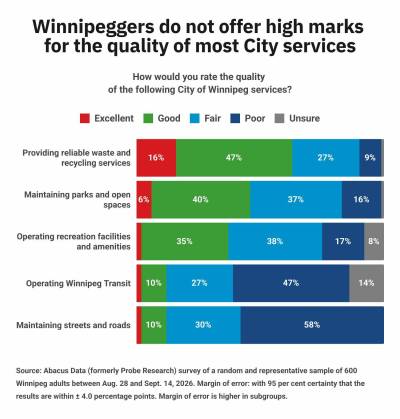
One-half of Winnipeggers believe the city is heading in the wrong direction, according to a new Abacus Data poll, with nearly one-third unsure if Winnipeg is regressing or progressing.

Only 21 per cent of residents believe the city is on the right track, the Free Press-commissioned poll found.

That discontentment extends to how the city spends its tax dollars, with four in 10 Winnipeggers believing they receive poor value for what they pay in property taxes.

Read
Yesterday at 2:37 PM CDT

Letters, Oct. 3

7 minute read Saturday, Oct. 3, 2026

A morning in the life …

My very first lesson does not start when I walk into that lecture hall, oh no — it starts long before. It begins when I walk to my car, check the estimated arrival time to the University of Manitoba and hope that Winnipeg traffic agrees with it.

A drive that appears completely manageable changes almost immediately when I’m greeted by a tsunami of orange pylons and a line of cars that appears to go on forever. Traffic moves by the inch, lanes magically disappear and the detour I took yesterday now has a detour of its own. These factors make me do a calculation that I have become all too familiar with. How late can I arrive and still find parking, run to my class across campus and get to class with enough time left to make it worth it?

I have grown used to people saying, “Why not just leave earlier?” I do. But when I’m already leaving for my 8:30 a.m. class at 7 a.m., there’s only so much I can do. This drive that some would think is relaxing is one that feels like an assignment that I didn’t know I had to complete and is due at 8:30 a.m.

Uncanny acting and bittersweet script a fitting tribute to Laurel and Hardy

Randall King  4 minute read Preview

Uncanny acting and bittersweet script a fitting tribute to Laurel and Hardy

Randall King  4 minute read Friday, Feb. 1, 2019

Laurel and Hardy, arguably one of the greatest comedy teams ever to grace the Vaudeville stage and screen, enjoyed a long and fruitful partnership. In fact, it lasted so long, it might as well have been a marriage.

That is the dramatic gist of this film by Jon S. Baird (Filth), who examines the duo in their career twilight, touring the music halls and theatres of England, circa 1953.

The Lancashire-born Stan Laurel (Steve Coogan) has the advantage of being on home turf. Oliver Hardy (John C. Reilly) is hobbled by health issues. While their routines are very much rooted in the English music hall tradition, they are past their prime. Feature films are the medium of choice for comedy duos. Laurel, who has a plaintive moment staring at a freshly installed billboard for the latest Abbott and Costello movie, is trying to cut a deal for a new film based on the legend of Robin Hood. It becomes increasingly obvious that the English producer he’s trying to contact is avoiding him.

Hardy is under different stresses, including failing health and an unhealthy penchant for the vices of drinking and gambling.

Read
Friday, Feb. 1, 2019

Not making the grade: rethinking student assessment

Maggie Macintosh 5 minute read Preview

Not making the grade: rethinking student assessment

Maggie Macintosh 5 minute read Thursday, Oct. 5, 2023

As most students in B.C. began the new school year without traditional grades, a former Manitoba teacher living in that province is urging colleagues here to do their homework on modern assessment and experiment with marking.

Starting this year, public and private school teachers in British Columbia are assessing kindergarten through Grade 9 with a scale describing a student’s level of understanding — “emerging,” “developing,” “proficient” or “extending” — instead of letter grades.

Grade 10, 11 and 12 students will continue to receive traditional letter grades and percentages.

“What’s wrong with percentages? There’s nothing wrong with them. They are a wonderful little tool, as long as they stay in their lane,” said Myron Dueck, an education consultant who was born in Winnipeg, where he graduated from teachers’ college in 1994.

Read
Thursday, Oct. 5, 2023

City, province, Ottawa strike task force to battle meth

Jessica Botelho-Urbanski 5 minute read Preview

City, province, Ottawa strike task force to battle meth

Jessica Botelho-Urbanski 5 minute read Tuesday, Dec. 18, 2018

The city, province and federal governments are teaming up to create a tri-level task force that will fight distribution of illicit drugs and address the root causes of the province's meth crisis.

"As far as we know, this is the first collaborative initiative like this in the country and it’s something that I’m very proud to be a part of," said Winnipeg Mayor Brian Bowman, who had been calling for such a task force (with unanimous council support) since September. 

In interviews last week, officials from the three levels of government told the Free Press they hadn't yet met in the same room to discuss the surge in meth-related problems.

By Tuesday, it seems they managed to clear their schedules.

Read
Tuesday, Dec. 18, 2018