Canada looking to help 126 Canadians quarantined in China for coronavirus

Advertisement

Advertise with us

OTTAWA - Foreign Affairs Minister Francois-Philippe Champagne said Tuesday Ottawa is "looking at all options" to help Canadians quarantined in China during the outbreak of a new coronavirus.

Read this article for free:


or

Already have an account? Log in here »

To continue reading, please subscribe:

Subscribe and receive a limited-edition Free Press branded hat or tote.

Digital Subscription

One year of digital access for only $205*

  • Enjoy unlimited reading on winnipegfreepress.com
  • Read the E-Edition, our digital replica newspaper
  • Access News Break, our award-winning app
  • Play interactive puzzles

*First annual payment billed as $205.00 + GST for one year. This annual subscription will automatically renew at $233.00 + GST every 52 weeks (10% off the regular annual price of $259.35). Offer available to new and qualified returning subscribers only. Cancel any time.

To continue reading, please subscribe:

Add Free Press access to your Brandon Sun subscription for only an additional

$1 for the first 4 weeks*

  • Enjoy unlimited reading on winnipegfreepress.com
  • Read the E-Edition, our digital replica newspaper
  • Access News Break, our award-winning app
  • Play interactive puzzles
Start now

*Your next Brandon Sun subscription payment will increase by $1.00 and you will be charged $17.95 plus GST for four weeks. After four weeks, your payment will increase to $24.95 plus GST every four weeks.

Hey there, time traveller!
This article was published 28/01/2020 (2442 days ago), so information in it may no longer be current.

OTTAWA – Foreign Affairs Minister Francois-Philippe Champagne said Tuesday Ottawa is “looking at all options” to help Canadians quarantined in China during the outbreak of a new coronavirus.

China began drastic containment efforts to limit the spread of the virus last week, cutting plane, train and bus links to Wuhan, a city of more than 11 million people. Several other nearby cities have been quarantined since, cutting off an estimated 19 million people.

Champagne said 250 Canadians have registered with Global Affairs Canada to say they are in Wuhan and 126 of them have asked for help to get home. He said his officials are trying to contact each one of them to assess their needs.

Wayne Duplessis, right, and his wife Emily Tjandra pose for a photo in their home in Wuhan, China in this handout photo. A Canadian teacher who has been living in China for about six years has some advice for those who want to evacuate from the epicentre of an outbreak of a new form of coronavirus. Don't. Wayne Duplessis, a teacher at Wuhan Optics Valley Weiming Experimental School, in Hubei province said he doesn't think it's wise. THE CANADIAN PRESS/HO, Wayne Duplessis *MANDATORY CREDIT*

“Every Canadian that has reached out to us for consular assistance will receive it,” he said.

He said Canada will tailor its response based on what it finds after all the Canadians asking for help have been contacted.

He noted the number of Canadians seeking help keeps changing as more and more people register via the Global Affairs Canada website — the previous day, the number of Canadians registered in the region was 167.

Champagne said help could include sending a plane to fly them home, but that Canada is also working with other countries in similar situations. Canada doesn’t have a diplomatic office in Wuhan but other countries do and are evacuating their workers. In some cases, others of their citizens are leaving alongside the diplomats.

Champagne said Canada is in contact with the Chinese government about making sure Canada can help its citizens.

Health Minister Patty Hajdu says she doesn’t yet know whether any of the Canadians in quarantine in China are sick or would be quarantined in Canada if they do come home.

Not all Canadians in the affected part of China want to leave.

Wayne Duplessis, working in China as a teacher, says he and his family are hunkered down in their home just outside of Wuhan’s city centre. He, his wife, Emily Tjandra, and their 15-year-old son Wyatt have spent the last two weeks chatting with people online, watching videos, movies, and the news, and listening to music.

Duplessis said in a Skype interview that he doesn’t want to spend hours in the air with people who could be sick.

Dr. Theresa Tam, Canada’s chief medical officer, has said symptoms of the new coronavirus are similar to those of the common flu and it can take up to two weeks for an infected person to start showing signs.

Duplessis is originally from Espanola, Ont., and he teaches at Weiming International High School in Dongxihu. He said he thinks it’s best to wait it out in Wuhan “no matter how difficult that is.”

His advice is to maintain routine.

“Get up in the morning, make your bed, brush your teeth, make breakfast, so some things are the same way every day … follow that routine so there is a structure to your day.”

Foreign Affairs Minister Francois-Philippe Champagne looks on as Minister of Health Patty Hajdu responds to a question in the Foyer of the House of Commons in Ottawa, Tuesday, January 28, 2020. THE CANADIAN PRESS/Adrian Wyld

China has confirmed nearly 6,000 cases of the new virus, with more than 100 deaths — though cases can also be mild and go undiagnosed. Most of the confirmed cases have been in Wuhan.

“Pretty much since they announced the lockdown … last week it’s been ridiculously quiet. Eerily quiet,” Duplessis said. “It’s been described by various people here like something out of a dystopian movie or something out of ‘The Walking Dead.'”

Duplessis said when he last visited the grocery store about a week ago, he saw a few people in masks and gloves and some wearing swim goggles.

The epidemic has revived memories of the SARS outbreak that originated in China in 2003 and killed nearly 800 people. Chinese authorities were criticized for reacting slowly and failing to disclose information.

Duplessis, who has lived in Asia since 1996 and was in China during SARS, said the cities weren’t locked down then and it didn’t seem as immediate.

“We moved around relatively freely. We still gathered together,” he said. “There wasn’t isolation as there is now.”

But credit cards, electronic money and the internet have helped people “effectively still be in contact with everyone,” he said.

“That has reduced the isolation or at least the feeling of isolation if not the cabin fever.”

This report by The Canadian Press was first published Jan. 28, 2020.

Note to readers: This is a corrected story. A previous version gave an incorrect day of the week for Champagne’s remarks.And a previous version gave an incorrect name of the school where Duplessis teaches.

Report Error Submit a Tip

More Stories

Magic number for marathon man

Eric Willemsen 5 minute read Sunday, Oct. 13, 2019

VIENNA — Roger Bannister, 1954. Eliud Kipchoge, 2019?

Like the sub-four-minute mile, running a marathon in less than two hours had seemed impossible — until Saturday. But this time, there’s an asterisk: Olympic champion Kipchoge performed his feat under conditions so tightly controlled to maximize his success that it won’t appear in the record books.

The 34-year-old Kenyan completed the 42.195 kilometres (26.2 miles) in one hour, 59 minutes, 40.2 seconds at the INEOS 1:59 Challenge, an event set up for the attempt.

Ahead of the event, Kipchoge even compared the feat to being “like the first man on the moon.”

The election of our discontent

Matthew Frank 7 minute read Preview

The election of our discontent

Matthew Frank 7 minute read Yesterday at 2:37 PM CDT

There’s an undercurrent of unhappiness running through the Winnipeg electorate as the municipal election day approaches.

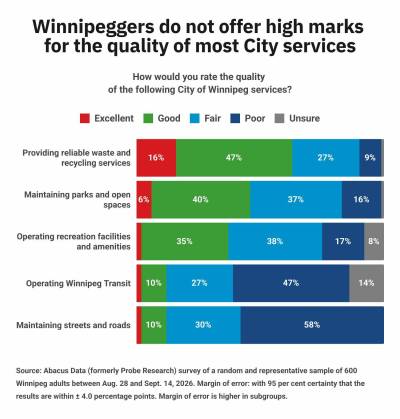
One-half of Winnipeggers believe the city is heading in the wrong direction, according to a new Abacus Data poll, with nearly one-third unsure if Winnipeg is regressing or progressing.

Only 21 per cent of residents believe the city is on the right track, the Free Press-commissioned poll found.

That discontentment extends to how the city spends its tax dollars, with four in 10 Winnipeggers believing they receive poor value for what they pay in property taxes.

Read
Yesterday at 2:37 PM CDT

All-Japan committee meets to promote Sapporo Olympic bid

Stephen Wade And Yuri Kageyama, The Associated Press 4 minute read Preview

All-Japan committee meets to promote Sapporo Olympic bid

Stephen Wade And Yuri Kageyama, The Associated Press 4 minute read Tuesday, May. 10, 2022

TOKYO (AP) — Yasuhiro Yamashita, the head of the Japanese Olympic Committee, acknowledged the biggest stumbling block to holding the Olympics is the billions in costs.

However, in another breath on Tuesday at a so-called “All Japan” meeting to promote Sapporo's bid for the 2030 Winter Olympics, he said that if the northern Japanese city lands the Games, little new construction will be needed — a major expense for every Olympics.

“From both inside and outside our country, there are many views about hosting the Olympic and Paralympic Games,” Yamashista said, among politicians and business leaders online — and in Sapporo — talking up the bid. “I realize there are also concerns about the huge costs involved.”

The official cost for last year's delayed Tokyo Olympics was $13.6 billion, although government audits suggest it may have been much more. At least 60% was public money.

Read
Tuesday, May. 10, 2022

Feds weighing options for Canadians in Wuhan

Mia Rabson and Hina Alam, The Canadian Press 5 minute read Preview

Feds weighing options for Canadians in Wuhan

Mia Rabson and Hina Alam, The Canadian Press 5 minute read Tuesday, Jan. 28, 2020

OTTAWA - Foreign Affairs Minister Francois-Philippe Champagne said Tuesday Ottawa is "looking at all options" to help Canadians quarantined in China during the outbreak of a new coronavirus.

China began drastic containment efforts to limit the spread of the virus last week, cutting plane, train and bus links to Wuhan, a city of more than 11 million people. Several other nearby cities have been quarantined since, cutting off an estimated 19 million people.

Champagne said 250 Canadians have registered with Global Affairs Canada to say they are in Wuhan and 126 of them have asked for help to get home. He said his officials are trying to contact each one of them to assess their needs.

"Every Canadian that has reached out to us for consular assistance will receive it," he said.

Read
Tuesday, Jan. 28, 2020

Not making the grade: rethinking student assessment

Maggie Macintosh 5 minute read Preview

Not making the grade: rethinking student assessment

Maggie Macintosh 5 minute read Thursday, Oct. 5, 2023

As most students in B.C. began the new school year without traditional grades, a former Manitoba teacher living in that province is urging colleagues here to do their homework on modern assessment and experiment with marking.

Starting this year, public and private school teachers in British Columbia are assessing kindergarten through Grade 9 with a scale describing a student’s level of understanding — “emerging,” “developing,” “proficient” or “extending” — instead of letter grades.

Grade 10, 11 and 12 students will continue to receive traditional letter grades and percentages.

“What’s wrong with percentages? There’s nothing wrong with them. They are a wonderful little tool, as long as they stay in their lane,” said Myron Dueck, an education consultant who was born in Winnipeg, where he graduated from teachers’ college in 1994.

Read
Thursday, Oct. 5, 2023

Broadening prediction-market gambling a bad idea

Editorial 4 minute read Preview

Broadening prediction-market gambling a bad idea

Editorial 4 minute read Saturday, Oct. 3, 2026

Let’s make a prediction: sooner or later, when Canadian governments find a way to take their own cut of the action, prediction-contract gambling on everything from sports to entertainment to political decisions is going to come to Canada.

And that’s a horrible, dangerous, pernicious idea.

Unless you have particular access to information — either inside information or strategic information based on skills or education — you’re not likely to make money at it. In fact, structurally, you’re likely to lose. In prediction markets, you basically pay an amount, plus fees from the company involved, to bet on whether something will or will not happen within a certain time frame. The amount you pay for your contract depends on how other people are also betting.

As Wealthsimple describes it, “You buy whichever side you think is right. Prices move with demand, so if the market leans towards one outcome, the more that side costs. If a lot of people are backing the TSX to finish above 38,000, yes gets more expensive and no gets cheaper.”

Read
Saturday, Oct. 3, 2026