Science Says: How daylight saving time affects health

Advertisement

Advertise with us

Office workers bemoan driving home in the dark. Night owls relish the chance to sleep in. As clocks tick toward the end of daylight saving time, many sleep scientists and circadian biologists are pushing for a permanent ban because of potential ill effects on human health.

Read this article for free:

or

Already have an account? Log in here »

To continue reading, please subscribe:

Subscribe and receive a limited-edition Free Press branded hat or tote.

Digital Subscription

One year of digital access for only $205*

  • Enjoy unlimited reading on winnipegfreepress.com
  • Read the E-Edition, our digital replica newspaper
  • Access News Break, our award-winning app
  • Play interactive puzzles

*First annual payment billed as $205.00 + GST for one year. This annual subscription will automatically renew at $233.00 + GST every 52 weeks (10% off the regular annual price of $259.35). Offer available to new and qualified returning subscribers only. Cancel any time.

To continue reading, please subscribe:

Add Free Press access to your Brandon Sun subscription for only an additional

$1 for the first 4 weeks*

  • Enjoy unlimited reading on winnipegfreepress.com
  • Read the E-Edition, our digital replica newspaper
  • Access News Break, our award-winning app
  • Play interactive puzzles
Start now

*Your next Brandon Sun subscription payment will increase by $1.00 and you will be charged $17.95 plus GST for four weeks. After four weeks, your payment will increase to $24.95 plus GST every four weeks.

Hey there, time traveller!
This article was published 31/10/2019 (2469 days ago), so information in it may no longer be current.

Office workers bemoan driving home in the dark. Night owls relish the chance to sleep in. As clocks tick toward the end of daylight saving time, many sleep scientists and circadian biologists are pushing for a permanent ban because of potential ill effects on human health.

Losing an hour of afternoon daylight sounds like a gloomy preview for the dark winter months, and at least one study found an increase in people seeking help for depression after turning the clocks back to standard time in November — in Scandinavia. Research shows the springtime start of daylight saving time may be more harmful, linking it with more car accidents, heart attacks in vulnerable people and other health problems that may persist throughout the time change.

Here’s what science has to say about a twice-yearly ritual affecting nearly 2 billion people worldwide.
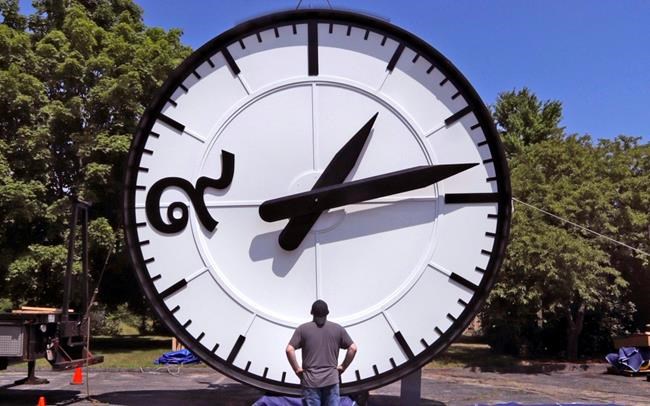
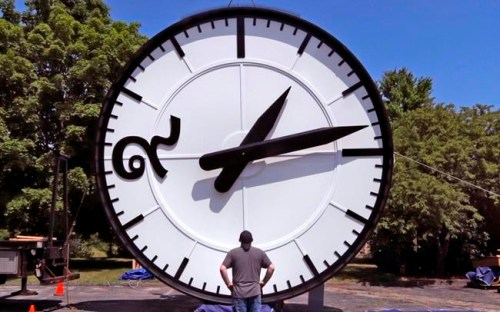
In this Thursday, July 25, 2019 photo, workers at the Electric Time Company in Medfield, Mass., test a 20 foot high clock, built for the a new train station in Bangkok, Thailand, prior to packing and shipment. The clock features a
In this Thursday, July 25, 2019 photo, workers at the Electric Time Company in Medfield, Mass., test a 20 foot high clock, built for the a new train station in Bangkok, Thailand, prior to packing and shipment. The clock features a "9" in Thai number script. Daylight saving time ends at 2 a.m. local time Sunday, Nov. 3, 2019, when clocks are set back one hour. Losing an hour of daylight sounds like a gloomy preview for the dark winter months, and at least one study found an increase in people seeking help for depression after turning the clocks back to standard time in November _ in Scandinavia. But far more research says that the springtime start of daylight saving time may be more harmful, linking it with more car accidents, heart attacks in vulnerable people and other health problems that may persist throughout the time change. (AP Photo/Charles Krupa)

SLEEP EFFECTS

Time changes mess with sleep schedules, a potential problem when so many people are already sleep deprived, says Dr. Phyllis Zee, a sleep researcher at Northwestern Medicine in Chicago.

About 1 in 3 U.S. adults sleep less than the recommended seven-plus hours nightly, and more than half of U.S. teens don’t get the recommended eight-plus hours on weeknights. One U.S. study found that in the week following the spring switch to daylight saving time, teens slept about 2 1/2 hours less than the previous week. Many people never catch up during the subsequent six months.

Research suggests that chronic sleep deprivation can increase levels of stress hormones that boost heart rate and blood pressure, and of chemicals that trigger inflammation.

HEART PROBLEMS

It has also been shown that blood tends to clot more quickly in the morning. These changes underlie evidence that heart attacks are more common in general in the morning, and may explain studies showing that rates increase slightly on Mondays after clocks are moved forward in the spring, when people typically rise an hour earlier than normal.

That increased risk associated with the time change is mainly in people already vulnerable because of existing heart disease, said Barry Franklin, director of preventive cardiology and cardiac rehabilitation at Beaumont Health hospital in Royal Oak, Michigan.

Studies suggest that these people return to their baseline risk after the autumn time change.

CAR CRASHES

Numerous studies have linked the start of daylight saving time in the spring with a brief spike in car accidents, and with poor performance on tests of alertness, both likely due to sleep loss.

The research includes a German study published this year that found an increase in traffic fatalities in the week after the start of daylight saving time, but no such increase in the fall.

Other studies on how returning to standard time in the fall might impact car crashes have had conflicting results.

OUR INTERNAL CLOCKS

Circadian biologists believe ill health effects from daylight saving time result from a mismatch among the sun “clock,” our social clock — work and school schedules — and the body’s internal 24-hour body clock.

Ticking away at the molecular level, the biological clock is entrained — or set — by exposure to sunlight and darkness. It regulates bodily functions such as metabolism, blood pressure and hormones that promote sleep and alertness.

Disruptions to the body clock have been linked with obesity, depression, diabetes, heart problems and other conditions. Circadian biologists say these disruptions include tinkering with standard time by moving the clock ahead one hour in the spring.

A mismatch of one hour daily is enough for ill effects, especially if it lasts for several months, according to Till Roenneberg, a circadian rhythm specialist at Ludwig-Maximilian University in Munich, Germany.

PRESSURE TO CHANGE

In the U.S., daylight saving time runs from the second Sunday in March to the first Sunday in November. It was first established 100 years ago to save energy. Modern-day research has found little or no such cost savings.

Federal law allows states to remain on standard time year-round but only Hawaii and most of Arizona have chosen to. Proposed legislation in several states would have them join suit — or switch to year-round daylight saving time, which would require congressional approval.

Roenneberg and Northwestern’s Zee are co-authors of a recent position statement advocating returning to standard time for good, written for the Society for Research on Biological Rhythms.

“If we want to improve human health, we should not fight against our body clock, and therefore we should abandon daylight saving time,” the statement says.

___

Follow AP Medical Writer Lindsey Tanner at @LindseyTanner.

___

The Associated Press Health and Science Department receives support from the Howard Hughes Medical Institute’s Department of Science Education. The AP is solely responsible for all content.

Report Error Submit a Tip

More Stories

Hydro CEO needs to reckon with winds of change

Dan Lett 5 minute read Preview

Hydro CEO needs to reckon with winds of change

Dan Lett 5 minute read Yesterday at 3:28 PM CDT

Methinks Hydro CEO Allan Danroth protests too much.

At a recent hearing in front of the Public Utilities Board, Danroth suggested Hydro’s plan to build a $3-billion natural-gas-powered generating plant near Brandon was being subjected to unfair criticism. The gas turbines are meant to bolster Hydro’s grid in the event that drought lowers output from hydro-generating stations.

After hearing submissions from interveners concerned about the gas-turbine plan, Danroth lashed out at the “constant, uninformed criticism” that has not only shaken trust in Hydro but also triggered threatening responses from the public.

Danroth said Hydro is monitoring “eight credible threats” against employees, five of which targeted the CEO himself. Although Danroth cited some specific incidents — employees being threatened with guns, and one where a homeowner set his dogs on a meter reader — he refused to elaborate on the circumstances.

Read
Yesterday at 3:28 PM CDT

Minister takes questions on proposed councils

Maggie Macintosh 4 minute read Preview

Minister takes questions on proposed councils

Maggie Macintosh 4 minute read Friday, May. 28, 2021

Provincial officials were pressed on how they expect parents to have either the expertise or time required to volunteer on new school councils, during a town hall on the Tory government’s proposal to overhaul the public education system.

For an hour Thursday, Education Minister Cliff Cullen, deputy minister Dana Rudy, and Scott Johnston, a former school trustee and current MLA for Assiniboia, who was chosen to lead Manitoba’s parent engagement task force, fielded questions.

The evening event — the first of four telephone town halls that are scheduled for families in different regions of the province over the coming weeks — drew caregivers from Winnipeg with queries about the Education Modernization Act (Bill 64) and related strategy.

The legislation aims to replace English school boards with a centralized authority made up of government appointees. Following the reforms, there will be 15 regional directors who correspond directly with local school leaders and parent-run councils in their areas.

Read
Friday, May. 28, 2021

The latest on protests in support of Wet'suwet'en

The Canadian Press 10 minute read Preview

The latest on protests in support of Wet'suwet'en

The Canadian Press 10 minute read Thursday, Feb. 27, 2020

Here is the latest news on protests across Canada over a natural gas pipeline project in British Columbia (All times Eastern):

9:15 p.m. ET

A meeting between Wet'suwet'en hereditary chiefs and federal and B.C. ministers has ended for the day in Smithers, B.C., with a plan to resume Friday morning.

Federal Crown-Indigenous Relations Minister Carolyn Bennett and B.C. Indigenous Relations Minister Scott Fraser didn't provide details of what was discussed when the meeting ended, less than three hours after it began.

Read
Thursday, Feb. 27, 2020

Science Says: How daylight saving time affects health

Lindsey Tanner, The Associated Press 5 minute read Preview

Science Says: How daylight saving time affects health

Lindsey Tanner, The Associated Press 5 minute read Thursday, Oct. 31, 2019

Office workers bemoan driving home in the dark. Night owls relish the chance to sleep in. As clocks tick toward the end of daylight saving time, many sleep scientists and circadian biologists are pushing for a permanent ban because of potential ill effects on human health.

Losing an hour of afternoon daylight sounds like a gloomy preview for the dark winter months, and at least one study found an increase in people seeking help for depression after turning the clocks back to standard time in November — in Scandinavia. Research shows the springtime start of daylight saving time may be more harmful, linking it with more car accidents, heart attacks in vulnerable people and other health problems that may persist throughout the time change.

Here's what science has to say about a twice-yearly ritual affecting nearly 2 billion people worldwide.

SLEEP EFFECTS

Read
Thursday, Oct. 31, 2019

Authors fall prey to scam artists and fraudsters

Allan Levine 5 minute read 2:00 AM CDT

Most every author, including me, wants to be noticed by the reading public, media and book world. The perceived wisdom is that a strong social media presence raises an author’s profile and sells books. In the past 15 years or so, authors have been pressured by publishers, editors and agents to maintain a website and regularly post about their work on Facebook, X and Instagram.

Whether this online activity actually increases book sales is debatable. But this much is certain — all of this visibility makes authors easy targets of scam artists and fraudsters.

Literally every day over the last 12 to 15 months, perhaps longer than that, I receive emails — often three or four a day — from editors, podcasters, movie producers, marketing promoters and book club presidents. They all want to make me famous and my books international best-sellers. What more could an author want?

The trouble is they are all — to paraphrase Elaine Benes on Seinfeld, commenting on another personal issue — fake, fake, fake. Generated by AI in workshops in Nigeria, Pakistan, the Philippines and other distant locales, they offer effusive praise of my “brilliant” writing and supposed extra-special story telling skills.

Making music a marathon rather than a sprint

Alan Small 5 minute read Preview

Making music a marathon rather than a sprint

Alan Small 5 minute read Thursday, Oct. 19, 2023

Larysa Musick has taken the stage countless times, armed with the verses she’s written and rehearsed.

The Winnipeg poetry-slam artist will do the same Friday night at the Times Change(d) High and Lonesome Club, except she’ll have songs from her debut EP to perform rather than poems to recite, and she’ll have a band to back her up instead of being alone to earn the audience’s kudos or criticism.

“It’s a little nerve-racking but it’s also exciting.” says Musick, who released the six-song Tomorrow Is Bound to Come on streaming services Oct. 13.

“The stakes are the same, because people are still watching you, but the difference in poetry slam is you’re scored from zero to 10 on your poetry. I’ve received five out of 10 on stage; I’ve received 10 out of 10.

Read
Thursday, Oct. 19, 2023