‘Looking at the world around us:’ Canadian scientist wins Nobel Prize in physics

Advertisement

Advertise with us

James Peebles, a Manitoba-born scientist who won the Nobel Prize for physics on Tuesday, said his relatively quiet life isn't so quiet anymore.

Read this article for free:


or

Already have an account? Log in here »

To continue reading, please subscribe:

Subscribe and receive a limited-edition Free Press branded hat or tote.

Digital Subscription

One year of digital access for only $205*

  • Enjoy unlimited reading on winnipegfreepress.com
  • Read the E-Edition, our digital replica newspaper
  • Access News Break, our award-winning app
  • Play interactive puzzles

*First annual payment billed as $205.00 + GST for one year. This annual subscription will automatically renew at $233.00 + GST every 52 weeks (10% off the regular annual price of $259.35). Offer available to new and qualified returning subscribers only. Cancel any time.

To continue reading, please subscribe:

Add Free Press access to your Brandon Sun subscription for only an additional

$1 for the first 4 weeks*

  • Enjoy unlimited reading on winnipegfreepress.com
  • Read the E-Edition, our digital replica newspaper
  • Access News Break, our award-winning app
  • Play interactive puzzles
Start now

*Your next Brandon Sun subscription payment will increase by $1.00 and you will be charged $17.95 plus GST for four weeks. After four weeks, your payment will increase to $24.95 plus GST every four weeks.

Hey there, time traveller!
This article was published 08/10/2019 (2529 days ago), so information in it may no longer be current.

James Peebles, a Manitoba-born scientist who won the Nobel Prize for physics on Tuesday, said his relatively quiet life isn’t so quiet anymore.

Peebles, who was born in the francophone community of St. Boniface before it became part of Winnipeg, completed his undergraduate studies at the University of Manitoba before moving to Princeton University in New Jersey for graduate school.

A dual Canadian-U.S. citizen, he has taught at the Ivy League school for the last five decades.
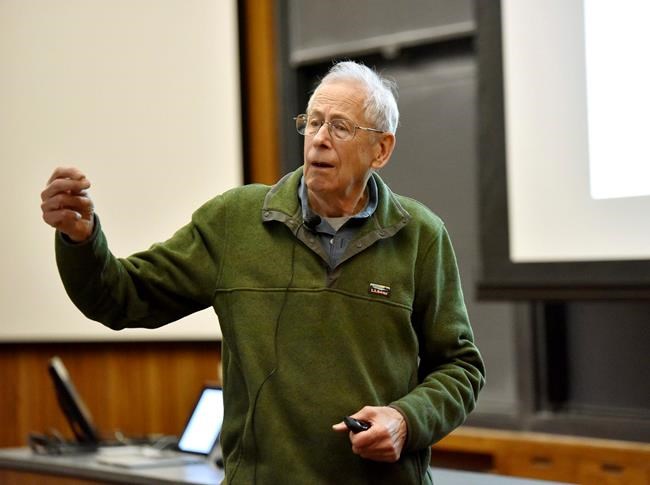
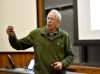
In this 2016 photo provided by Princeton University, James Peebles speaks at the 43rd annual Donald R. Hamilton Lecture, at the university in Princeton, N.J. Peebles was among three scientists who won the 2019 Nobel Prize in Physics on Tuesday, Oct. 8, 2019, for their work in understanding how the universe has evolved, and the Earth's place in it. The prize was given to Peebles
In this 2016 photo provided by Princeton University, James Peebles speaks at the 43rd annual Donald R. Hamilton Lecture, at the university in Princeton, N.J. Peebles was among three scientists who won the 2019 Nobel Prize in Physics on Tuesday, Oct. 8, 2019, for their work in understanding how the universe has evolved, and the Earth's place in it. The prize was given to Peebles "for theoretical discoveries in physical cosmology" and the other half jointly to Michel Mayor and Didier Queloz "for the discovery of an exoplanet orbiting a solar-type star." (Mark Czajkowski/Princeton University via AP)

Peebles, 84, has been retired for 20 years, but he says he has continued to research and teach at a “relaxed rate” because he enjoys it.

“Life will go on,” he said in a phone interview between media events. “I suppose the aura of the Nobel is such that my life will change, but I don’t think I’m going to let it change much.

“You understand, I’m used to a quiet life.”

The Nobel committee said it gave Peebles the honour because his work is the basis of our contemporary ideas about the universe from the big bang to the present day.

“The field has exploded,” Peebles said. “It’s just a remarkable extension of well-tested natural science … so it should be recognized. And I’ve been working on it longer than anyone.”

He also told news conferences Tuesday that while awards are “very much appreciated,” that’s not why young people should study science.

“You should enter it for the love of the science,” he said. “You should enter science because you are fascinated by it. That’s what I did.”

Peebles said part of his childhood in Manitoba was spent building or taking apart thing such as the clocks in his family’s home.

“One of my earliest memories is throwing a tantrum because I wasn’t allowed to put together the coffee percolator,” he said.

“I simply liked looking at the world around us.”

Neil Turok, who worked with Peebles at Princeton and now serves as director of the Centre for the Universe at the Perimeter Institute in Waterloo, Ont., described his former colleague as an unsung hero, famous in the world of cosmology, but seldom recognized outside of it.

“Jim is one of the most modest people in the field. His contributions are frequently overlooked. The experts know you can’t oversee him,” Turok said.

Peebles has honorary doctorates from a string of Canadian universities and is a fellow of the Royal Society of Canada and the Order of Manitoba.

He is also the author or co-author of five books, including “Physical Cosmology” and “Finding the Big Bang.” He said he has a sixth book coming out next year, which maps the history of cosmology from Albert Einstein to today.

Peebles shares the Nobel Prize with Swiss scientists Michel Mayor and Didier Queloz, who won for the discovery of an exoplanet orbiting a solar-type star. Mayor and Queloz announced their discovery 24 years ago.

The three men will share a nine-million kronor (C$1.2 million) cash award, a gold medal and a diploma. The laureates are to receive them at a ceremony in Stockholm on Dec. 10.

Peebles said he plans to give some of his winnings to charity and his family. “I owe a lot to the University of Manitoba and a chunk will go to it.”

David Barnard, president of the University of Manitoba, said Peebles’s achievements have inspired new generations of scientists.

Prime Minister Justin Trudeau tweeted his congratulations and Manitoba Premier Brian Palliser issued a statement.

“As Manitobans, we know looking to the vast night sky is often a powerful experience,” Pallister wrote. “Dr. Peebles has reminded us that it can also be the beginning of a journey towards knowledge, achievement and academic excellence to be shared with the world.”

Peebles is the second Canadian in a row to win the physics prize. The University of Waterloo’s Donna Strickland was honoured last in 2018.

Arthur McDonald, a retired professor at Queen’s University, won physics prize in 2015.

This report by The Canadian Press was first published Oct. 8, 2019.

— With files from The Associated Press and Kelly Geraldine Malone in Winnipeg

Note to readers: This is a corrected story. An early version said Peebles took part in news conferences Friday.

Report Error Submit a Tip

More Stories

Pallister’s education policies crash the party

Niigaan Sinclair 5 minute read Preview

Pallister’s education policies crash the party

Niigaan Sinclair 5 minute read Monday, May. 10, 2021

The University of Manitoba graduated 510 Indigenous students on Saturday, the largest cohort in its history.

Comparatively, in 2011 — the year I started teaching at the U of M — there were 158.

That’s more than three times as many and one of the highest numbers in North America (University of Saskatchewan hasn’t released this year's numbers yet but it is often slightly higher than the U of M).

This means we will have more Indigenous professionals entering the workforce than ever before, and its a number that has been increasing every year for a decade.

Read
Monday, May. 10, 2021

Scores of dead bodies found floating in India's Ganges River

The Associated Press 3 minute read Preview

Scores of dead bodies found floating in India's Ganges River

The Associated Press 3 minute read Tuesday, May. 11, 2021

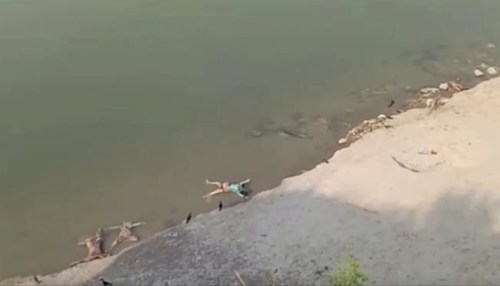
NEW DELHI (AP) — Scores of dead bodies have been found floating down the Ganges River in eastern India as the country battles a ferocious surge in coronavirus infections. Authorities said Tuesday they haven't yet determined the cause of death.

Health officials working through the night Monday retrieved 71 bodies, officials in Bihar state said.

Images on social media of the bodies floating in the river prompted outrage and speculation that they died from COVID-19. Authorities performed post mortems on Tuesday but said they could not confirm the cause of death due to the decomposition of the bodies.

More corpses were found floating in the river on Tuesday, washing up in Ghazipur district in neighboring Uttar Pradesh state. Police and villagers were at the site, about 50 kilometers (30 miles) from Monday’s incident.

Read
Tuesday, May. 11, 2021

City exceeds housing targets as millions in federal funds set to roll in

Joyanne Pursaga 3 minute read Preview

City exceeds housing targets as millions in federal funds set to roll in

Joyanne Pursaga 3 minute read Yesterday at 2:58 PM CDT

The City of Winnipeg has exceeded several homebuilding targets tied to its share of the federal Housing Accelerator Fund, with permits issued for 14,833 new housing units since December 2023.

The agreement to claim $126.5 million from the fund since the end of 2023 required the city to approve at least 14,251 new dwellings before Dec. 5.

“We set aggressive targets for new building permits in the Housing Accelerator Fund and we have exceeded the targets that we set three months before the deadline… (It) is very good news for Winnipeg at a time when we need more housing,” said Mayor Scott Gillingham.

The city expects to receive its final $32.6-million federal payment in early 2027, after its results are reviewed by the Canada Mortgage and Housing Corporation.

Read
Yesterday at 2:58 PM CDT

Climate: ‘No good outcomes’

Gwynne Dyer 5 minute read Yesterday at 2:00 AM CDT

‘EL NIÑO is being supersized before our eyes,’ United Nations Secretary-General António Guterres said last week.

“The science leaves no room for doubt: the planet is in uncharted waters, and those waters are heating up. The world is in the danger zone of extreme weather.”

He’s right — we are in even deeper trouble than we thought on the climate front.

Zeke Hausfather, a leading American climate scientist, warns that 2027 is almost certain to be the hottest year. It will be, he said, “a climate time-machine, temporarily driving global average temperatures to levels not normally expected until the late 2030s.” (Note the “temporarily.” We’ll get back to that.)

Indian club apologizes for quarantine breach in Maldives

John Duerden, The Associated Press 4 minute read Monday, May. 10, 2021

Bengaluru FC owner Parth Jindal has apologized for an “inexcusable” breach of COVID-19 protocols by two of his players and a coach that led to the Indian club being told to leave the Maldives before a scheduled AFC Cup playoff game against a local team.

The players and a member of the coaching staff were reported by local media to have left their hotel in the capital Male on Saturday, sparking criticism from the Maldives sports minister.

Jindal told the Associated Press on Monday that against a backdrop of a surging COVID-19 cases in India and rising local opposition to the game going ahead, he understood the reaction on the island.

“The optics and timing of the breach has led to the reaction and what the players did was inexcusable," Jindal said. "They were well aware of the protocols and they knew they couldn’t step out, however briefly”

Wiseman leans on pro experience

Joshua Frey-Sam 6 minute read Preview

Wiseman leans on pro experience

Joshua Frey-Sam 6 minute read Yesterday at 8:47 PM CDT

Todd Wiseman knows what pressure feels like in a sporting arena.

The Port Moody, B.C. resident faced it every summer across an eight-year playing career as a defensive back in the Canadian Football League with the B.C. Lions, Toronto Argonauts and Hamilton Tiger-Cats.

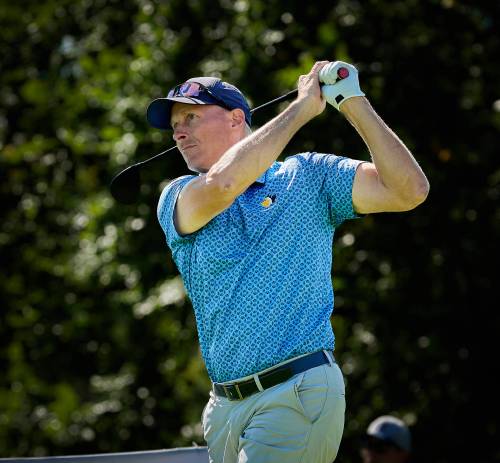
Wiseman, who switched from knocking down passes to knocking down birdies after the 1994 season, is feeling a different kind of weight this week in the Canadian senior men’s championship at Niakwa Country Club, but has managed it well through two rounds.

Wiseman turned in a rather clean three-under 69 on Wednesday, his two bogeys outweighed by five birdies, to grab a share of the lead in the 55-plus national event. Wiseman tied a single-round tournament low to share the 36-hole lead with Winnipegger David White and America’s top-ranked senior amateur Bryan Hoops.

Read
Yesterday at 8:47 PM CDT