A collection of wise words
Author releases book sharing lessons learned from city's homeless

Advertisement
Read this article for free:
or
Already have an account? Log in here »
To continue reading, please subscribe:

Digital Subscription
One year of digital access for only $205*
- Enjoy unlimited reading on winnipegfreepress.com
- Read the E-Edition, our digital replica newspaper
- Access News Break, our award-winning app
- Play interactive puzzles
*First annual payment billed as $205.00 + GST for one year. This annual subscription will automatically renew at $233.00 + GST every 52 weeks (10% off the regular annual price of $259.35). Offer available to new and qualified returning subscribers only. Cancel any time.
To continue reading, please subscribe:
Add Free Press access to your Brandon Sun subscription for only an additional
$1 for the first 4 weeks*
- Enjoy unlimited reading on winnipegfreepress.com
- Read the E-Edition, our digital replica newspaper
- Access News Break, our award-winning app
- Play interactive puzzles
*Your next Brandon Sun subscription payment will increase by $1.00 and you will be charged $17.95 plus GST for four weeks. After four weeks, your payment will increase to $24.95 plus GST every four weeks.
Read unlimited articles for free today:
or
Already have an account? Log in here »
Hey there, time traveller!
This article was published 28/01/2019 (2759 days ago), so information in it may no longer be current.
When my editor called me over to his desk and suggested I might want to write a feature about Dr. Neil Craton and his new book about lessons learned from the homeless, I laughed.
Not because I thought it was funny. No, I laughed because I instantly flashed back to the time I spent as a young man hanging out with Neil, especially the day he gave me a ride on his motorcycle, which was about the same size as a children’s scooter.
“Neil and I were buddies back in the day,” is what I told my editor, who simply frowned at me, because that is the kind of thing modern newspaper editors are trained to do.
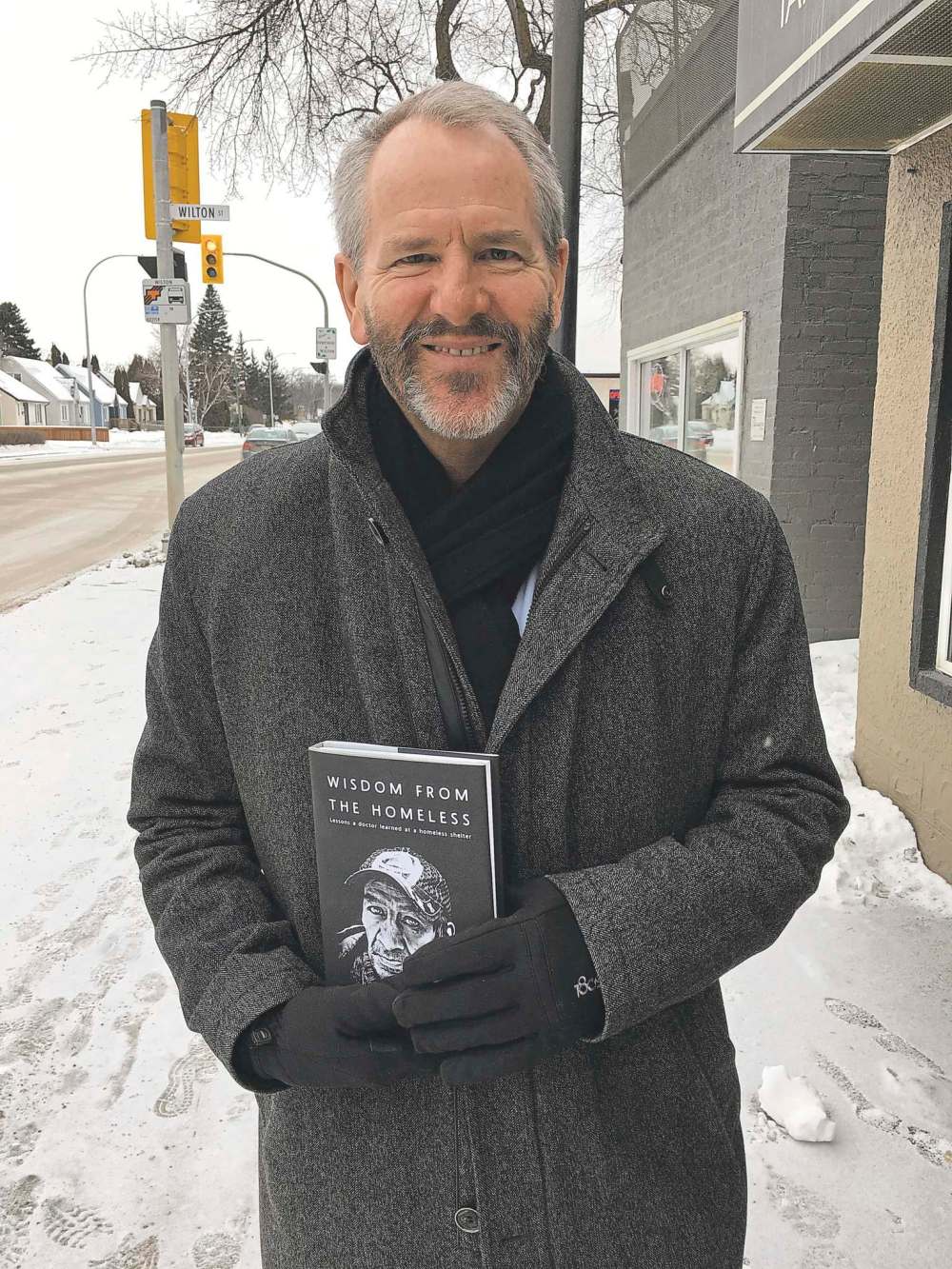
For the record, today Neil is among Canada’s leading experts in sports medicine. A doctor for 35 years, he has spent most of that time caring for elite athletes and wounded weekend warriors. But when he’s not treating the bumps and bruises of the Winnipeg Blue Bombers — something he’s done for the past 23 years — he’s offering compassion and care to members of this city’s homeless community.
Every second Friday for the past 10 years, you’ll find Neil in the Saul Sair Health Centre at Siloam Mission tending to the injuries and illnesses that afflict people who are forced to live on Winnipeg’s cold, and too often mean, streets.
If you read Saturday’s paper, you’ll know my old buddy has published a new book — Wisdom from the Homeless: Lessons a Doctor Learned at a Homeless Shelter, the remarkable story of how a suburban doctor found enlightenment and joy caring for the most vulnerable members of society.
Naturally, I had to read the book before sitting down to interview Neil, a conversation that took place at my favourite breakfast haunt, Falafel Place on Corydon Avenue, over heaping helpings of bacon, eggs and coffee.
Here’s my mini review: The book is an emotional gut punch, the story of a humble doctor, a devout Christian, who felt a calling to help the homeless and was blessed with unexpected lessons about resilience, courage, humility, hope, joy and the strength of the human spirit.
The strangest thing for me was the feeling of getting reacquainted with an old friend I hadn’t seen in far too long.
Back in the day, Neil and I ran in the same crowd. We played football and basketball together — our team was nicknamed The Knads, which allowed our fans to chant: “Go, Knads! Go, Knads!” We attended the same parties, and visited the same lakes in the summer.
He’s one of the most remarkable athletes I have ever seen, and I had a perfect view. There I’d be, lying on my back on the court, sweating like a Christmas turkey, while 6-3 Neil soared gracefully over me to slam dunk the ball in the basket.
When we got together for breakfast, the first thing out of his mouth was the story of how, many years ago, he had driven me home from the U of M on the back of his teeny-tiny motorcycle, me clinging to him like a sweaty, terrified monkey.
When we got home, I slid off the back of the bike like a sack full of jelly, looked at Neil and gasped: “I didn’t think we were gonna make it.”
I remember Neil smiling, laughing and chirping: “Neither did I!”
“I don’t think I had a licence to drive passengers, so I think I was breaking the law,” he chuckled as we gulped coffee. “I think the two of us weighed about 400 pounds at least, and my bike was rated for about 250. I was very thankful to get us home in one piece. You were also a very good hugger, I remember that.”
Which is when he pointed at a section of his book, the part wherein an anonymous friend at a party warns him that the love of his life, Kate, would never marry him because he was not a Christian.
“That friend was YOUR sister, Sharon,” Neil said, laughing. “Your sister at a party at YOUR house says to me, ‘You know that Kate will never marry you because you are not a Christian.’ I thought that I was a Christian, so I put that to Kate that night and it began kind of an awkward conversation about faith. It got the ball rolling.”
So, yes, in a weird way it was my sister who started a conversation that led to a friend undertaking a spiritual journey that resulted in his marriage — Neil and Kate have two children: Sam, 22, a medical student, and Abi, 24, a teacher — and him taking a path that led to Siloam Mission’s medical clinic.
There are too many remarkable stories — all viewed through the filter of Neil’s faith — to share here. Some are gritty — a man in the throes of alcohol dementia whose skin was literally crawling with the worst infestation of lice he’d ever seen; or a man burned beyond belief when criminals locked him inside a burning building.
What I found most moving were the stories in which Neil and his homeless patients discovered joy amid unimaginable suffering, including one you won’t find in the book.

“He had a swelling in his leg that got more and more significant,” the doctor recalled. “He had a blood clot. He thought he’d put pins in his leg to drain the ‘air’ in his calf. And every place he put a pin he got this resistant bacterial ulcer, so his whole leg was profoundly swollen and infected.
“He had to go to the hospital… I saw him about a month later. He had to spend 12 days in the hospital. He came back and was so excited because I’d taken his problem seriously. I was now his doctor after two visits. He got a bill from the WRHA because his health card had expired. He’s homeless! Have you ever heard of anybody getting a bill from the WRHA? I’ve never heard of it. First time in 35 years. He’s a homeless guy. And we laughed at this bill and (he said) doctor maybe you could start a GoFundMe page to pay for my bill. We had a good laugh at this.”
So do yourself a favour and buy a copy of this book, because it’s a compelling read, and all the proceeds go to support the mission. And if you find yourself on the back of a too-small motorcycle, please wear a helmet.
doug.speirs@freepress.mb.ca
By buying through links provided on this page, you are supporting local writers, reviewers and book sellers.
Doug has held almost every job at the newspaper — reporter, city editor, night editor, tour guide, hand model — and his colleagues are confident he’ll eventually find something he is good at.
Our newsroom depends on a growing audience of readers to power our journalism. If you are not a paid reader, please consider becoming a subscriber.
Our newsroom depends on its audience of readers to power our journalism. Thank you for your support.
Where to get it
Dr. Neil Craton’s book, Wisdom from the Homeless, is available for $21.99 at McNally Robinson Booksellers, Performance Healthcare Products, 160 Meadowood Drive, and online at Amazon.ca. All the proceeds go to support Siloam Mission. You donate to the shelter online at Siloam.ca.
Doug has held almost every job at the newspaper — reporter, city editor, night editor, tour guide, hand model — and his colleagues are confident he’ll eventually find something he is good at.
Our newsroom depends on a growing audience of readers to power our journalism. If you are not a paid reader, please consider becoming a subscriber.
Our newsroom depends on its audience of readers to power our journalism. Thank you for your support.
Related Articles
Physician's book follows discovery that tending to city's vulnerable is a powerful prescription for the soul
Advertisement Advertise With Us
Advertisement Advertise With Us