Safer opioids actively being reviewed for epidemic: chief public health officer

Advertisement

Advertise with us

OTTAWA - Public health officials across the country are seriously considering increasing the supply of safer opioids to quell a crisis that newly released data show helped claim more than 2,000 lives in the first half of the year.

Read this article for free:


By clicking the button above, an account will be created and you will begin to receive some of our recommended newsletters. You may opt out of any newsletter by visiting your Email and Communication Preferences page or by clicking "unsubscribe" at the bottom of any email.

or

Already have an account? Log in here »

To continue reading, please subscribe:

Digital Subscription

One year of digital access for only $1.44 a week*

  • Enjoy unlimited reading on winnipegfreepress.com
  • Read the E-Edition, our digital replica newspaper
  • Access News Break, our award-winning app
  • Play interactive puzzles

*Billed as $5.77 plus GST every four weeks. After 52 weeks, price increases to the regular rate of $19.95 plus GST every four weeks. Offer available to new and qualified returning subscribers only. Cancel any time.

To continue reading, please subscribe:

Add Free Press access to your Brandon Sun subscription for only an additional

$1 for the first 4 weeks*

  • Enjoy unlimited reading on winnipegfreepress.com
  • Read the E-Edition, our digital replica newspaper
  • Access News Break, our award-winning app
  • Play interactive puzzles
Start now

*Your next Brandon Sun subscription payment will increase by $1.00 and you will be charged $17.95 plus GST for four weeks. After four weeks, your payment will increase to $24.95 plus GST every four weeks.

Hey there, time traveller!
This article was published 12/12/2018 (2880 days ago), so information in it may no longer be current.

OTTAWA – Public health officials across the country are seriously considering increasing the supply of safer opioids to quell a crisis that newly released data show helped claim more than 2,000 lives in the first half of the year.

Canada’s chief public health officer said Wednesday a toxic drug supply is a key part of Canada’s opioid epidemic.

Creating a safer opioid supply is “being actively reviewed and discussed” with provinces and territories, Dr. Theresa Tam said, and will require exploring what treatments people require.
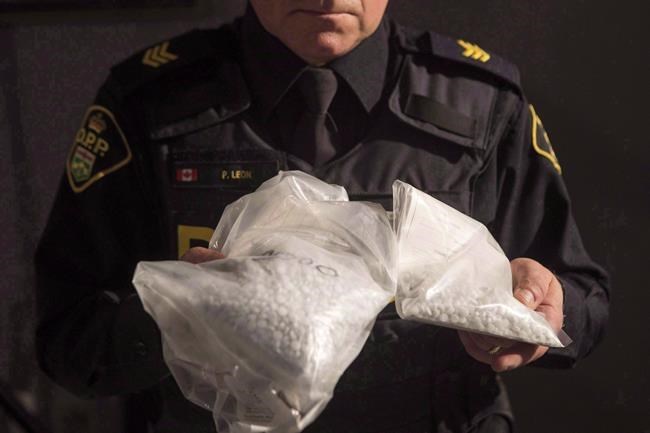
An OPP officer displays bags containing fentanyl as Ontario Provincial Police host a news conference in Vaughan, Ont., on February 23, 2017. Canada's chief public health officer says the need to increase access to a
An OPP officer displays bags containing fentanyl as Ontario Provincial Police host a news conference in Vaughan, Ont., on February 23, 2017. Canada's chief public health officer says the need to increase access to a "safer supply" of opioids is being reviewed with provinces and territories, a move encouraged by a number of public health experts. THE CANADIAN PRESS/Chris Young

Tam said clamping down on the market-driven supply of illicit drugs won’t be easy, adding she also hopes Canadians come to understand the seriousness of the problem.

“Across Canada, not everybody is on the same page,” Tam said. “I think my plea is an escalated, compassionate response. To implement a lot of these measures, you need society to be on side.”

British Columbia’s provincial health officer praised the decision to look at a more safe supply — something the province has long pushed for.

“Right now, the issue that we are dealing with in B.C. and increasing across the country, is the poisonous, toxic street-drug supply,” said Dr. Bonnie Henry.

“That is what is killing people in this province right now. We know, that coupled with the stigma and the fact that people who have addictions, they need these drugs. It is not like it is a choice and they can say ‘Oh, I’m not going to take them anymore.'”

Donald MacPherson, executive director of the Canadian Drug Policy Coalition, has said a safer supply of opioids is a “no-brainer” to ensure people are not forced to turn to a “deadly, illegal market.”

Figures released Wednesday by the Public Health Agency show that 94 per cent of opioid-related deaths this year were classified as “accidental poisonings.” Nearly 72 per cent were unintentional deaths involving highly toxic fentanyl and fentanyl-related substances.

Fentanyl — a highly potent and addictive opioid — is estimated to be up to 100 times stronger than morphine and is commonly mixed into opioids sold on the street, meaning users don’t know the potency of the drugs they take.

The Canadian Institute for Health Information also reported data on a 27-per-cent increase in hospitalizations due to “opioid-related poisonings” over the past five years. Hospitalization rates last year were 2.5 times higher in smaller communities, with populations between 50,000 and 100,000, compared to Canada’s largest cities, the institute said.

Canadian health-care experts have also encouraged Ottawa to adopt Portugal’s approach to drug policy, which decriminalizes limited amounts of drugs for personal use, while offering education and social supports. Henry argued the Liberals should consider decriminalization.

“The federal government at this point is not look at decriminalizing people at a national basis,” Henry said.

“We are facing a crisis in B.C. where we need to do more.”

—Follow @kkirkup on Twitter

Report Error Submit a Tip

More Stories

Rural hospital shutdowns continue into fall

Katie May 5 minute read Preview

Rural hospital shutdowns continue into fall

Katie May 5 minute read Monday, Sep. 12, 2022

Summer shutdowns at some rural Manitoba hospitals have quietly extended into fall, and the uncertainty about reopening is frustrating residents.

Read
Monday, Sep. 12, 2022

Olympics Overnight: Speedskater Blondin wins silver in the mass start, Bowman narrowly misses podium in halfpipe skiing, Jamaica returns to bobsled track

Richie Assaly - Toronto Star, Toronto Star 6 minute read Preview

Olympics Overnight: Speedskater Blondin wins silver in the mass start, Bowman narrowly misses podium in halfpipe skiing, Jamaica returns to bobsled track

Richie Assaly - Toronto Star, Toronto Star 6 minute read Saturday, Feb. 19, 2022

Here’s what you missed overnight at Day 15 of the 2022 Beijing Olympics.

Read
Saturday, Feb. 19, 2022

Defunding police ‘illogical step’: Pallister

Carol Sanders 5 minute read Preview

Defunding police ‘illogical step’: Pallister

Carol Sanders 5 minute read Tuesday, Jun. 9, 2020

Manitoba Premier Brian Pallister says he’s open to channelling justice funding to preventive programs, but questions whether defunding police is the best approach — warning there will always be criminals taking advantage of vulnerable people.

“I think the motivation that lies in frustrations of the actions of some police services — not necessarily here in Winnipeg exclusively, but elsewhere — is justifiable and understandable, and I get it,” Pallister said Tuesday, when asked to comment on the 30,000 signatures collected for a Justice 4 Black Lives Winnipeg petition calling for the abolition of the city police.

“But then moving to defunding police is, to me, an illogical step from that one. Don’t let your frustration lose your common sense... There’s a lot of people out there in vulnerable communities who depend on the police to protect them and make sure they’re safe from the action of criminals.”

There has been a widespread call to restructure police funding in the wake of George Floyd’s death May 25 in Minneapolis.

Read
Tuesday, Jun. 9, 2020

Nine more deaths, 107 new COVID-19 cases in Manitoba

Katie May 6 minute read Preview

Nine more deaths, 107 new COVID-19 cases in Manitoba

Katie May 6 minute read Monday, Dec. 28, 2020

Manitoba is restarting its COVID-19 vaccination efforts, following a five-day break — and amidst questions about the delay.

The planned pause over Christmas was in the name of efficiency, a provincial government spokesman says, offering no other explanation on the reasoning behind the decision not to vaccinate anyone Dec. 24-28.

On Monday, the province announced nine more pandemic deaths and 107 new cases of the novel coronavirus.

As part of Manitoba's vaccination plan, the most recent immunization clinic happened Dec. 23; the next was set to start Dec. 29.

Read
Monday, Dec. 28, 2020

Has the political wind changed?

Gwynne Dyer 5 minute read 2:01 AM CDT

It has been quite a week. First we had “Lula” – Luiz Inácio da Silva (as nobody but his mother ever called him) – defying everybody’s expectations. After winding up two million votes behind his challenger, Flávio Bolsonaro, in the first round of the Brazilian presidential election, he made a “miraculous” comeback in the second.

It was like a man going into a revolving door behind you and coming out in front. At the end of the first round, Lula was two million votes behind; at the end of the second round on Oct. 25 he was four million votes ahead. So how did he win a fourth term without cheating?

That’s what Bolsonaro claims he did, having fled to the United States; Trump, Flávio’s mentor, hints at the same. But Lula’s victory was not miraculous. He only learned to read when he was 10, and at 80 he still refused to have a mobile phone. His team finally made him get one and use it.

He wouldn’t do social media videos, so they created a WhatsApp channel called Lula’s Army, and made him appear on it at least daily. The channel went from zero to 10.8 million viewers in two weeks, and Lula won.

The long and winding road

Editorial 4 minute read Preview

The long and winding road

Editorial 4 minute read 2:01 AM CDT

As theatre goes, it sent a strong message.

Manitoba Premier Wab Kinew, standing in front of microphones and television cameras, holding up his Indigenous status card and saying that he didn’t feel Canada should have “a race-based form of identification in this country, but that is a reality,” adding that it was time to abolish the Indian Act.

“I think it’s time to abolish the Indian Act, get rid of the Indian Act, move past the Indian Act, and it needs to be done with First Nations people and First Nations governments, of course. I think it’s long overdue that we have a relationship with Indigenous Peoples in Canada that reflects who we are as Canadians today,” he said.

The Indian Act — the name alone suggests how out-dated and out of place the law has become. Originally dating from 1876, the law was put in place to “amend and consolidate the laws respecting Indians” and gave the Minister of the Interior the responsibility to “control and management of the reserves, lands, moneys and property of Indians in Canada.”

Read
2:01 AM CDT