Lost rites
Socially distanced grieving has isolating effect on communal response to death

Advertisement
Read this article for free:
or
Already have an account? Log in here »
To continue reading, please subscribe:
Digital Subscription
One year of digital access for only $1.44 a week*
- Enjoy unlimited reading on winnipegfreepress.com
- Read the E-Edition, our digital replica newspaper
- Access News Break, our award-winning app
- Play interactive puzzles
*Billed as $5.77 plus GST every four weeks. After 52 weeks, price increases to the regular rate of $19.95 plus GST every four weeks. Offer available to new and qualified returning subscribers only. Cancel any time.
To continue reading, please subscribe:
Add Free Press access to your Brandon Sun subscription for only an additional
$1 for the first 4 weeks*
- Enjoy unlimited reading on winnipegfreepress.com
- Read the E-Edition, our digital replica newspaper
- Access News Break, our award-winning app
- Play interactive puzzles
*Your next Brandon Sun subscription payment will increase by $1.00 and you will be charged $17.95 plus GST for four weeks. After four weeks, your payment will increase to $24.95 plus GST every four weeks.
Read unlimited articles for free today:
or
Already have an account? Log in here »
Hey there, time traveller!
This article was published 01/02/2021 (2092 days ago), so information in it may no longer be current.
There’s no way for Susan Crichton to know how many people can see her as she steps to the lectern, clutching a little stuffed moose. She knows they’re out there, watching on laptops or phones in homes across Canada and the United Kingdom and Scandinavia, but she cannot see them or draw strength from their presence.
The only eyes she can meet this Saturday morning in early December, in the small chapel of the Thomson in the Park funeral home off McGillivray Boulevard, belong to four family members, a funeral director, and a minister. Susan glances at them, then peels off her mask and, in a voice softened by grief, begins to speak.

“Good morning,” she says, hoping the people watching online can hear her. “This is all so weird, as we sit here in an empty room which should be filled with all the people that loved my dad, and us. I thank you for joining us virtually as we try to celebrate my dad in a way that he would have wanted, and deserves.”
This is what mourning often looks like now: a near-empty room, a stillness, a quiet. The pandemic is, in part, a story of celebrations never shared and social patterns disrupted; and of all life’s milestones, it’s death that can be the most shattering when its traditions are taken away.
And over the last 11 months, rituals of loss have been profoundly changed. The details shift as public health orders tighten or loosen: recently, Manitoba moved to allow 10 mourners at funerals, up from a limit of five handed down in November. Still, the fact remains that grieving cannot be too communal, at least not in person.
That has left thousands of Manitoban families who have lost loved ones over the last year, and particularly in the last several months, to navigate difficult decisions. Do they postpone the funeral, or cancel it altogether? If they do hold a service, which of the deceased’s loved ones can come, when only a handful are allowed to gather?
These are not questions Susan Crichton ever imagined she and her family would have to answer.
Susan’s father, Vince Crichton, was larger than life. That’s what everyone who knew him says. It was not only for his height, which at six-foot-seven was considerable, so tall that when he went into St. Boniface Hospital’s palliative care last August it was hard to find a bed long enough for his frame. It was, most of all, the way his energy filled up a space.

“Doc Moose,” everyone called him, because his passion for the animal was relentless. He’d seen at least 30,000 of them in his 40-year career as a biologist for the province, and yet every time he saw another, he would light up with wide-eyed excitement. He spent countless days trekking through the bush, studying how moose live.
This work earned him many admirers. He crossed the globe to attend moose conferences, where he made friends with other “mooser” scientists. He co-authored a book known as “the bible” of moose biology, and was featured in the Free Press and a recent CBC documentary for his outspoken conservation efforts.
So if Vince had gotten sick any other year, his hospital room would have been filled by friends sharing laughs at his bed to help ease his journey with pancreatic cancer. Instead, in the shadow of COVID-19, the hospital allowed a list of four approved visitors to palliative care patients.
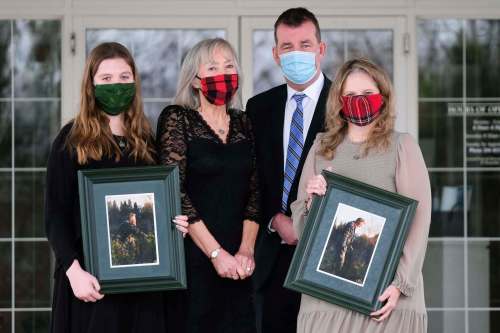
That meant Kim Crichton, Vince’s wife of 20 years, could visit him. So could Susan, her husband Craig and their 15-year-old daughter Julia, who Vince adored. Even this was a fragile privilege: when St. Boniface was hit by a COVID-19 outbreak in October, a nurse warned Kim she may have to leave, and may not be able to return.
“I almost said, ‘then I’m not leaving,’” Kim says. “I didn’t know how to leave him. I don’t know how people can.”
And if Vince had died in any other year, colleagues and friends would have come from all over the world to pay their respects. There would have been at least 500 people at his funeral, Kim thinks, and they all would have had stories to tell about Vince and his moose adventures. It would have meant something to share those together.
Instead, just two days after he died on Dec. 3, Susan and Kim found themselves in a meeting room at Thomson in the Park, sitting six feet apart, trying to figure out how they could properly honour the passing of a character so large in a world that had become so small.
“It feels so surreal. This whole experience of his being so ill and dying in the midst of the pandemic, you just feel helpless. It feels really empty, and really lonely.”– Susan Crichton
“It feels so surreal,” Susan says, softly, her eyes glistening above the edge of her mask. “This whole experience of his being so ill and dying in the midst of the pandemic, you just feel helpless. It feels really empty, and really lonely.”
Four years before, Susan had held her mother’s funeral at Thomson, in a big chapel that can fit hundreds of guests. She remembers how much it meant, to look out over the room and feel the warmth of all those people who loved her. That chapel is closed now, used as storage for chairs that have nobody to sit on them.
“COVID has definitely put a wrench into everything,” funeral director Lorraine Greig said, as she explained the new rules. “People are dying alone, and don’t have someone to come support them. And when you have people coming to give you support, that’s what the funeral is all about.”
She recalled a family of seven who lived together. When one died, the other six were left to decide which one of them would have to stay home from the service, which at the time allowed five people. These are the decisions left now to grieving families, and funeral directors struggle with having to be the ones to implement the restrictions.
“It’s devastating to me, as a funeral director,” Greig said. “I go home and I cry by myself every day. My heart is breaking for the families. I understand the importance of funerals… and I don’t have an answer for how to fix it.”
Together, Greig and the Crichtons settled on a plan. They would hold a drive-by viewing of the urn on a Friday night, setting it up in an open doorway at the side of the building. The funeral, with just five participants, would be streamed online the next morning. It wasn’t what they imagined for Vince, but at least it was something.
“COVID has definitely put a wrench into everything. People are dying alone, and don’t have someone to come support them. And when you have people coming to give you support, that’s what the funeral is all about.”– funeral director Lorraine Greig
There was one hitch. At the same time as the Crichtons’ meeting, lawyers for Springs Church were arguing in court for the right to hold drive-in worship services. Funeral directors were watching closely for how the ruling may impact their own drive-by offerings, Greig noted: the urn viewing may have to be altered or cancelled.
“I just don’t want to overpromise,” Greig said. “We’re hoping to hear back today, but we haven’t as of yet.”
When Greig stepped out of the room to fetch paperwork, Kim turned to Susan and shook her head.
“It doesn’t stop, what the roadblocks are,” she said, and sighed. “It just doesn’t stop.”
For a few days, that plan went ahead. But two days before the funeral, Susan texted to say they’d decided not to hold the viewing. They’d just been given new rules: each attending vehicle would need to be assigned a time slot, with no more than five vehicles scheduled at once and at least 45 minutes between each group.
“Totally impossible,” Susan wrote, in a text.
That left only the Saturday morning service, streamed online from the small chapel.
One by one, Susan, Julia and Kim stand up to deliver their eulogies, but as they look out at five distanced chairs, they each feel an emptiness. It’s so surreal. They tell funny stories about Vince, and ache to hear a ripple of laughter; Julia doesn’t know whether to look at her family or the camera.
Still, they pour their hearts into it. Kim recalls how she and Vince planned their honeymoon to piggyback on a moose conference. They play a slideshow of photographs, capturing Vince in his happiest places: photos of Vince in Riding Mountain National Park, of Vince and Kim on their wedding day, of Vince and young Julia in a canoe on a placid lake.

Suddenly, the video stops. The copyrighted music they’d picked to accompany the slideshow triggered Facebook Live to cancel the stream. Thomson staff manage to get a new video link up minutes later, but most of the more than 200 people who’d been watching don’t return to see the end of the service, not realizing it had been restored.
When the funeral is over, everything is quiet. There is no reception, no hugs over sandwiches, no murmured words of comfort shared between friends. Instead, the five people who Vince most loved step out into the crisp winter air, pose for a few photos, then get into their cars and drive home.
“This is something we can never get back,” Susan says, a few days later. “There will be no do-overs with this. At the end of the day, we’re a family who wants to grieve the loss of our husband and our dad and our grandpa… and we’re not going to get another opportunity to do that. And it’s really sad.
“I walked away from (my mom’s funeral) with more of a sense of peace and satisfaction,” she adds. “It was a lovely service. I was able to talk to them after, and share a hug and stories and nice and kind gentle things. I walked out of this one thinking, ‘oh my god, the video got cut off, we lost a whole bunch of people and that sucks.’”
Someday, when the pandemic is in the rearview mirror, this is one of the impacts that will have to be counted in the grand sum of its costs. Over the last 10 months, researchers have set out to better understand how COVID-19 restrictions have affected the ways families grieve, and more to the point, how that impacts mental health.
This is, after all, part of what makes us human. Every culture since the dawn of humankind has cultivated some form of communal response to death, and some way of honouring its dead; these funeral rites are so unique in the animal kingdom that anthropologists treat their existence as one of the definitive markers of modern homo sapiens.
So the prayers, the gatherings, the sandwiches and small talk at the reception: these things matter, to the living. The challenge now, for families and funeral directors and clergy, is to find ways to adapt these rituals of grief to convey at least some of the same meaning, without the in-person gatherings.
At Temple Shalom, a Reform Jewish congregation, Rabbi Allan Finkel believes he’s found such an adaptation.

From the start of the pandemic, Manitoba’s rabbis had met regularly together and with the province. Most of these meetings, Finkel says, were about how to navigate funeral rites. The congregations agreed early on that they would suspend in-person worship services until further notice, but people were still going to die.
One of those questions was how to adapt the traditional Jewish period of mourning, known as shiva. Traditionally, shiva lasts for seven days, during which time mourners stay home, their door left open for a stream of friends, relatives and community members who come bearing food and comfort; the atmosphere can be busy and vibrantly social.
Having dozens of people in and out of one’s house was not an option during COVID-19. But as the weeks wore on, Finkel decided to try guiding a shiva through the online video streaming platform Zoom. It had been adopted elsewhere, with some success. At first, he says, families were uncertain, but they were open to giving it try.
On the first call, he watched as folks began to share their stories of the deceased; hesitantly, at first, then with more confidence and emotion. He watched as people wiped away tears and leaned in toward their screen, listening raptly to the speakers. He watched as the stories grew funnier, the mood lighter, and laughter began to flutter.
It was almost, Finkel thinks, as if the nature of the medium carried them closer to the tradition’s core. In this shiva, he says, there was no cluster of people lingering near the dining table, talking about the Jets: instead of sharing minutes with a grieving family among a crowd of visitors, they held what felt like a sacred space for hours.
“I get goosebumps when I think about it,” he says. “There was just a beautiful sense of storytelling that was actually enhanced by the limitations of Zoom, which only allows one person to talk at a time… as the shiva week went on, it actually accomplished its purpose in a beautiful way.”
Since then, Finkel has held more than five Zoom shivas, including one as a participant: when his own mother died in October, his family used Zoom to share their days of mourning. And each time, he says, families have given glowing reviews about what the experience meant to them. He expects the approach to remain, as an option.
“I think going to be very much present in Jewish custom going forward,” he says. “The nature of Judaism has always been that adversity creates opportunity. It’s not just an opportunity of bouncing back, it’s bouncing forward. I think that COVID-19 is going to have that similar thing.”
But it has not been that way, for all.
In the days after Vince Crichton’s funeral, everything seemed so quiet. Friends left care packages on Susan’s porch; Kim delivered the funeral programs they’d had made to friends who wished they could have been at the service. And the grief inched forward, like a door closing slowly, but it was still thick with the feeling of disappointment.
“Everything feels very unfinished,” says Julia, 15, chatting on a video call a few days after her grandfather’s funeral. “Everybody hasn’t had any closure. That’s one of the really big important things is the acceptance, and the closure. Which I don’t think anybody’s really gotten.”
As the locked-down days turned, Vince’s family wrestled with what happened, and what could have been. They kept thinking back to how many people would have been there for Vince, and also for them. He was larger than life, that’s what everybody always said, so it was hard to accept how his farewell had been so much smaller.
“I still feel cheated that Vince didn’t get what he deserved,” Kim says. “We did the best that we could with what we had, no doubt about that. But it should have been more for him.”
Susan nods in agreement.
“I feel this overwhelming sense of disappointment for my dad that he didn’t have what he would have deserved and would have wanted,” she says. “Nobody got what they needed from this. From the very beginning and his being so isolated and alone (at the hospital), to this. He deserved more than a Facebook funeral.”
“Everything feels very unfinished. Everybody hasn’t had any closure. That’s one of the really big important things is the acceptance, and the closure. Which I don’t think anybody’s really gotten.”– Julia Hobson, Vince Crichton’s granddaughter
Sometimes, Julia looked at her friends who, cavalier in their youth, weren’t taking COVID-19 too seriously, and felt a wave of frustration. She thought about all her family had been through, over the months of Vince’s illness and death. It wasn’t COVID-19 that took him, but it was the virus that stole their ways of grieving.
“My grandfather couldn’t even have a funeral,” she says. “It’s really hard and frustrating to see how people I’m close to don’t seem to care as much. When he was at the hospital too, everybody was worried with code red they couldn’t see their friends, I was just worried the hospitals wouldn’t stay open and I couldn’t see my grandpa.”
For Vince’s family, one of the hardest parts of all this was that they couldn’t fully carry out Vince’s wishes. He wanted to be buried in his hometown of Chapleau, Ont., a small town about 190 km northeast of Sault Ste. Marie, in the vast northern Ontario forests. With the logistics of travelling during the pandemic, that couldn’t happen. Not yet.
But someday, when it’s safe, they will take his ashes and inter them in town’s little graveyard, right next to his parents. They will invite everyone to join them at Chapleau’s legion or at the family camp, where they will hug and tell stories and, above all, be surrounded by people Vince loved.
It’s not what they imagined. Not what they would have chosen. But nothing in 2020 was, and so in the end, all they could do was make the best of the situation, turn their eyes towards the horizon, and just keep trying to get through.
“I’ve been holding onto the thought that this is not it, and we will in the future have some sort of gathering,” Julia says. “That’s going to be a big part of us moving forward. One of my favourite parts about grampy was, he was a storyteller. I feel like a really big part for me is going to be just… telling stories and remembering him like that.”
melissa.martin@freepress.mb.ca
Our newsroom depends on a growing audience of readers to power our journalism. If you are not a paid reader, please consider becoming a subscriber.
Our newsroom depends on its audience of readers to power our journalism. Thank you for your support.
Our newsroom depends on a growing audience of readers to power our journalism. If you are not a paid reader, please consider becoming a subscriber.
Our newsroom depends on its audience of readers to power our journalism. Thank you for your support.
Advertisement Advertise With Us
Advertisement Advertise With Us