

A war without goals or successes
Advertisement
Read this article for free:
or
Already have an account? Log in here »
To continue reading, please subscribe:
Monthly Digital Subscription
$1 per week for 24 weeks*
- Enjoy unlimited reading on winnipegfreepress.com
- Read the E-Edition, our digital replica newspaper
- Access News Break, our award-winning app
- Play interactive puzzles
*Billed as $4.00 plus GST every four weeks. After 24 weeks, price increases to the regular rate of $19.95 plus GST every four weeks. Offer available to new and qualified returning subscribers only. Cancel any time.
Monthly Digital Subscription
$4.99/week*
- Enjoy unlimited reading on winnipegfreepress.com
- Read the E-Edition, our digital replica newspaper
- Access News Break, our award-winning app
- Play interactive puzzles
*Billed as $19.95 plus GST every four weeks. Cancel any time.
To continue reading, please subscribe:
Add Free Press access to your Brandon Sun subscription for only an additional
$1 for the first 4 weeks*
- Enjoy unlimited reading on winnipegfreepress.com
- Read the E-Edition, our digital replica newspaper
- Access News Break, our award-winning app
- Play interactive puzzles
*Your next Brandon Sun subscription payment will increase by $1.00 and you will be charged $17.95 plus GST for four weeks. After four weeks, your payment will increase to $24.95 plus GST every four weeks.
Read unlimited articles for free today:
or
Already have an account? Log in here »
The collapse of weekend peace talks between the United States and Iran is less a surprise than a grim confirmation of what many feared from the outset: that this war was launched without a clear, attainable objective.
And it now risks drifting toward an even more dangerous stalemate.
After 21 hours of negotiations in Islamabad, both sides emerged pointing fingers, their positions largely unchanged after 40 days of fighting that cost thousands of lives, shook global markets, destabilized an already volatile region and inflicted significant damage on Iran.
The Associated Press
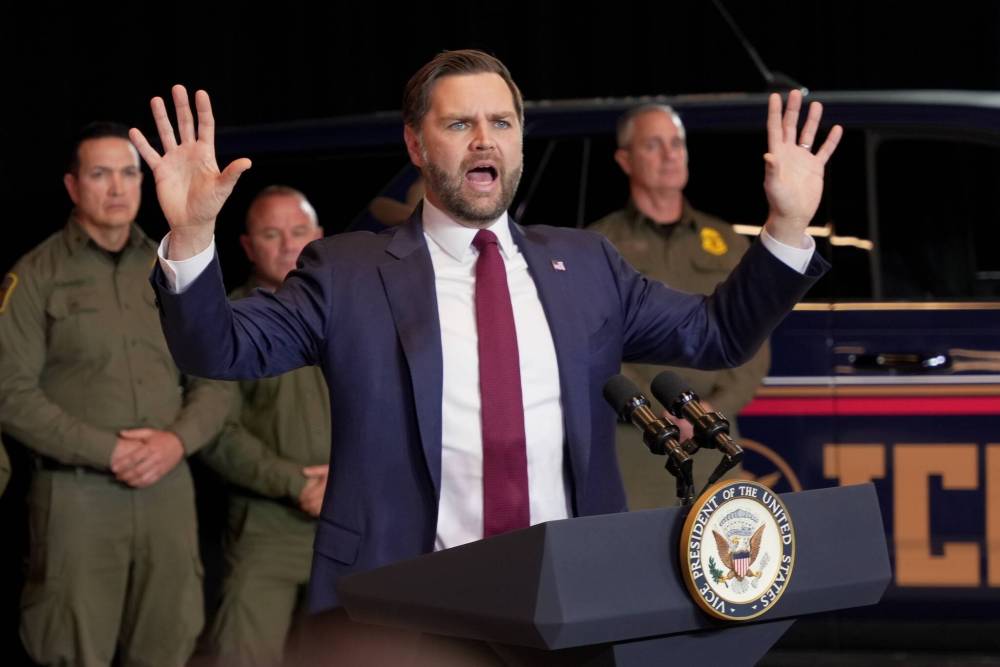
U.S. Vice-President JD Vance
The failure to secure even a modest agreement — with a fragile two-week ceasefire set to expire April 22 — raises a more fundamental question: what, exactly, was the point of this war?
When the United States and Israel initiated hostilities on Feb. 28, the stated goals were sweeping and wildly ambitious: dismantle Iran’s nuclear program, eliminate its missile capabilities, sever its ties to proxy groups across the Middle East and achieve regime change.
None of those stated objectives were realistic and none have been fully achieved.
Now, weeks later, those same goals appear either quietly diluted or strategically out of reach. The U.S. has reportedly put forward a 15-point plan that still includes many of its original demands, while Iran counters with its own list — insisting on control of the Strait of Hormuz, an end to attacks on its allies and compensation for war damages.
These are not negotiating positions inching toward compromise; they are entrenched stances reflecting two sides that believe they have little reason to bend.
That, perhaps, is the most telling failure of this war. Both Washington and Tehran seem to think time is on their side.
U.S. Vice-President JD Vance framed the lack of agreement as worse for Iran than for America. Iranian officials, meanwhile, speak openly about securing the “achievements” of the conflict.
This mutual sense of leverage is a recipe not for peace, but for prolonged tension and the ever-present risk of renewed violence.
For U.S. President Donald Trump, the situation represents a profound political and strategic miscalculation. This was a war of choice, not necessity — one that has delivered none of the clarity or decisive outcomes promised at its outset.
Instead, it has exposed the limits of military force in resolving deeply rooted geopolitical disputes.
Trump’s shifting rhetoric throughout the conflict has only compounded the uncertainty. Objectives have seemed to evolve by the day, switching between total disarmament, regime pressure and vague assertions of deterrence.
Such inconsistency undermines credibility at the negotiating table and leaves allies and adversaries struggling to interpret American intentions.
Meanwhile, the costs are mounting — and not just in the Middle East. Iran’s effective closure of the Strait of Hormuz has sent oil prices soaring, rattling economies far beyond the region.

American consumers, like Canadians, are feeling the ripple effects in higher energy costs and market instability.
And now, Trump has declared that the U.S. will blockade the Strait of Hormuz — how, nobody knows —and he has renewed threats to strike civilian infrastructure in Iran, all of which would escalate the conflict further.
What is needed now is not more threats or maximalist demands, but a recalibration of expectations. Durable peace, if it is achievable at all, will require incremental steps, mutual concessions and a recognition that neither side can impose its will outright.
That may be an unsatisfying conclusion for those who believed this war could deliver a decisive resolution. But it is a far more realistic one than the illusions that led to this point.
As the April 22 ceasefire deadline approaches, the world is left watching a conflict that has already proven its futility.