

Finding hope in space, if not on Earth
Advertisement
Read this article for free:
or
Already have an account? Log in here »
To continue reading, please subscribe:
Monthly Digital Subscription
$1 per week for 24 weeks*
- Enjoy unlimited reading on winnipegfreepress.com
- Read the E-Edition, our digital replica newspaper
- Access News Break, our award-winning app
- Play interactive puzzles
*Billed as $4.00 plus GST every four weeks. After 24 weeks, price increases to the regular rate of $19.95 plus GST every four weeks. Offer available to new and qualified returning subscribers only. Cancel any time.
Monthly Digital Subscription
$4.99/week*
- Enjoy unlimited reading on winnipegfreepress.com
- Read the E-Edition, our digital replica newspaper
- Access News Break, our award-winning app
- Play interactive puzzles
*Billed as $19.95 plus GST every four weeks. Cancel any time.
To continue reading, please subscribe:
Add Free Press access to your Brandon Sun subscription for only an additional
$1 for the first 4 weeks*
- Enjoy unlimited reading on winnipegfreepress.com
- Read the E-Edition, our digital replica newspaper
- Access News Break, our award-winning app
- Play interactive puzzles
*Your next Brandon Sun subscription payment will increase by $1.00 and you will be charged $17.95 plus GST for four weeks. After four weeks, your payment will increase to $24.95 plus GST every four weeks.
Read unlimited articles for free today:
or
Already have an account? Log in here »
As was the case half a century ago when a manned spacecraft first travelled past the moon and then negotiated a precise orbital U-turn en route to a splashdown return to Earth, it’s hard to be anything but awestruck by what is occurring far beyond our planet’s atmosphere this week.
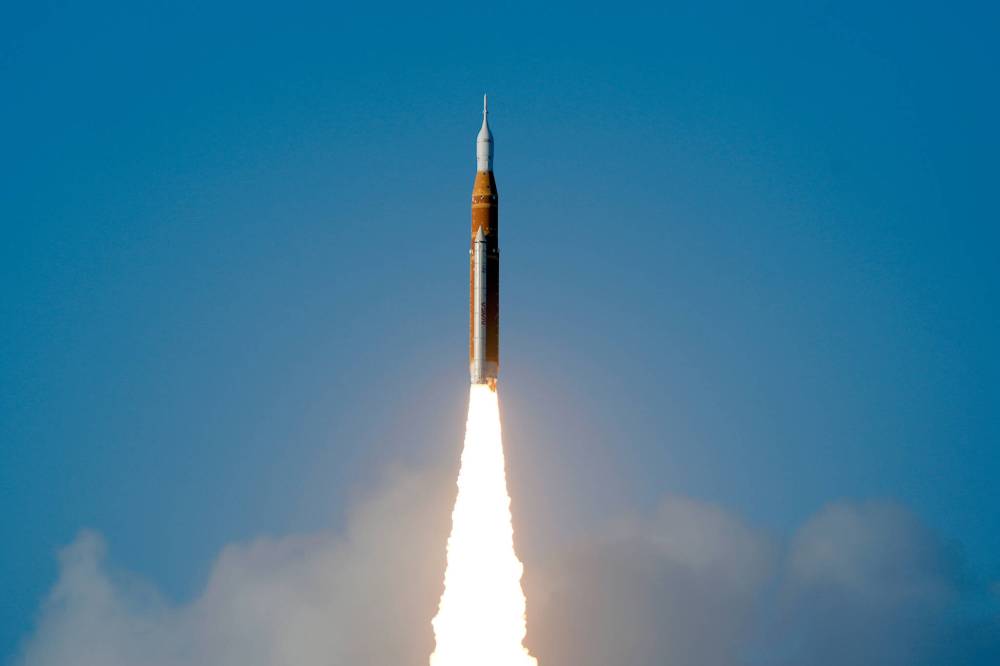
After lifting off from the Kennedy Space Center on April 1, the Artemis II mission — NASA’s long-awaited rekindling of humankind’s space-exploration ambitions — carried a four-person crew of astronauts 406,771 kilometres from Earth, the farthest anyone has travelled into space. The previous mark was 400,171 km, achieved by Apollo 13 in 1970.
(The mission’s name is, as before, inspired by mythology, with Artemis being the ancient Greek goddess of the moon and twin sister to Apollo, the namesake of the earlier NASA program that first landed humans on the lunar surface.)
John Raoux / The Associated Press
NASA’s Artemis II moon rocket
During Monday’s lunar fly-by, which included 40 minutes of radio silence as the Orion space capsule carved its sweeping arc around the far side of the moon, the spacecraft got as close as 6,550 km from the surface, allowing crew members to capture stunning images of the lunar landscape, as well as pictures of a full solar eclipse and a breathtaking “Earth rise” as their home planet came back into view.
The crew — which includes Canadian Space Agency mission specialist Jeremy Hansen, the first non-American to participate in a deep-space journey, as well as American astronauts Reid Wiseman, Victor Glover and Christina Hammock Koch — is scheduled to splash down shortly after 7 p.m. CST on Friday off the coast of California. And as daunting as the adventure has been so far, the most difficult and perilous moments await as the capsule re-enters Earth’s atmosphere.
After completing its four-day return leg, the tiny spacecraft will slam into the atmosphere at speeds exceeding 32,000 km/h, requiring its heat shields to withstand friction-induced temperatures above 1,600 degrees Celsius. Only after the crew has survived that ordeal and been recovered from a safely splashed-down capsule can the mission be considered a success.
But even before Friday’s return, which will be broadcast live by NASA and carried on various TV and streaming services, there’s no disputing the Artemis II mission has offered inspiration to those who have followed in from every corner of the Earth. While it was launched under the auspices of the U.S. space agency, this was inarguably a global undertaking, with the design, assembly and testing of the Orion capsule having been carried out by a coalition of 11 countries across two continents. Indeed, fully 61 nations have signed on to the Artemis Accords, a collection of global agreements committed to peaceful collaboration in space and on the moon.

Of course, the Earth the Artemis astronauts are returning to is a much different place than the one that awaited the crews of the Apollo missions half a century ago. The relative simplicity of terrestrial life back then — pre-internet, pre-social-media, pre-climate-crisis, pre-pandemic and decidedly pre-Trump — allowed for the optimism inspired by space exploration to be boundlessly wide-eyed. That innocence has long since been lost.
While the ambitions of the ongoing Artemis program — with a mission next year to conduct docking tests with a lunar lander, followed by a scheduled lunar landing in 2028 and the eventual construction of a permanent lunar base — are a testament to the vastness of human potential, whatever is accomplished by the exhilarating exploits of this and future missions must, lamentably, also be measured against the magnitude of the mess to which each courageous crew returns.