

Government data shows extent of truancy issue
Advertisement
Read this article for free:
or
Already have an account? Log in here »
To continue reading, please subscribe:
Monthly Digital Subscription
$1 per week for 24 weeks*
- Enjoy unlimited reading on winnipegfreepress.com
- Read the E-Edition, our digital replica newspaper
- Access News Break, our award-winning app
- Play interactive puzzles
*Billed as $4.00 plus GST every four weeks. After 24 weeks, price increases to the regular rate of $19.95 plus GST every four weeks. Offer available to new and qualified returning subscribers only. Cancel any time.
Monthly Digital Subscription
$4.99/week*
- Enjoy unlimited reading on winnipegfreepress.com
- Read the E-Edition, our digital replica newspaper
- Access News Break, our award-winning app
- Play interactive puzzles
*Billed as $19.95 plus GST every four weeks. Cancel any time.
To continue reading, please subscribe:
Add Free Press access to your Brandon Sun subscription for only an additional
$1 for the first 4 weeks*
*Your next subscription payment will increase by $1.00 and you will be charged $16.99 plus GST for four weeks. After four weeks, your payment will increase to $23.99 plus GST every four weeks.
Read unlimited articles for free today:
or
Already have an account? Log in here »
You start to deal with a problem by admitting that you actually have one, not by burying it because you’re concerned about how it might look.
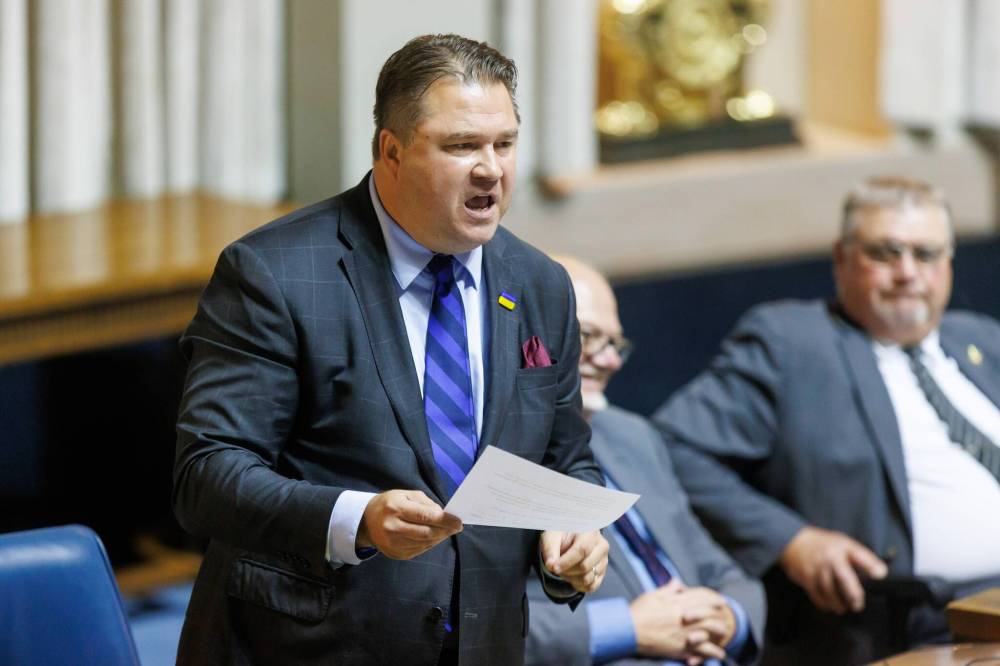
On Wednesday, independent MLA Mark Wasyliw tabled leaked information in the legislature about truancy in Manitoba schools. Included in the information was an internal briefing note, dated July 26, 2024, that contained a breakdown of “severe chronic absenteeism” across Manitoba’s 37 public school divisions in 2023-24.
Severe chronic absenteeism for an elementary student means missing 20 per cent of classes during a reporting period. For a high school student, that level is reached if they have 20 or more unexcused absences in a core course.
Mike Deal / Free Press files
Independent MLA Mark Wasyliw
More than 15,000 students were chronically absent in the 2023-2024 school year, a staggering number. That’s eight per cent of K to 12 students across the board, though some districts were much higher: 60 per cent in the Frontier school division, and 20 per cent in Kelsey (The Pas), Turtle River (McCreary) and Mystery Lake (Thompson) schools.
Kent Dueck, the executive director of Inner City Youth Alive, had a succinct response to the numbers: “This should force us into action on the issue … Now that it’s out in the open and everybody knows, I think we’re in a much better position — at least we can start to generate solutions and rethink our model.”
The Free Press story on the issue pointed out particular issues: “Students who self-identify as First Nations, Métis or Inuit accounted for 64 per cent of K-8 students and 58 per cent of high schoolers with severe chronic absenteeism. Among elementary schoolers, that figure surpassed 80 per cent in Winnipeg, Swan Valley, Seven Oaks, Portage la Prairie, Mystery Lake, Kelsey and Flin Flon.”
Obviously, work should be done immediately to find ways to bring down truancy rates, especially in hard-hit school districts. Children don’t make up lost school time somewhere: left behind in essential areas of learning, they don’t just magically catch up.
Days and weeks that are lost aren’t easily recovered: lesson plans and other students move steadily on, and those that have missed out struggle, and will continue to struggle.
But if the data was troubling, the government’s response to the release of the leaked documents was equally concerning.
Education Minister Tracy Schmidt not only supported keeping the information under wraps, but wouldn’t commit to releasing future data on the truancy problem.
“Data in decision-making is very, very important but we have to balance that with our concern about not stigmatizing any particular community or school division,” Schmidt said.
No: data exists to be seen and to be used, and to act as clear justification for what should be, in this case, immediate action.
Truancy data has to be available so that the public will understand the need when the government takes specific actions to increase spending and launch programs in particular districts. So that problems will be seen, understood and addressed, not handled quietly behind closed doors while anecdotal information swirls around like rumour.

It shouldn’t be hidden because the government doesn’t like the way it looks.
A footnote: the other problem is that freedom of information legislation, like many parts of government, is essentially based on trust — when a request for information is answered with a statement that the government has no records that match the request, there’s nothing to do after that except take the government at its word.
Wasilyiw said that he requested truancy information from the province in a freedom of information request, and was told the province didn’t keep those sorts of records.
Yet he was able to obtain those records through other means.
Once broken, that trust is not easily repaired.