

After a court decision on tariffs, what’s next?
Advertisement
Read this article for free:
or
Already have an account? Log in here »
To continue reading, please subscribe:
Monthly Digital Subscription
$1 per week for 24 weeks*
- Enjoy unlimited reading on winnipegfreepress.com
- Read the E-Edition, our digital replica newspaper
- Access News Break, our award-winning app
- Play interactive puzzles
*Billed as $4.00 plus GST every four weeks. After 24 weeks, price increases to the regular rate of $19.95 plus GST every four weeks. Offer available to new and qualified returning subscribers only. Cancel any time.
Monthly Digital Subscription
$4.99/week*
- Enjoy unlimited reading on winnipegfreepress.com
- Read the E-Edition, our digital replica newspaper
- Access News Break, our award-winning app
- Play interactive puzzles
*Billed as $19.95 plus GST every four weeks. Cancel any time.
To continue reading, please subscribe:
Add Free Press access to your Brandon Sun subscription for only an additional
$1 for the first 4 weeks*
*Your next subscription payment will increase by $1.00 and you will be charged $16.99 plus GST for four weeks. After four weeks, your payment will increase to $23.99 plus GST every four weeks.
Read unlimited articles for free today:
or
Already have an account? Log in here »
U.S. President Donald Trump loves the word tariffs — he’s said so many times.
In fact, he’s said “I love the word tariffs — it’s the most beautiful word in the dictionary.”
The U.S. Supreme Court? Not so much. At least, not when the president claims he can unilaterally impose them.
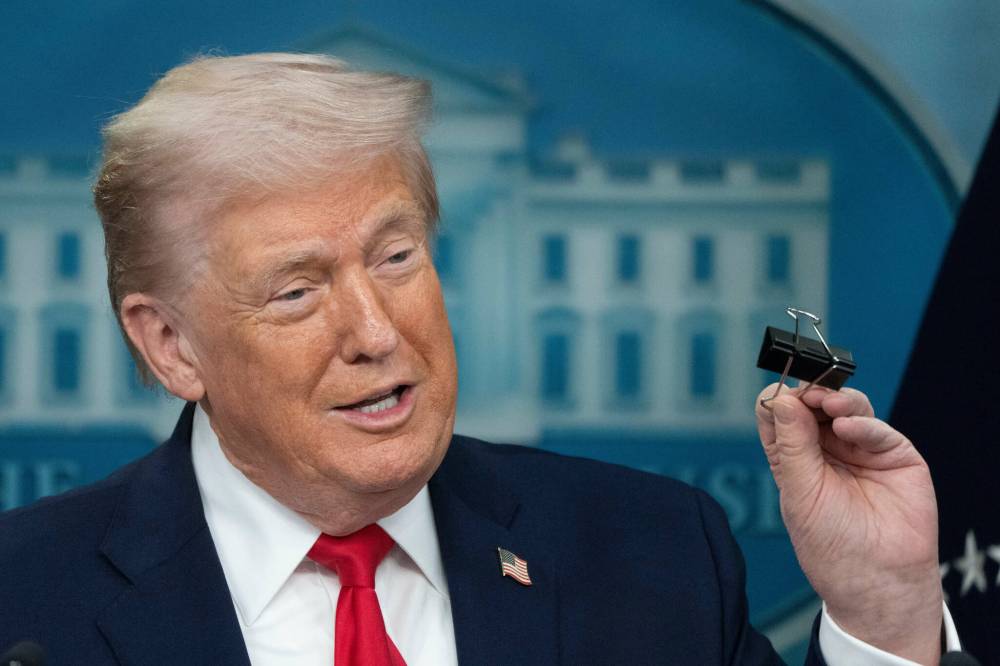
Mark Schiefelbein / The Associated Press
U.S. President Donald Trump
Friday, a majority of the court struck down Trump’s use of the 1977 International Emergency Economic Powers Act, saying, bluntly, “IEEPA does not authorize the president to impose tariffs.”
The power to impose tariffs, the court ruled, is rightfully held by the U.S. congress.
Trump used the IEEPA legislation to impose the “Liberation Day” tariffs of at least 10 per cent against all U.S. trading partners, as well as 25 per cent direct tariffs against Canada and Mexico, along with tariffs of, at one point, up to 145 per cent applied to products coming from China.
Now, that doesn’t mean everything’s over. Congress might decide to reimpose the tariffs legally through legislation, for example.
But the problem may well be that elected Republicans may now be more frightened of voters than they are of Trump. Tariff legislation — especially tariffs based on fripperies as transparent as Trump not liking a foreign leader’s tone and hiking tariff levels — is not necessarily an easy sell to Americans watching prices rise and jobs dry up.
After all, the economics — despite Trump’s own words — show that the majority of the tariffs are being collected from American businesses and customers, meaning that much of the US$200 billion in tariffs collected so far has come from ordinary Americans.
And what of that US$200 billion?
If the money was collected improperly, according to the highest court in the land, a government can hardly argue that it has to keep the ill-gotten gains because it can’t afford to pay the money back — or sort out who it illegally collected the money from.
It’s somewhat akin to claiming “Yes I stole the car, your honour, but I can’t give it back because it’s the only way I have to get the kids to school.”
All of this, however, depends on the rule of law, and the willingness of an administration — and a president — to actually accept that rule of law. Early comments from the president, which undoubtedly appear in future court actions and verdicts, suggest that Trump intends to subvert the clear court decision by making some collection of workarounds.
Right now, though, it’s hardly the art of the deal. Trump has successfully alienated many of America’s most steadfast trading partners, causing much of the world to look elsewhere for business, all for a cash gain that he was not entitled to impose. And which the U.S. may now have to repay.
Now, Trump looking for ways to wriggle out of the mess that he, and he alone, has made.
All that being said, now is not the time to celebrate.
Because this is not a chess match.
This is wrestling a desperate Vaseline-covered swamp weasel — and there’s guaranteed to be plenty of biting and scratching before it’s all over.

So let’s keep the celebration low-key until the dust settles.
What should we do?
The federal minister responsible for U.S.-Canada trade, Dominic LeBlanc, clearly understands the assignment, writing on social media “The United States Supreme Court’s decision reinforces Canada’s position that the IEEPA tariffs imposed by the United States are unjustified. … Through a period of transformation in Canada’s relationship with the United States and as we approach the first joint review of the Canada-United States-Mexico Agreement, we are working to create growth and opportunities on both sides of the border, while strengthening our collaboration with reliable trading partners and allies around the world.”
Move slowly. Deliberately.
And most of all, move deliberately slowly.