

Doctor retention matters — just like recruitment
Advertisement
Read this article for free:
or
Already have an account? Log in here »
To continue reading, please subscribe:
Monthly Digital Subscription
$1 per week for 24 weeks*
- Enjoy unlimited reading on winnipegfreepress.com
- Read the E-Edition, our digital replica newspaper
- Access News Break, our award-winning app
- Play interactive puzzles
*Billed as $4.00 plus GST every four weeks. After 24 weeks, price increases to the regular rate of $19.95 plus GST every four weeks. Offer available to new and qualified returning subscribers only. Cancel any time.
Monthly Digital Subscription
$4.99/week*
- Enjoy unlimited reading on winnipegfreepress.com
- Read the E-Edition, our digital replica newspaper
- Access News Break, our award-winning app
- Play interactive puzzles
*Billed as $19.95 plus GST every four weeks. Cancel any time.
To continue reading, please subscribe:
Add Free Press access to your Brandon Sun subscription for only an additional
$1 for the first 4 weeks*
*Your next subscription payment will increase by $1.00 and you will be charged $16.99 plus GST for four weeks. After four weeks, your payment will increase to $23.99 plus GST every four weeks.
Read unlimited articles for free today:
or
Already have an account? Log in here »
Manitoba deserves credit for finally showing some momentum on doctor recruitment. Bringing 13 U.S.-trained physicians into the province in a matter of months — a development announced last week — is no small achievement, particularly for a jurisdiction that has long struggled to compete for medical talent.
It’s also a record: more than double Manitoba’s best previous year for American recruits.
But the applause needs to be brief. Because while Manitoba is getting better at attracting doctors, it remains one of the worst places in the country at keeping them.
MIKE DEAL / FREE PRESS
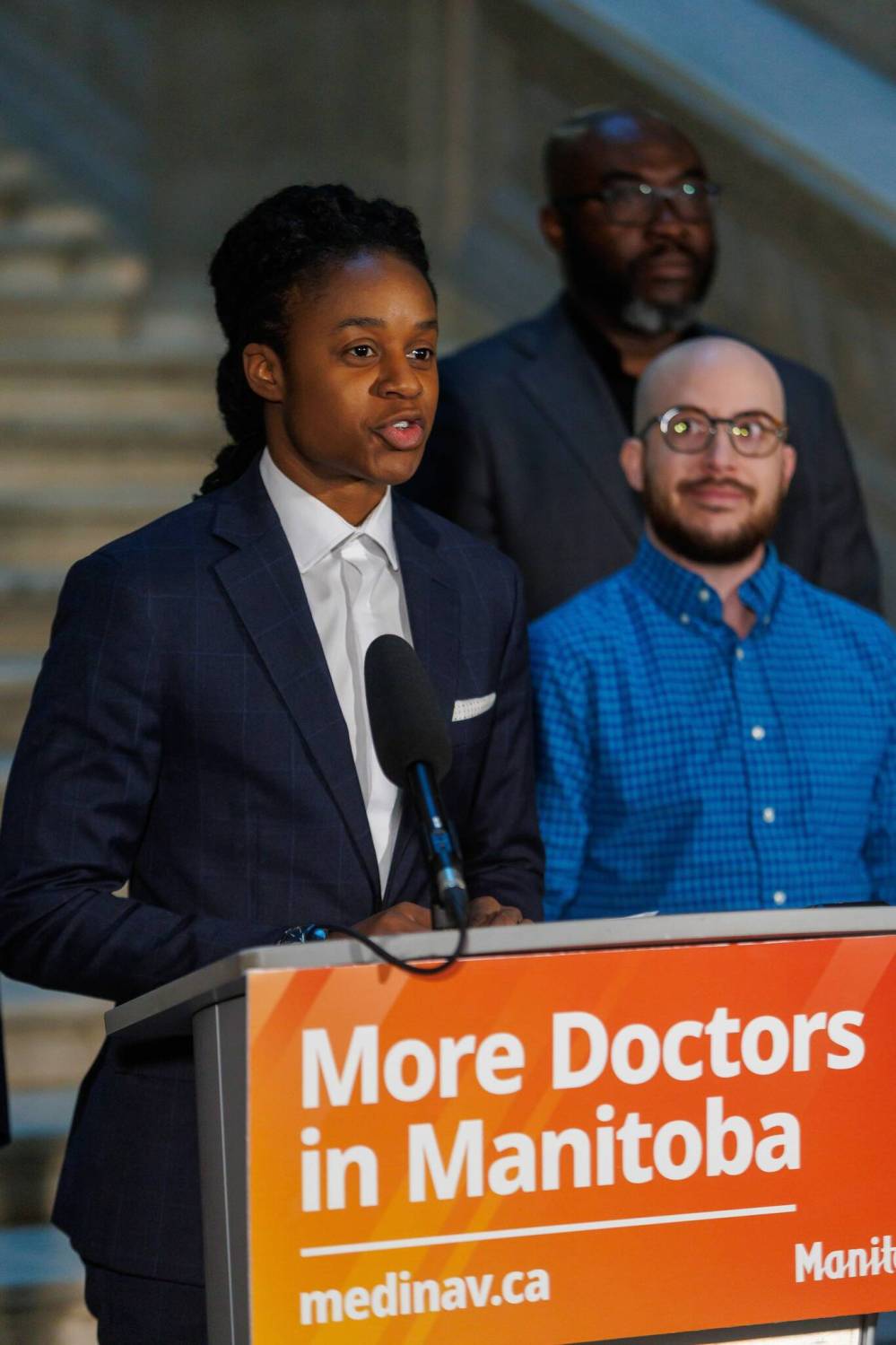
Health, Seniors and Long-Term Care Minister Uzoma Asagwara
That uncomfortable truth sits beneath last week’s upbeat news conference at the legislature, where Premier Wab Kinew leaned into symbolism and values, including paraphrasing words from the Statue of Liberty as he welcomed American physicians “yearning to be free.”
The message was clear: Manitoba offers something increasingly rare — a publicly funded health-care system where care is based on need, not a credit card.
For doctors like Dr. Jesse Krikorian, who left Michigan to practice family medicine at Winnipeg’s Klinic Community Health, that difference is not theoretical. He no longer spends his lunch hours arguing with insurance companies. He can focus on patients, not billing codes.
That alone makes Manitoba attractive in a U.S. health-care landscape that many physicians find morally and professionally exhausting.
Health Minister Uzoma Asagwara is right to point out that regulatory changes last June, which streamlined licensing for U.S.-trained doctors, have paid off. The province also deserves acknowledgment for hiring a net 285 physicians since the NDP formed government in October 2023.
And yet, the broader picture remains troubling.
Despite record recruitment in 2025, Manitoba still lost doctors to other provinces at one of the highest rates in the country — 8.3 physicians per 1,000 on a net basis, according to the Canadian Institute for Health Information. Only one province performed worse. Just 66 per cent of Manitoba medical graduates stay here, a figure that should alarm anyone concerned about the sustainability of the health-care system.
Doctors Manitoba is blunt about the problem. Its annual survey found 43 per cent of physicians are considering reducing hours, retiring or leaving the province within the next three years.
Manitoba clearly has a physician retention problem. The obvious question is, why? Why does Manitoba, year after year, train doctors or recruit them from elsewhere only to watch so many pack up and leave?
Some factors are outside government control. Geography and weather will never be selling points for everyone. Larger provinces can offer denser professional networks and, in some cases, higher earning potential. But those realities apply to Saskatchewan and the Atlantic provinces as well and Manitoba still performs worse than most of them.

Other factors, such as chronic staffing shortages, long wait lists — including for physician specialists — and underfunded hospitals do fall squarely in the purview of government control. And those are areas where the province can and must do better, not only to improve patient care but to help retain doctors and other health care staff.
New physicians — whether from Michigan or Manitoba — will not stay if they are quickly burned out, professionally isolated or unable to deliver the care they were trained to provide.
The good news is that Manitoba now has proof it can attract doctors when it removes unnecessary barriers and clearly articulates its values. The bad news is that attraction is only the first step.
The harder work is making Manitoba a place where doctors choose to build long careers. That means sustained investment in equipment and technology, reducing wait times and improving access to doctor specialists.
Until that happens, record recruitment will remain a headline, not a solution.