

Teachers need support to deal with violence
Advertisement
Read this article for free:
or
Already have an account? Log in here »
To continue reading, please subscribe:
Monthly Digital Subscription
$1 per week for 24 weeks*
- Enjoy unlimited reading on winnipegfreepress.com
- Read the E-Edition, our digital replica newspaper
- Access News Break, our award-winning app
- Play interactive puzzles
*Billed as $4.00 plus GST every four weeks. After 24 weeks, price increases to the regular rate of $19.95 plus GST every four weeks. Offer available to new and qualified returning subscribers only. Cancel any time.
Monthly Digital Subscription
$4.99/week*
- Enjoy unlimited reading on winnipegfreepress.com
- Read the E-Edition, our digital replica newspaper
- Access News Break, our award-winning app
- Play interactive puzzles
*Billed as $19.95 plus GST every four weeks. Cancel any time.
To continue reading, please subscribe:
Add Free Press access to your Brandon Sun subscription for only an additional
$1 for the first 4 weeks*
*Your next subscription payment will increase by $1.00 and you will be charged $16.99 plus GST for four weeks. After four weeks, your payment will increase to $23.99 plus GST every four weeks.
Read unlimited articles for free today:
or
Already have an account? Log in here »
The numbers are stark, disturbing — and overdue for a serious response.
A new study suggests one in two Manitoba teachers experienced violence on the job during the 2023-24 school year. More than half were threatened or physically harmed. Fifteen per cent endured more than 20 violent incidents in just 10 months. A third needed time off to recover.
As resource teacher and researcher Julie Braaksma — who penned the report — put it, the findings are “not shocking — it should be, but it’s not.”
TREVOR HAGAN / WINNIPEG FREE PRESS
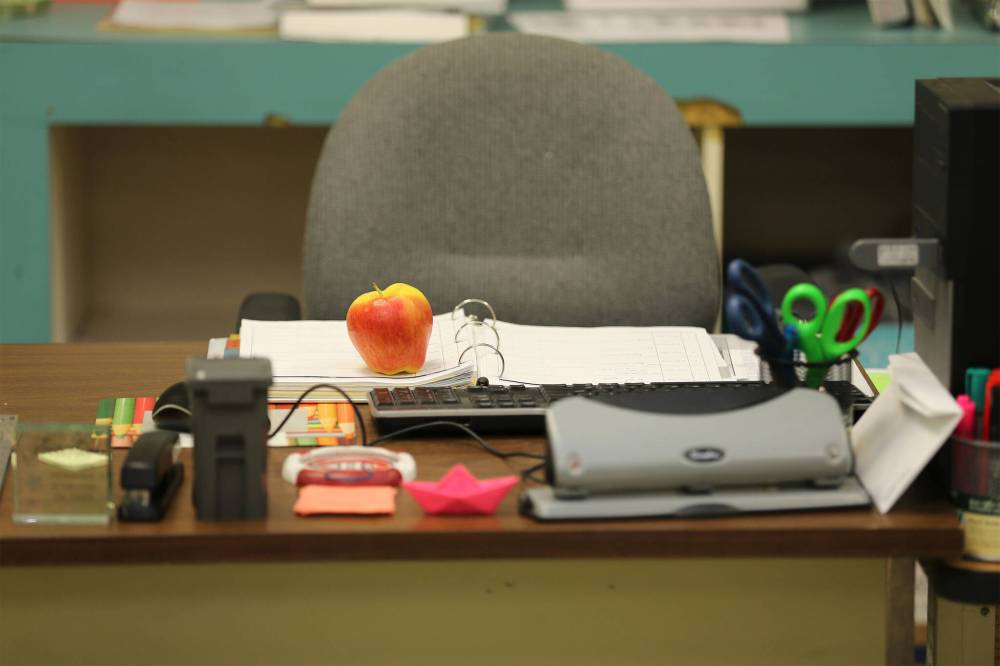
Teachers need more support.
That alone should alarm us.
Teachers have been telling anyone who will listen that violence is becoming normalized in Manitoba classrooms. Braaksma’s doctoral research, based on responses from 191 teachers across 22 public school divisions, confirms what has been whispered in staff rooms and union meetings for years: this is not an isolated problem, nor the experience of a few unlucky educators.
It is systemic.
More troubling still is what the data say about why violence is rising. Nearly 60 per cent of respondents pointed to the growing number of students with high needs being integrated into mainstream classrooms without adequate supports. Another 14 per cent cited limited access to behavioural specialists and other resources.
Inclusion is a cornerstone of public education.
But inclusion without support is not inclusion, it is abandonment. It sets students up to fail and teachers up to be harmed.
The Manitoba Teachers’ Society has long warned that class sizes are too large and staffing levels too thin to meet increasingly complex needs.
Union president Lillian Klausen’s question is blunt but fair: how can individual needs be met in a class of 30 students? The answer, teachers know all too well, is that they can’t — not consistently, and not safely.
The consequences are visible. Burnout is rampant, with 51 per cent of teachers reporting medium to high levels. Evacuations due to student outbursts are becoming routine. Some educators now wear protective arm guards as part of their daily work attire. If that doesn’t signal a system in crisis, what does?
This matters beyond teacher well-being. Chronic violence erodes learning environments for all students. It drives experienced educators out of the profession. And it undermines public confidence in schools as safe community spaces.
Yet responsibility continues to be diffused. School divisions cite funding limits. The province points to local governance. Parents are frustrated. Teachers are left to absorb the impact, physically and emotionally.
That must change.
Braaksma has offered 13 practical recommendations, from capping elementary classes at 15 students to consistent investigations, better record-keeping and consequences for violence, regardless of who initiates it. None of these ideas is radical.
Her call for mandatory non-violent crisis intervention training and better preparation for teaching neurodiverse learners should not be controversial.
Nor should the expectation that teachers be informed when incoming students have a documented history of violence.

Teachers cannot fix this alone. Asking them to be “strong self-advocates” is necessary but insufficient. Reporting incidents takes time, energy and emotional labour, especially when educators fear being blamed for behaviour beyond their control. Without clear backing from school leadership, divisions and the province, reporting can feel futile.
The provincial government must step up with targeted funding tied specifically to classroom safety: more educational assistants, more behavioural specialists, smaller classes where needs are greatest. School divisions must apply policies consistently and transparently, rather than improvising responses crisis by crisis.
Most importantly, leaders must say clearly that violence against teachers is unacceptable — not inevitable, not the cost of inclusion, and not something educators should simply endure.
Manitoba’s teachers are not asking for sympathy. They are asking for action.
The warning lights are flashing. Ignoring them will only make the damage harder — and more expensive — to repair.