

A relationship that’s on the rocks
Advertisement
Read this article for free:
or
Already have an account? Log in here »
To continue reading, please subscribe:
Monthly Digital Subscription
$0 for the first 4 weeks*
- Enjoy unlimited reading on winnipegfreepress.com
- Read the E-Edition, our digital replica newspaper
- Access News Break, our award-winning app
- Play interactive puzzles
*No charge for 4 weeks then price increases to the regular rate of $19.00 plus GST every four weeks. Offer available to new and qualified returning subscribers only. Cancel any time.
Monthly Digital Subscription
$4.75/week*
- Enjoy unlimited reading on winnipegfreepress.com
- Read the E-Edition, our digital replica newspaper
- Access News Break, our award-winning app
- Play interactive puzzles
*Billed as $19 plus GST every four weeks. Cancel any time.
To continue reading, please subscribe:
Add Free Press access to your Brandon Sun subscription for only an additional
$1 for the first 4 weeks*
*Your next subscription payment will increase by $1.00 and you will be charged $16.99 plus GST for four weeks. After four weeks, your payment will increase to $23.99 plus GST every four weeks.
Read unlimited articles for free today:
or
Already have an account? Log in here »
The hardest part of a breakup, it’s sometimes said, is letting go.
When it comes to Canada-U.S. relations, it seems many Manitobans might be ready to do just that.
Recent polling by Probe Research shows a clear majority — nearly two-thirds of 1,000 Manitobans surveyed between Nov. 25 and Dec. 10 — agree the United States is no longer Canada’s ally.
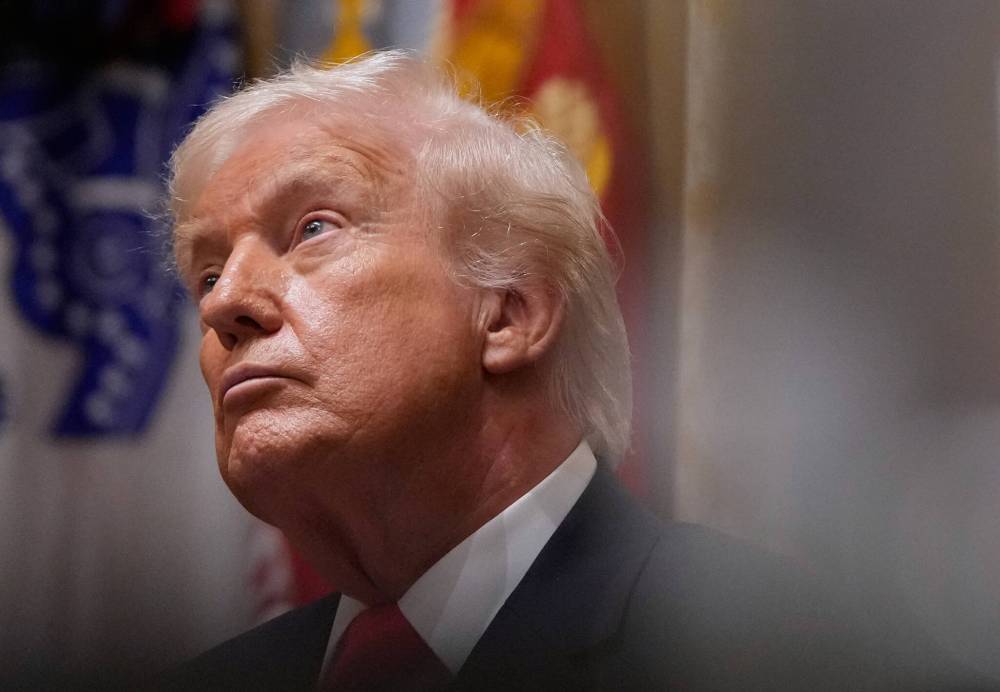
U.S. President Donald Trump (Julia Demaree Nikhinson / The Associated Press files)
After a year filled with trade uncertainty, erratic tariff impositions and inflammatory but nonsensical musings by President Donald Trump about annexing this country as the 51st U.S. state, a great many folks hereabouts think significant damage has befallen what was once the world’s most reliable and enviable international relationship.
Sixty-four per cent of the poll’s respondents aligned themselves with the statement that the U.S. is no longer an ally (27 per cent strongly agreed and 37 per cent somewhat agreed), while 36 per cent disagreed (17 per cent strongly and 19 per cent somewhat).
The data was collected just as hearings got underway on the looming renegotiation of the Canada-United States-Mexico Agreement (CUSMA) on trade.
Nearly half of those polled said no deal with the U.S. is a preferred outcome over a bad agreement (worded as “any” deal), while less than one-quarter said any deal with the U.S. is better than none.
While these perspectives on the devolution of the Canada-U.S. relationship are unsettling, they could hardly be described as surprising. Since his reinstallation in the White House in January, Trump has seemed determined to position himself as antagonist in chief, upending what had previously been productive and mostly collegial relations with long-standing global trading partners.
And while the situation regarding Canada and the U.S. has improved slightly since Prime Minister Mark Carney entered the picture and Justin Trudeau — whom Trump openly despised for reasons never fully explained — exited politics, the volatility of the ongoing relationship is clearly reflected in the Probe poll results.
Recent data from Statistics Canada, released in October, show a 24 per cent reduction in air travel to the U.S. and a 30 per cent drop in land crossings across the Canada-U.S. border in the first three quarters of 2025. And survey results released last month by Angus Reid showed 70 per cent of those polled would be uncomfortable travelling to the U.S. this winter.

Perhaps what’s most confounding about Canadians’ collective inclination to move on from the broken U.S. relationship, is that the breakup is completely unnecessary.
Trump’s oft-repeated claims that Canada (and every other trading partner) has been “ripping off” the U.S. are without merit, and the tariffs he has imposed as a means of punishing Canadian enterprises have been equally devastating to the American economy as businesses and farmers come to realize who actually foots the bill for Trump’s trade aggressions.
Winnipeg Chamber of Commerce president Loren Remillard rightly described the Probe Research findings as “a measuring stick of just how angry Manitobans are about the relationship we have with our No. 1 trading partner,” adding that “when I look at those results, I see more emotion than I do a real dissection of the economics.”
The emotional reaction is valid. Breaking up, as the early-’60s pop song laments, is hard to do.
But Merriam-Webster defines an ally as “one that is associated with another as a helper,” so there’s no disputing that with Trump at the helm, the U.S. has emphatically ceased to be that for Canada.