

‘Forward guidance’ on Canadian climate targets
Advertisement
Read this article for free:
or
Already have an account? Log in here »
To continue reading, please subscribe:

Digital Subscription
One year of digital access for only $205*
- Enjoy unlimited reading on winnipegfreepress.com
- Read the E-Edition, our digital replica newspaper
- Access News Break, our award-winning app
- Play interactive puzzles
*First annual payment billed as $205.00 + GST for one year. This annual subscription will automatically renew at $233.00 + GST every 52 weeks (10% off the regular annual price of $259.35). Offer available to new and qualified returning subscribers only. Cancel any time.
To continue reading, please subscribe:
Add Free Press access to your Brandon Sun subscription for only an additional
$1 for the first 4 weeks*
- Enjoy unlimited reading on winnipegfreepress.com
- Read the E-Edition, our digital replica newspaper
- Access News Break, our award-winning app
- Play interactive puzzles
*Your next Brandon Sun subscription payment will increase by $1.00 and you will be charged $17.95 plus GST for four weeks. After four weeks, your payment will increase to $24.95 plus GST every four weeks.
Read unlimited articles for free today:
or
Already have an account? Log in here »
At last, some honesty in Canadian climate policy
Prime Minister Mark Carney spoke the truth last week about where greenhouse gas emissions were going in Canada: up, not down. This is the first time any prime minister has stated the reality of the country’s emissions trajectory. Until now, it’s all been about putting a positive gloss on far-off reduction goals and unrealistic ambitions.
The prime minister’s second instalment of “forward guidance”, as he calls it, focused on what’s ahead on energy and climate. It was a refreshing and overdue pivot in crafting a more realistic and durable climate policy for the country.
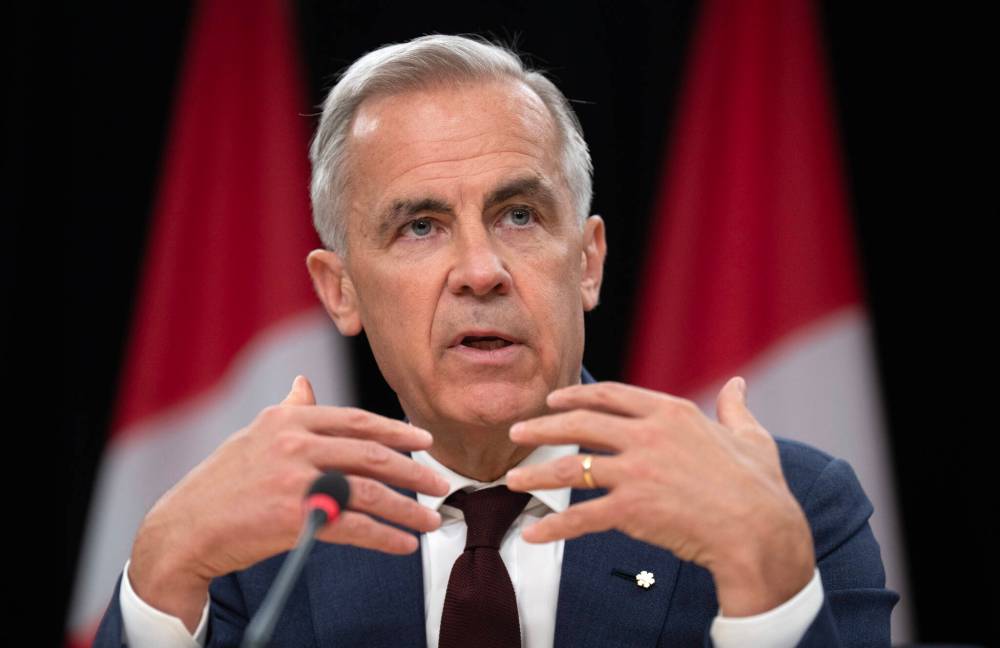
THE CANADIAN PRESS FILES
Prime Minister Mark Carney’s climate action strategy for Canada is less ambitious, more realistic.
Here’s what he said: “I want to be clear on this point. The changes we have made will mean that our emissions will be higher in the next few years than they were projected to be under the previous government’s plan. But in my judgment, that plan was not sustainable over the long term.”
He didn’t spell out the “changes we have made.” But they amount to throwing much of Justin Trudeau’s climate plan under the bus. From eliminating the consumer carbon tax to softening clean electricity regulations to getting rid of the oil and gas emissions cap to supporting a possible new west coast bitumen pipeline, Carney’s climate stance is less ambitious for the future but more realistic for the times.
Affordability and unity are the reasons Carney gave. It would have been “too expensive for Canadians” and “would have been too divisive for our country”. This is an obvious if belated nod to how climate action has riven us. He could have added that Canada wasn’t on track to meet the target anyway. Instead, he pitched it as an economic necessity: “We can’t afford to restrain the growth of an important part of our energy mix, oil and gas, to meet a short-term goal.”
That’s that, then. Or is it?
The Carney government has not yet articulated what its alternative climate plan and emissions trajectory will look like. His public admission means Canada will not meet its 2030 GHG reduction target that is enshrined in law, courtesy of the Canada Net Zero Accountability Act. That 2021 law requires the government to set out a plan to meet that target and future ones enroute to the main prize of achieving net-zero emissions by 2050. That plan is now out-of-date.
This means his government will have to spell out an alternative climate plan and goals. Climate advocates will invariably see this as backtracking or giving up on climate. Actually, it offers the prospect of creating a stronger foundation and political consensus for ongoing climate action by a serious and popular prime minister. One who is realistic about goals and sensible about approaches. Something Canada has been lacking for too long.
The Canada/Alberta memorandum of understanding on energy and climate signed last year offers a template for a new collaborative intergovernmental approach to climate action. One that binds both orders of government in a joint effort to keep reducing emissions while growing the economy.
Rather than the coercive, top-down federalism of “backstops” and “command and control” regulations practiced by his predecessor, Carney should use the Alberta model and sign bilateral climate action agreements with each province and territory. This would commit both sets of governments to ongoing climate action, spelled out in specific joint actions relevant to that province with measurable goals and timeframes to hold both accountable. The “backstop” would not be federal laws but federal financial commitments to advance agreed climate actions that reduce emissions in that jurisdiction and prepare for net-zero. The more you do, the more you get.
Call it asymmetrical federalism if you want, or just collaborative federalism of carrots, not sticks. It would match bilateral climate action plans to the carbon emitting realities of each province. Oil and gas in Alberta, transportation in Ontario, agriculture and trucking in Manitoba, and so on. It has the added value of respecting each jurisdiction’s constitutional competence which is no small national unity matter these days.

There would have to be room for national climate goals including forging an achievable net-zero path. A key feature of each agreement should be building the clean national electrical grid the PM is already seeking. Equally, there should be a strong nature and natural infrastructure component to replenish carbon sinks such as boreal forests and wetlands that are needed to offset residual emissions to reach net-zero by 2050.
They say a political gaffe is when a politician tells the truth. If so, Mark Carney has spelled out a very inconvenient truth for his party’s large, noisy, and increasingly restless climate constituency. Inconvenient truths that led to reassuring lies about progress and outcomes.
He now needs to go the next step. Forge a made-in-Canada climate policy that reflects our economic and political realities and actually achieves carbon reduction goals the vast majority of Canadians will support and stick with.
Mr. Carney’s forward guidance may just mean the time has finally arrived when we will no longer be gaslit about greenhouse gases.
David McLaughlin is a former clerk of the executive council and cabinet secretary in the Manitoba government.