

U of W delivers lesson for downtown development
Advertisement
Read this article for free:
or
Already have an account? Log in here »
To continue reading, please subscribe:

Digital Subscription
One year of digital access for only $205*
- Enjoy unlimited reading on winnipegfreepress.com
- Read the E-Edition, our digital replica newspaper
- Access News Break, our award-winning app
- Play interactive puzzles
*First annual payment billed as $205.00 + GST for one year. This annual subscription will automatically renew at $233.00 + GST every 52 weeks (10% off the regular annual price of $259.35). Offer available to new and qualified returning subscribers only. Cancel any time.
To continue reading, please subscribe:
Add Free Press access to your Brandon Sun subscription for only an additional
$1 for the first 4 weeks*
- Enjoy unlimited reading on winnipegfreepress.com
- Read the E-Edition, our digital replica newspaper
- Access News Break, our award-winning app
- Play interactive puzzles
*Your next Brandon Sun subscription payment will increase by $1.00 and you will be charged $17.95 plus GST for four weeks. After four weeks, your payment will increase to $24.95 plus GST every four weeks.
Read unlimited articles for free today:
or
Already have an account? Log in here »
A few weeks back, I moderated a lively discussion on the future of Winnipeg’s downtown. It was a conversation that has been held many times before and certainly won’t be the last. Like most discussions, participants framed ideas around how to move downtown forward while touching on various challenges and successes. This included highlighting the growth of the downtown population and how major projects have driven billions of dollars into the entertainment, commercial and, increasingly, the medical sectors over the past two decades.
However, what received less attention was how higher education can play an even greater role in supporting downtown revitalization.
Over nearly three decades at the University of Winnipeg, I watched the campus grow substantially. Today, we have one of the largest footprints in the downtown. This growth was not accidental. It was shaped largely by Dr. Lloyd Axworthy, who became president in 2004. He advanced the idea that higher education must play a broader role in the community and reach more people. This was defined by the intentional effort to become more of a positive and visible presence in the downtown and the inner city. The thought was that education can leverage development while being a beacon for hope and change that extends well beyond the classroom and the lab.
FREE PRESS FILES
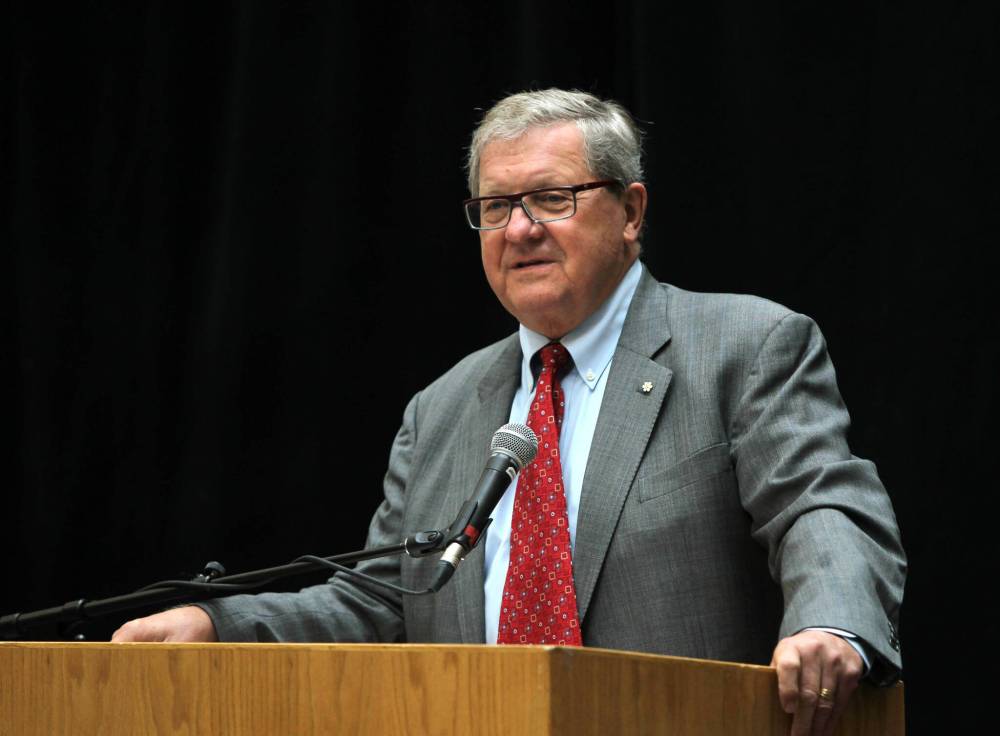
Lloyd Axworthy, then-president and vice-chancellor of the University of Winnipeg, speaks in the Richardson College for the Environment and Science complex in 2012.
This transformation began 22 years ago when I stood on Spence Street with then-president Axworthy. It was one of my first meetings with him, in which he shared a bold vision for the campus and the broader downtown. He said a starting point would be closing Spence Street to vehicle traffic. If I recall correctly, he referred to it as a four-lane highway in the heart of the campus. During his 10-year presidency, the university transformed into a bustling community of over 10,000 students, staff and faculty. Equally, it became a welcoming place for visitors to campus for events and supports.
The transformation of the campus was guided by a well-defined plan that laid out a strong vision for growth. The plan had a clear purpose, was sustainable, and certainly mindful of the characteristics of the inner-city population and the downtown economy. Critical for success was a focus on strengthening the academic core through the addition of the Richardson College of the Environment and Science complex, and the Buhler Centre. These two large projects anchored the campus along Portage Avenue. They were also supported by two highly innovative and mixed-use housing projects that included student, affordable and market units. The housing model developed was a first for downtown when few affordable housing options existed, let alone led by a university.
This innovative approach to campus development was supported by the creation of the University of Winnipeg Renewal Corporation (UWCRC). The UWCRC would become the development arm of the university, initially led by the late Sherman Kreiner. His early leadership helped create one of the most successful models for downtown development. Today, UWCRC remains a key contributor to affordable housing and innovation in the inner city and has won numerous awards for its work.

Perhaps the most visible outcome has been the revitalization of Colony Street with three housing towers and the Buhler Centre, which includes the faculty of business and economics and commercial spaces. These projects continue to build on the vision that a university can be a force for redevelopment delivered through the lens of sustainable, affordable and purposeful design.
As much as the physical footprint of campus has grown, we have responsibilities to give back. This is most evident in the addition of the Axworthy Rec Plex. This massive complex was built around a community charter, which sets out that 30 per cent of the time is offered back to the local community. There is nothing more rewarding than watching local community groups pack the fields on a cold winter evening when few options exist.
Over the next few months, we will launch a new campus plan. This plan will build on a strong legacy of transformation in the downtown, guided by the recognition that a university can and must do more. The plan will also ensure we focus on providing accessible and high-quality education led by our faculty members. Ultimately, we will offer a way forward for our students while ensuring there are more reasons to come downtown not simply to study but to be inspired by a city and campus on the move.
See you on campus.
Jino Distasio is interim president and vice-chancellor of the University of Winnipeg and a strong voice for downtown revitalization.