

Hats off to Steven Guilbeault
Advertisement
Read this article for free:
or
Already have an account? Log in here »
To continue reading, please subscribe:

Digital Subscription
One year of digital access for only $205*
- Enjoy unlimited reading on winnipegfreepress.com
- Read the E-Edition, our digital replica newspaper
- Access News Break, our award-winning app
- Play interactive puzzles
*First annual payment billed as $205.00 + GST for one year. This annual subscription will automatically renew at $233.00 + GST every 52 weeks (10% off the regular annual price of $259.00). Offer available to new and qualified returning subscribers only. Cancel any time.
To continue reading, please subscribe:
Add Free Press access to your Brandon Sun subscription for only an additional
$1 for the first 4 weeks*
- Enjoy unlimited reading on winnipegfreepress.com
- Read the E-Edition, our digital replica newspaper
- Access News Break, our award-winning app
- Play interactive puzzles
*Your next Brandon Sun subscription payment will increase by $1.00 and you will be charged $17.95 plus GST for four weeks. After four weeks, your payment will increase to $24.95 plus GST every four weeks.
Read unlimited articles for free today:
or
Already have an account? Log in here »
Bye-bye, Steven Guilbeault. Having already suffered the fate of countless environmentalist environment ministers in federal and provincial governments — isolated in cabinet, disappointing their followers, shuffled out of the portfolio at the earliest convenience — he has, to his credit, taken the honourable way out; freeing himself from the chains of caucus solidarity to criticize the many less-than-environmentally-friendly government policies.
Of course, the current Liberal government is rhetorically environment-friendly. In fact, the Conservative Party of Canada stands apart from all other parties as appearing to be not overly concerned about the environment.
But it matters little. Neither the Trudeau government nor its successor has shown any inclination to take meaningful environmental action. Reducing Canada’s minor contribution to world greenhouse gas emissions, a carbon tax returned to the taxpayers, a few millions toward solving the billion-dollar Lake Winnipeg problem, no meaningful action on climate change adaptation; not exactly a green agenda.
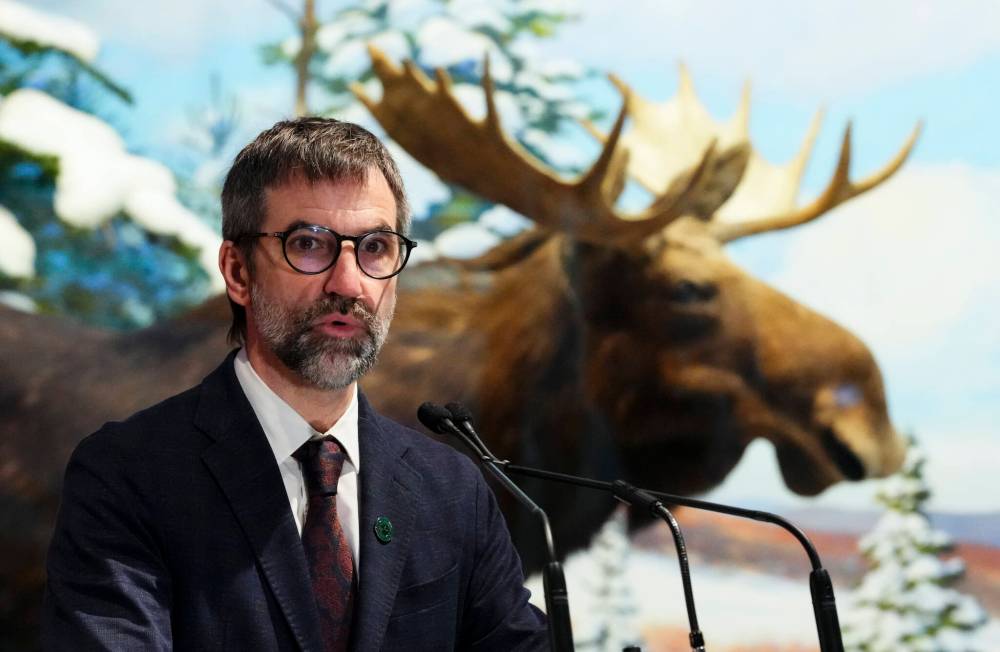
THE CANADIAN PRESS/Sean Kilpatrick
Steven Guilbeault, a former minister of environment and climate change, will leave parliament later this summer, citing “backsliding” by the government on dealing with climate change.
As any former environment minister can tell you, no environmental decision escapes close economic scrutiny. It’s the economy, stupid. Well, at least the economy as defined by GDP, by budget deficits, by bond rating agencies, by cost-of-living index, interest rates, inflation and a host of other indicators that militate against addressing issues that are seen to detract from that definition.
Meaning climate change, big-ticket environmental issues such as Lake Winnipeg, and future generations take a back seat.
So the disillusioned-yet-wiser Steven Guilbeault exits parliament, the proximate cause being the prime minister’s declared intention to “streamline” the federal project approvals process which really means the environmental approval process.
A little history here. Nowhere does “environment” appear in our constitution. In fact, as the owners of their natural resources, one could logically assume that environmental regulation was mostly a provincial matter; and prior to the late 1980s, this was in fact the case. Federal environmental laws related to regulating chemicals and supporting research and monitoring.
But then environment, as a result of several highly publicized environmental disasters, such as the Bhopal chemical spill in India, became the top-of-mind issue in public opinion polls (it dropped off that list in the early ’90s and has never got back there since).
How could Ottawa stand aside when political hay could be made by turning green?
Eventually a federal appeals court astonishingly declared that a set of federal environmental review “guidelines” meant to apply only to federally funded projects, and never approved by parliament, had the force of law for any projects with potential environmental effects. Canada promptly passed the Environmental Assessment Act, that over the years expanded in scope to cover many aspects of projects over which there was clearly no federal jurisdiction.
The fact is that Ottawa lost serious interest in heavy lifting on the environment when it ceased to be that hot button issue and succeeding governments have continued to be long on talk and short on action.
Currently all provinces have environmental laws every bit as effective as Ottawa’s; but it would be unthinkable that our national government would be uninvolved in environmental issues. Where Ottawa is providing project funding or potential environmental effects are trans-boundary — conditions that apply to most or perhaps all “nation-building” projects so far proposed — the federal project review process must be applied.
The PM has declared that the urgency attached to these projects necessitates a much speedier federal review than has heretofore been the case.
There are four major reasons that contribute to less than hasty federal reviews.
Although there have been improvements, federal and provincial reviews continue to be imperfectly harmonized, creating duplication, overlap and delays.
In the past, the federal review has concerned itself with a host of issues and concerns that are clearly outside Canada’s constitutional authority, lengthening and complicating the process.
Consultation, particularly under section 35 of the constitution, has created uncertainty and delay, largely because governments have failed to define “meaningful” consultation and worse, generally failing to deliver it to First Nations.

Finally, project proponents can add to process time by simply failing to deliver adequate and credible analysis of potential project impacts.
Hence the departure of Steven Guilbeault, who clearly believes a shorter review process does not necessarily deliver better environmental outcomes, and very likely worse ones.
No doubt Ottawa will be throwing scads of money — and forcing proponents to do the same — into effecting the speedup. But Mr. Guilbeault knows from experience just how stingy government is on environment and we can assume he believes resources for substantive critique — which, after all, might cause a rethink of the project — will continue to be scant.
So, hats off to Steven. He may no longer be rappelling down the side of smokestacks, or pedalling his bike to work in an Ottawa winter, but his resignation is a gesture with much more heft — a politician acting on principle. He will be a much more effective spokesperson for the environment — and heaven knows we need all the advocacy we can get — then he could ever be, snared in the coils of a government run by an investment banker.
Norman Brandson is the former deputy minister of the Manitoba departments of environment, conservation and water stewardship.