

Alberta’s long-standing mentality of grievance
Advertisement
Read this article for free:
or
Already have an account? Log in here »
To continue reading, please subscribe:

Digital Subscription
One year of digital access for only $205*
- Enjoy unlimited reading on winnipegfreepress.com
- Read the E-Edition, our digital replica newspaper
- Access News Break, our award-winning app
- Play interactive puzzles
*First annual payment billed as $205.00 + GST for one year. This annual subscription will automatically renew at $233.00 + GST every 52 weeks (10% off the regular annual price of $259.00). Offer available to new and qualified returning subscribers only. Cancel any time.
To continue reading, please subscribe:
Add Free Press access to your Brandon Sun subscription for only an additional
$1 for the first 4 weeks*
- Enjoy unlimited reading on winnipegfreepress.com
- Read the E-Edition, our digital replica newspaper
- Access News Break, our award-winning app
- Play interactive puzzles
*Your next Brandon Sun subscription payment will increase by $1.00 and you will be charged $17.95 plus GST for four weeks. After four weeks, your payment will increase to $24.95 plus GST every four weeks.
Read unlimited articles for free today:
or
Already have an account? Log in here »
In October, Albertans will vote in a referendum about a referendum. They will be asked if they support another future “binding” referendum on whether Alberta should separate from Canada.
My prediction: the results of the October referendum will be about 70 per cent against separation. Based on recent polls, at most 27 per cent of Alberta voters support such drastic action.
Alberta separation, like Quebec separation, makes little sense. Politically, economically, geographically, and logistically it is pretty much an impractical and impossible scenario to conceive. Not to mention, it would impact Alberta’s Indigenous population’s long-held treaty rights.
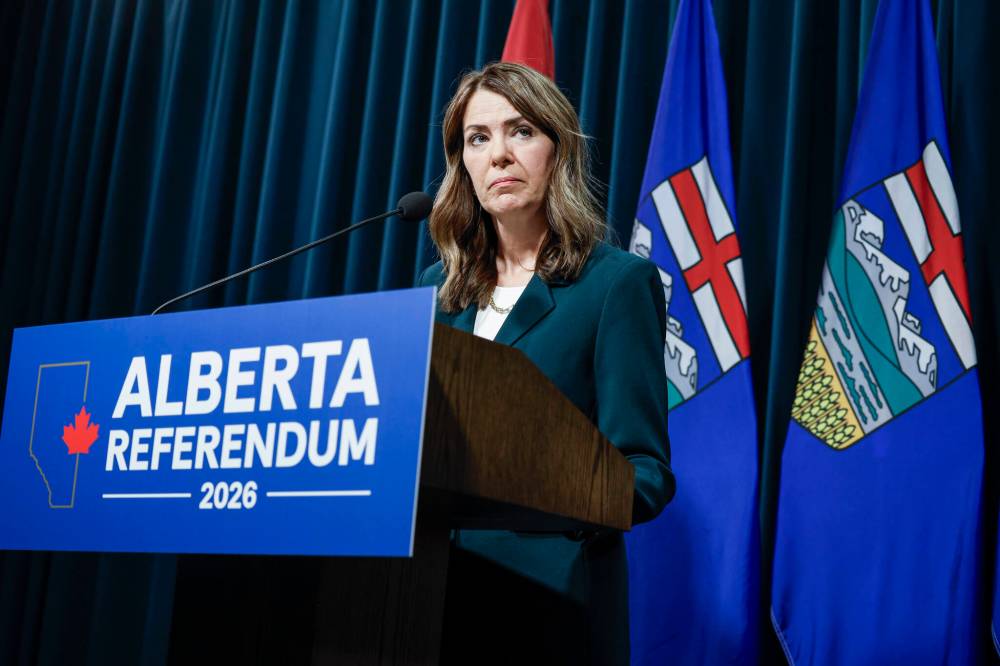
THE CANADIAN PRESS/Jeff McIntosh
Alberta Premier Danielle Smith speaks at a May 22 news conference in Calgary.
A recent court ruling by a justice of the Alberta Court of King’s Bench declared that a pro-separation citizen-initiated petition, which would have forced the province to hold a referendum on Alberta independence, was unconstitutional because the government did not first consult with First Nations.
Alberta Premier Danielle Smith, of the United Conservative Party (UCP), declared that the court decision was “erroneous” and “interferes with democratic rights.”
Her misguided solution is now a referendum on holding another referendum. Several commentators have deemed her decision politically opportunistic and a bone for her more extreme UCP supporters who are in favour of separation — though most of them are unhappy with her lame referendum compromise.
Smith wants it both ways. She says Alberta should remain part of Canada, although she often frames this “by the rather suspicious phrase ‘a sovereign Alberta within a united Canada,’ while simultaneously making it easier than ever for a secession referendum to actually be held,” writes Globe and Mail opinion editor Tyler Dawson.
Albertans’ discontent with Canada dates back more than 140 years, at least two decades before Alberta (and Saskatchewan) became a province in 1905. An excellent survey of the history of this perpetual grievance can be found in Dawson’s book, The Republic of Alberta: An Idea That Won’t Go Away, published a few months ago.
While the possibility of Alberta separation is raised throughout his narrative, it was and continues to be the unrealistic objective of fringe groups.
Dawson’s book, in fact, is mainly about the rise of western Canadian alienation and the frequently emotional response to a political system that seems to treat Albertans and other westerners as second-class Canadians.
That is an exaggeration to be sure, but it is a byproduct of federalism and demographic realities: Alberta’s current population of approximately five million, with 37 seats in the House of Commons (from a total of 343), has a difficult time competing for political attention when compared to Ontario with a population of 16.1 million and 122 seats and Quebec with a population of about nine million and 78 seats.
By its very design, federalism, in which power is divided between a central or federal government and provincial or state governments — as it is in Canada and the U.S. — frequently leads to disagreements and confrontations over jurisdictional control. In the U.S., a bitter dispute over slavery led to a bloody civil war.
In Canada, the British North America Act of 1867 left residual power with the central government based in Ottawa. On many occasions since, the provinces have pushed back on the central government’s attempts to dictate national economic and social policies.
Like other westerners, for example, many Albertans disdained the protective tariffs imposed by Ottawa from the late 1870s to the mid-20th century as a way of propping up eastern Canadian businesses.
In 1905, Alberta and Saskatchewan were established by the federal government essentially as colonies, to serve national interests.
To this end, the federal government maintained control over the natural resources of the two new provinces, as it did for Manitoba, until 1930. This was deeply resented.
In 1911, six years after Alberta became a province, as Dawson notes, an Alberta politician prophetically warned that Ottawa’s domineering treatment of the province might some day lead to secession.
The discovery of oil in Alberta in 1947, an industry supported by the federal government for several decades, ultimately gave the province substantial economic power, but not the political power its politicians ultimately demanded.
Ottawa’s obsession with keeping Quebec happy and squelching that province’s more serious separatist movement was an additional grievance that Albertans scorned.

So, too, was the national energy program initiated by the Liberal government of Pierre Trudeau in 1980 that regulated the price of oil. A majority of Albertans were outraged (and still are) that under the federal equalization payments scheme Alberta, a “have” province, was compelled to subsidize “have-not” provinces.
All of this resentment eventually split the Progressive Conservative Party and resulted in the birth of the right-wing populist, western-Canadian-based Reform Party of Canada, led by Albertan Preston Manning; as well as the organization of a few fringe parties, such as the Western Canada Concept and West-Fed, which again raised Alberta separation as an option worth considering.
More recent federal environmental policies on the oil industry pushed by Pierre Trudeau’s son, Justin, contributed to the rise of Danielle Smith and the UCP and the grassroots separatist movement behind the recent petition.
As innocuous as the threat of Alberta separation probably is, get ready for a steady stream of media stories, commentaries and social media posts in the next five months about the spectre of separation and the supposed calamity it will provoke.
Now & Then is a column in which historian Allan Levine puts the events of today in a historical context. His most recent book is The Dollar-A-Year Men: How the Best Business Brains in Canada Helped to Win the Second World War.