

Manitoba’s flag: A symbol of shared heritage at 60
Advertisement
Read this article for free:
or
Already have an account? Log in here »
To continue reading, please subscribe:
Digital Subscription
One year of digital access for only $1.44 a week*
- Enjoy unlimited reading on winnipegfreepress.com
- Read the E-Edition, our digital replica newspaper
- Access News Break, our award-winning app
- Play interactive puzzles
*Billed as $5.77 plus GST every four weeks. After 52 weeks, price increases to the regular rate of $19.95 plus GST every four weeks. Offer available to new and qualified returning subscribers only. Cancel any time.
To continue reading, please subscribe:
Add Free Press access to your Brandon Sun subscription for only an additional
$1 for the first 4 weeks*
- Enjoy unlimited reading on winnipegfreepress.com
- Read the E-Edition, our digital replica newspaper
- Access News Break, our award-winning app
- Play interactive puzzles
*Your next Brandon Sun subscription payment will increase by $1.00 and you will be charged $17.95 plus GST for four weeks. After four weeks, your payment will increase to $24.95 plus GST every four weeks.
Read unlimited articles for free today:
or
Already have an account? Log in here »
On a fair spring afternoon 60 years ago, the Flag of Manitoba made its debut at the provincial legislature. In what the Winnipeg Free Press called an “impressive ceremony,” then-lieutenant-governor Richard Bowles formally proclaimed the new provincial flag on May 12, 1966.
Premier Duff Roblin presided over the flag raising, joined by opposition politicians and dignitaries, including Archbishop Maurice Baudoux of St. Boniface. The Mennonite Children’s Choir performed the old school song Manitoba, while 2,000 flag-raising events took place simultaneously across the province.
The two men selected to hoist the flag in Winnipeg were deliberately chosen to represent the unity of Manitoba’s Indigenous and British heritage.
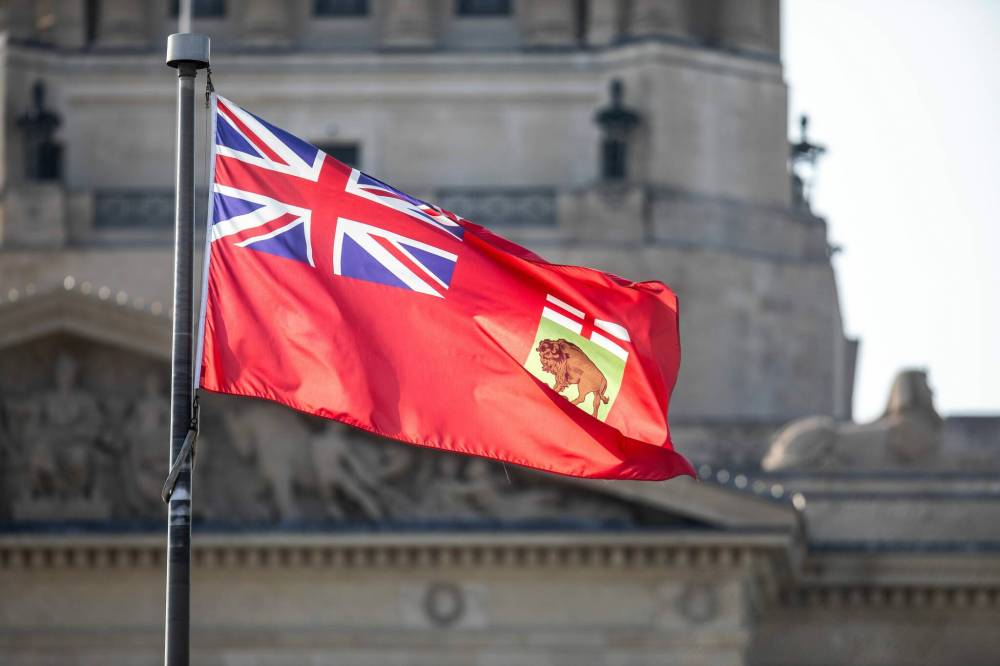
MIKAELA MACKENZIE / FREE PRESS files
The Manitoba flag flies at the legislature in 2024. A Probe Research poll taken that year found 49 per cent of Manitobans would support creating a new flag for the province.
Cornelius Bignell, former councillor and chief of Opaskwayak Cree Nation (then The Pas Indian Band) and later a founder of the Assembly of Manitoba Chiefs, stood for the Indigenous side. Beside him was Edward Button, a descendant of Sir Thomas Button, the English explorer credited with raising the first British flag in the region at the Nelson River in 1612.
At precisely 2:59 p.m., the flag was unfurled before guests, schoolchildren, veterans and curious passersby. A reception followed at Government House.
Notably, the province had issued a special invitation to all Manitobans born in 1870 — the year of Confederation — to attend and receive a bison statuette. None reportedly came forward.
Every schoolchild in Grades 1 to 6 received a small souvenir flag.
Later that month, one reckless Winnipeg teenager was brought to court for stealing a provincial flag from The Bay. He was released by a sympathetic magistrate, who declared it an act of “a loyal man.”
Manitoba’s adoption of a provincial Red Ensign was a result of the preceding Great Canadian Flag Debate.
In 1964, seeking to bolster national unity and amid rising Quebec nationalism, then-prime minister Lester B. Pearson sought the adoption of a national flag free of historical affiliation.
After fierce parliamentary debate, Canada adopted the now iconic red-and-white maple leaf in February 1965.
An opposition proposal to grant the Red Ensign — Canada’s former national flag — official status was rejected by the government. In response, Manitoba and Ontario adopted the Red Ensign as their provincial flags, reflecting strong public attachment to the symbol.
Deeply intertwined with Canada’s formative years, the Ensign retained broad support outside of Quebec, even among many who favoured the new national flag.
Prominent on Manitoba’s flag is the Union Jack. Far from a symbol of colonial imposition, it holds profound significance for the history of the province, including for Métis and many Indigenous peoples.
Manitoba historian David Grebstad, himself of Red River Métis heritage, has highlighted that during the 1869-70 Resistance, Louis Riel hoisted the Union Jack, affirming their loyalty to the Crown and appealing to it as protector of Métis rights as British subjects against Ottawa’s annexation of Rupert’s Land.
The Crown’s intervention enabled fair negotiations and the Manitoba Act, recognizing Métis land rights and cultural distinctiveness. Thus, the Union Jack may symbolize Métis agency, nation-to-nation ties, protection and justice — not erasure.
Some call for changes to provincial symbols. But removing the Union Jack would sever this vital thread of heritage. It would diminish the flag’s role as a bridge between Manitoba’s Indigenous, Métis and British founding stories — the unity so deliberately honoured on that spring day in 1966.

It would also remove a broader transcultural connection we share with a diverse range of societies that retain the Union Jack on their flags, including New Zealand, Fiji and Hawaii.
Sixty years have passed since the adoption of our now iconic red and white Maple Leaf. Yet a flag is more than mere cloth — it has a soul.
The loss of the Canadian Red Ensign, a long-familiar symbol for much of English Canada, was deeply felt by many. However, the adoption of provincial Red Ensigns by Manitoba and Ontario was seen by some as a compromise. The acceptance of the new Flag of Canada, after the contentious national debate, was smoothed by a sensible political compromise that allowed both traditionalists and supporters of change to feel represented.
If our national flag symbolizes our dynamic and ever-changing nation, our provincial flags help to anchor us to our origins. Their public presence is living history relevant to the present moment. As one Ontario newspaper wrote presciently in 1964: “…the Red Ensign represents, as no other flag ever could, Canada’s status as an independent country. Far from being a badge of subservience, it has stood as a token of our distinctive identity on the American continent…”
J.A. Hart has recently published the history of the flag of Ontario.