

Climate change: Keeping a sense of proportion
Advertisement
Read this article for free:
or
Already have an account? Log in here »
To continue reading, please subscribe:
Monthly Digital Subscription
$1 per week for 24 weeks*
- Enjoy unlimited reading on winnipegfreepress.com
- Read the E-Edition, our digital replica newspaper
- Access News Break, our award-winning app
- Play interactive puzzles
*Billed as $4.00 plus GST every four weeks. After 24 weeks, price increases to the regular rate of $19.95 plus GST every four weeks. Offer available to new and qualified returning subscribers only. Cancel any time.
Monthly Digital Subscription
$4.99/week*
- Enjoy unlimited reading on winnipegfreepress.com
- Read the E-Edition, our digital replica newspaper
- Access News Break, our award-winning app
- Play interactive puzzles
*Billed as $19.95 plus GST every four weeks. Cancel any time.
To continue reading, please subscribe:
Add Free Press access to your Brandon Sun subscription for only an additional
$1 for the first 4 weeks*
- Enjoy unlimited reading on winnipegfreepress.com
- Read the E-Edition, our digital replica newspaper
- Access News Break, our award-winning app
- Play interactive puzzles
*Your next Brandon Sun subscription payment will increase by $1.00 and you will be charged $17.95 plus GST for four weeks. After four weeks, your payment will increase to $24.95 plus GST every four weeks.
Read unlimited articles for free today:
or
Already have an account? Log in here »
U.S. President Donald J. Trump is a showman, and he knows how to keep the world’s attention by offering journalists shockingly good copy. He threatens a genocide: “A Whole Civilization Will Die Tonight.” He writes “Fuckin’ Strait” on a presidential post. (Note the tastefully dropped ‘g’ in “Fuckin’” to show that he’s a man of the people.)
But now that I have your attention, I’d like to draw it elsewhere. Specifically, to the fact that the perpetual melodrama of Trump’s wars and other blunders blots out practically everything else on the news horizon. However, he is not the most important and dangerous phenomenon we must deal with today.
Trump’s wars are quite small affairs (2,200 dead Iranians, 100 dead Venezuelans and Cubans, 13 dead Americans), and there has never been any risk of a nuclear war: Iran has no nukes and has never even been near to getting them. The U.S. has thousands of them, of course, but so long as the Iranians let Trump withdraw without losing face, he won’t be tempted to use one.
The Canadian Press
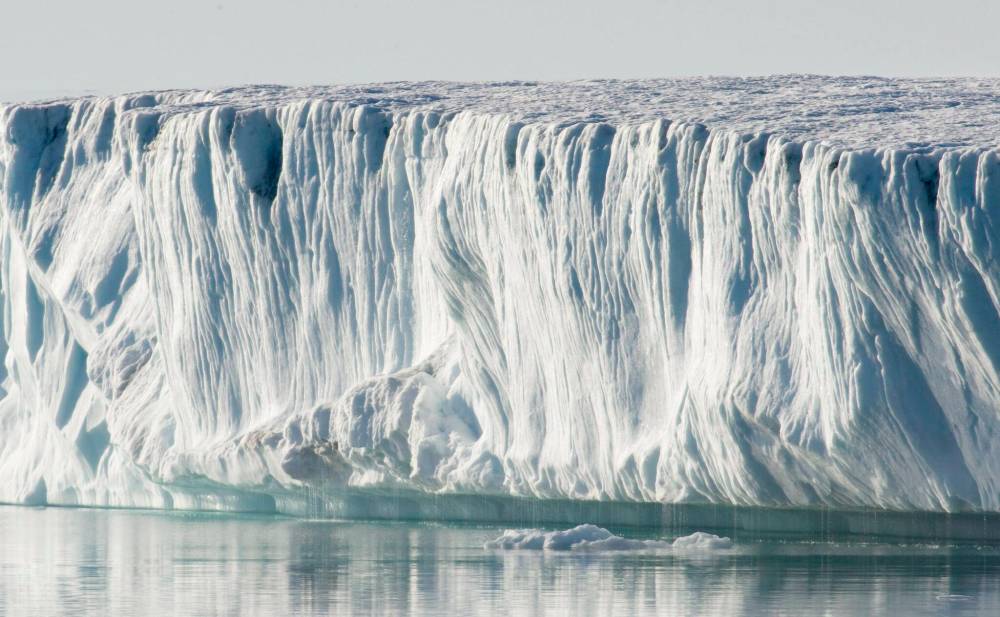
The disappearance of Arctic ice is a climate change trigger point that will accelerate warming.
There are only two other big wars at the moment, in Ukraine (four years old) and in Sudan (three years old). Each has killed about half a million people, but neither shows any signs of spreading more widely. On a planet with almost 200 countries and eight billion people, this scale of violence is not failure.
There is reason for worry, in the sense that two of the three greatest powers, Russia and America, have abandoned the international rule of law and are shamelessly waging aggressive wars, but they have not yet dragged everybody else in. Indeed, the Europeans, the Chinese and most developing countries are trying quite hard to protect and preserve that principle.
There’s probably also a big recession on the way because of the U.S. attack on Iran and Tehran’s consequent closing of the Strait of Hormuz. It would be only the fifth recession since 1980, but it could be the deepest if the Strait stays closed to normal traffic for a few more months.
It seems like a long list of troubles but compared to most other decades of the past two thousand years, it’s average to good. The Mongol Invasions and the Black Death were definitely bad decades, but even the sum of all this doesn’t remotely compare with the threat of climate change. That is completely off the scale — and I hardly see it in the news feeds at all.
This is particularly unfortunate because we are entering a period where some major changes in climate policy will need to happen quite fast — a decade or two — if we are to avoid ending up on full “Hothouse Earth” by the end of the century.
“Hothouse Earth,” according to the Stockholm Resilience Centre, “is a climate scenario where self-reinforcing feedback loops push global temperatures 4-5 degrees C above pre-industrial levels and raise sea levels by 10-60 metres, rendering parts of the planet uninhabitable.” It is the “point of no return,” after which we can’t reverse the changes, and it’s not that far away.
Climate scientists are ultra-cautious in making statements about when they think these things will actually happen for fear of being accused of panic-mongering. However, I have interviewed most of the well-known ones (hint: two books on the subject in 2008 and 2024), and off the record they are even more frightened.
The problem is that the warming is not just “linear.” There is a smooth curve of warming driven mostly by human emissions, but the killers are the sudden upward lurches that are triggered by that same warming. These “feedbacks” or “tipping points” are activated by events like thawing permafrost, Amazon dieback or loss of Arctic sea ice, and there are lots of them.
We already crossed one in 2023 (that’s when the average global temperature jumped to 1.5 C above pre-industrial and never came back down again). There are about a dozen more of these climate tripwires, and if they all blow as predicted they could deliver the world to 3 C as soon as 2050.

That’s 25 years from now, so if you’re under 60 — tag, you’re it. Beyond 3 C the climate is trapped on an up escalator that does not require further human emissions to reach four, five, or six degrees Celsius.
This sort of thing has happened several times in the past half-billion years, usually caused by massive volcanic eruptions lasting many thousands of years. It always involves mass diebacks.
That is the hellbound train we are on at the moment, and we urgently need to get off. Do worry about the Third Gulf War and Ukraine and Lebanon and Gaza too, but keep a sense of proportion.
This is what really matters.
Gwynne Dyer’s new book is Intervention Earth: Life-Saving Ideas from the World’s Climate Engineers. The previous book, The Shortest History of War, is also still available.