

The autism strategy gap is already here
Advertisement
Read this article for free:
or
Already have an account? Log in here »
To continue reading, please subscribe:
Monthly Digital Subscription
$1 per week for 24 weeks*
- Enjoy unlimited reading on winnipegfreepress.com
- Read the E-Edition, our digital replica newspaper
- Access News Break, our award-winning app
- Play interactive puzzles
*Billed as $4.00 plus GST every four weeks. After 24 weeks, price increases to the regular rate of $19.95 plus GST every four weeks. Offer available to new and qualified returning subscribers only. Cancel any time.
Monthly Digital Subscription
$4.99/week*
- Enjoy unlimited reading on winnipegfreepress.com
- Read the E-Edition, our digital replica newspaper
- Access News Break, our award-winning app
- Play interactive puzzles
*Billed as $19.95 plus GST every four weeks. Cancel any time.
To continue reading, please subscribe:
Add Free Press access to your Brandon Sun subscription for only an additional
$1 for the first 4 weeks*
*Your next subscription payment will increase by $1.00 and you will be charged $16.99 plus GST for four weeks. After four weeks, your payment will increase to $23.99 plus GST every four weeks.
Read unlimited articles for free today:
or
Already have an account? Log in here »
In Winnipeg classrooms, the autism strategy gap is not theoretical. It is visible every day.
On March 17, I witnessed the second reading of Bill 232, the Autism Strategy Act, in Manitoba’s Legislature — and was deeply disappointed by the lack of meaningful support from the government. Legislative action should signal progress. Instead, what it revealed was a disconnect between policy debate and the realities already unfolding in our schools.
We speak of an autism strategy as if it belongs to the future — while students and educators are already paying the price in the present.
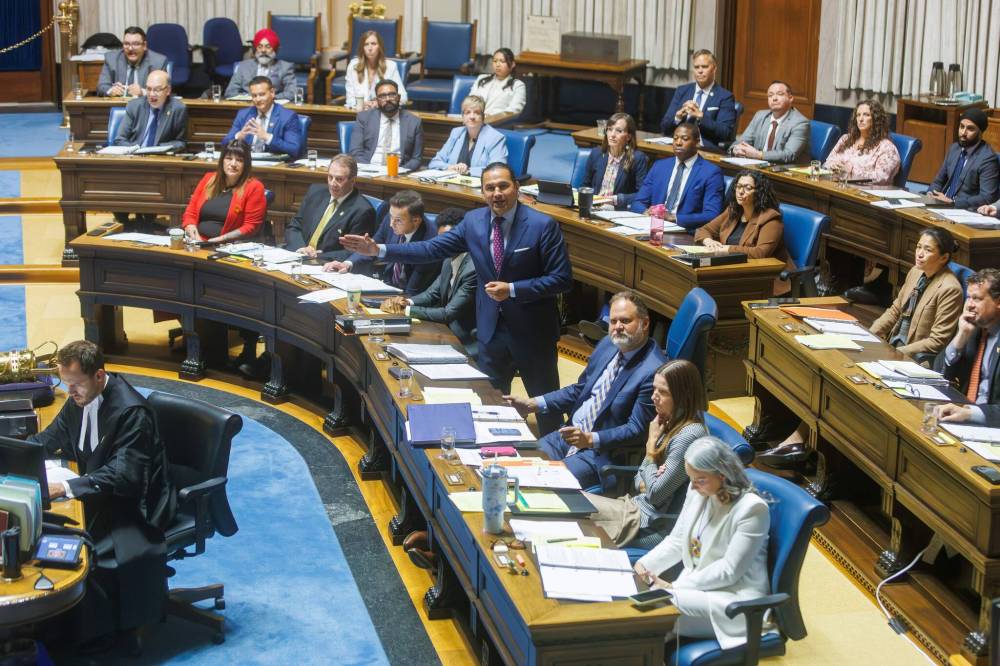
MIKE DEAL / FREE PRESS
Bill 232, The Autism Strategy Act, will go to a committee in the legislature, but when will meaningful autism supports arrive in Manitoba schools?
Autism diagnoses in Manitoba have nearly tripled over the past decade, with approximately one in 60 children now identified on the spectrum. That rapid growth is not abstract — it is showing up in our schools, where educators are being asked to respond to increasingly complex needs within a system that has not kept pace.
As a school trustee and active member and past chair of the Inclusive Advisory Committee of the Winnipeg School Division, I see these challenges firsthand. I have also worked closely with families of children with autism at St. Amant, and I know the pressures caregivers face navigating a fragmented system. Teachers are adapting lessons in real time, supporting students without formal diagnoses, and stretching limited resources to ensure no child is left behind. Students enter kindergarten still waiting for assessment. Families have done everything right — seeking referrals, following up, advocating — but months, sometimes longer, pass before a diagnosis is confirmed.
At a time when diagnostic demand has more than tripled since 2011, these delays are not incidental — they are systemic.
In that gap, schools step in. Teachers and support staff respond with professionalism and care, but without the clinical clarity that informs targeted intervention. This is where education quietly absorbs delays from the health system.
Once students are in school, a second challenge emerges: support is not consistently aligned to individual need. Manitoba’s funding model allocates resources at the divisional level, giving flexibility to school divisions but also requiring difficult internal decisions. Trustees and administrators must distribute finite resources across a wide range of needs, often without the ability to guarantee consistent levels of support for every student who requires it.
The result is unevenness. Two students with similar needs can experience very different levels of support depending on how resources are allocated within a division. These are not failures of schools — they are structural realities of a system that prioritizes flexibility over predictability.
Today, nearly 9,400 children and youth in Manitoba have been diagnosed with autism — each requiring varying levels of educational support. Educators continue to innovate within these constraints, but innovation cannot replace capacity.
Geography compounds the issue. While Winnipeg families face wait times and service navigation challenges, those in rural and northern Manitoba encounter even greater barriers, including limited access to specialists and the need to travel for assessment and therapy. These disparities do not disappear at the school door — they shape what schools can realistically provide. A provincial strategy that does not address geographic inequity will simply reproduce it in classrooms.
Then there is the transition beyond school. For many students, the K-12 system represents the most stable and coordinated period of support they will experience. As graduation approaches, families begin asking what comes next — and too often, the answer is unclear. Approximately 1.5 per cent of Manitoba’s adult population is also on the autism spectrum, yet coordinated supports beyond school remain limited. Schools cannot solve this alone, yet they are often the last consistent point of support.

This is the core political issue: fragmentation. Responsibility for autism supports is distributed across health, education, and family services, but no single system is accountable for the full trajectory of a child’s development. When responsibility is shared, accountability becomes diluted.
Bill 232 represents an opportunity — but only if it is matched with political will, funding, and accountability. Without that, it risks becoming another symbolic step that leaves frontline systems to absorb the consequences.
From my perspective as a school trustee and advocate for caregivers and students with diverse needs, the path forward is clear. Manitoba must enact the Bill 232, The Autism Strategy Act, and: guarantee timely, publicly accessible diagnosis, so students arrive at school with the information needed to support them effectively; align funding with individual student needs, ensuring that support is consistent and equitable across all classrooms and regions; and, integrate services across departments, creating a coordinated system so schools are not left compensating for gaps in health or social services.
In Winnipeg classrooms, educators are already doing their part. They are adapting, supporting, and advocating every day. The data is no longer emerging — it is established. The question is whether provincial policy will finally align with the reality they face — or continue to rely on schools to carry a system that was never designed to stand on their shoulders alone.
Ann Evangelista is a school trustee, and an active member of, and past chair of, the Inclusive Advisory Committee of the Winnipeg School Division.