

Walking the diplomatic tightrope
Advertisement
Read this article for free:
or
Already have an account? Log in here »
To continue reading, please subscribe:
Monthly Digital Subscription
$1 per week for 24 weeks*
- Enjoy unlimited reading on winnipegfreepress.com
- Read the E-Edition, our digital replica newspaper
- Access News Break, our award-winning app
- Play interactive puzzles
*Billed as $4.00 plus GST every four weeks. After 24 weeks, price increases to the regular rate of $19.95 plus GST every four weeks. Offer available to new and qualified returning subscribers only. Cancel any time.
Monthly Digital Subscription
$4.99/week*
- Enjoy unlimited reading on winnipegfreepress.com
- Read the E-Edition, our digital replica newspaper
- Access News Break, our award-winning app
- Play interactive puzzles
*Billed as $19.95 plus GST every four weeks. Cancel any time.
To continue reading, please subscribe:
Add Free Press access to your Brandon Sun subscription for only an additional
$1 for the first 4 weeks*
*Your next subscription payment will increase by $1.00 and you will be charged $16.99 plus GST for four weeks. After four weeks, your payment will increase to $23.99 plus GST every four weeks.
Read unlimited articles for free today:
or
Already have an account? Log in here »
Realpolitik is a two-way street. Foreign and domestic. Prime Minister Mark Carney, the Davos-speech advocate of foreign policy realpolitik, is receiving blowback in domestic politics realpolitik following his early public support for U.S. and Israel’s war on Iran.
He’s gotten the message. Which is why he is adjusting his message. Clear-eyed realism on day one of the conflict — “Canada supports the United States acting to prevent Iran from obtaining a nuclear weapon and to prevent its regime from further threatening international peace and security” — has given way to a dewy-eyed fatalism of “we take this position with regret, because the current conflict is another example of the failure of the international order.”
Mr. Carney isn’t the only world leader on the receiving end of either Trump’s disdain or voters’ disdain for Trump. The president said U.K. prime minister Keir Starmer was “no Winston Churchill” after his government prevaricated on allowing U.S. warplanes to fly from bases in Britain. Despite being an allied member of NATO, Spain was labelled “terrible” by Trump for barring American forces from using its bases in the country for operations against Iran. “We’re going to cut off all trade” with Spain, Trump thundered in response.
THE CANADIAN PRESS / Adrian Wyld
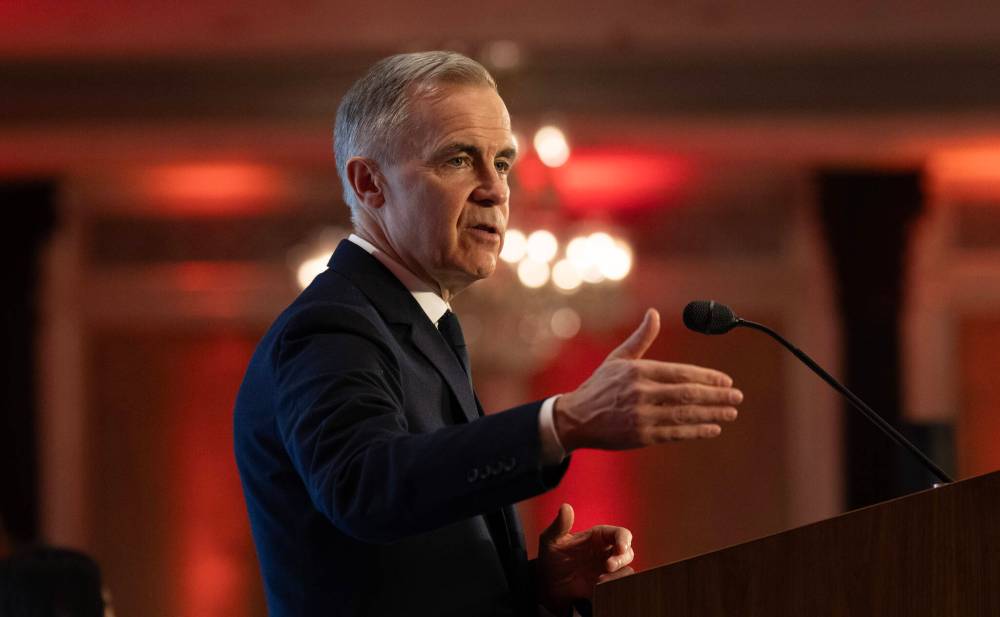
Prime Minister Mark Carney has to find the sweet spot between pragmatism and principles while dealing with an erratic U.S. president.
The prime minister has yet to receive any public dressing-down from the American president for his shift in tone and message on Iran. He remains “Prime Minister Carney” not “Governor Carney” for now.
With Trump, one never knows. And that lies at the root of the PM’s dilemma on finding a political sweet spot in calibrating his Iran message. His initial message remains valid as a robust reminder of Canada’s position on the Iranian regime. We stand four-square against Iran developing a nuclear capability. We have had no diplomatic relations with the regime for almost 15 years. Fifty-five Canadian citizens and 30 permanent residents of Canada were killed by Iran’s Revolutionary Guards when they murderously shot down Ukrainian Airlines Flight 752 in 2020. And we strongly condemned the regime’s brutal killing of demonstrators in January.
The prime minister channelled that shared Canadian disgust and opprobrium towards the Iranian regime that first day. Very few of us want to preserve that malevolent theocracy. We would welcome regime change. Trouble is, Trump’s own war aims remain elusive. It gets hard to pin your diplomatic tail of support on this ambassadorial ass, so to speak, as Mr. Carney is finding out.
But ends and means are very different things. And Trump’s sudden war, without international sanction or allies beyond Israel, is not the means most Canadians are comfortable with. No matter that neither Canada nor any other NATO ally had any say in Trump’s decision to strike Iran. No matter that we were not asked to join in militarily, unlike the Iraq invasion by U.S. President George W. Bush in 2003. The 2026 version of the “coalition of the willing” is small indeed. As an historic champion of international law and global rules of order, Canadians are decidedly uncomfortable with arbitrary aggressive actions by any state, whether it is Russia against Ukraine or America against Iran.
But foreign policy realpolitik makes for a difficult calculus. Trump will strike anyway if he wants to. There is little any leader can really do to rein him in. He is impulsive and capricious in his statecraft. He makes his own rules of international disorder. So, short of freezing relations with the U.S., what’s an “intermediate power” (as Carney calls Canada) that shares a history, border, and economy with Trump’s America, to do?
Our opposition will make zero difference to what America does. Our support for the ends, if not the means, of emasculating Iran’s nuclear wet dream once and for all, given its long history of exporting terror in the Middle East and elsewhere, should not be lightly discarded because of our animus towards Trump. The end of this Iranian regime and its relentless threats to international peace and security are worth achieving. Military pressure remains an essential tool to both preserve and affect greater international security, as we experienced during the Cold War.

In Davos, Mr. Carney said this: “We aim to be both principled and pragmatic — principled in our commitment to fundamental values, sovereignty, territorial integrity, the prohibition of the use of force, except when consistent with the UN Charter.” Trump’s illegal war crosses this line. But Carney also said this: “We actively take on the world as it is, not wait around for a world we wish to be.” Realpolitik is causing the prime minister to navigate between his own two poles with a domestic audience now perennially suspicious and even opposed to all-things-Trump.
Principled Carney opposes what Trump is doing. Pragmatic Carney accepts “with regret.” It is a necessary diplomatic tightrope the Opposition will surely ridicule, and Canadians may not wish to walk.
Four revolutions have defined our modern world. America’s in 1776, France’s in 1789, Russia’s in 1917 and Iran’s in 1979. We live with and within their detritus.
Now, with Donald Trump fomenting another possible Iranian revolution, Mr. Carney has his work cut out for him to ensure Operation Epic Fury doesn’t spark an epic fury against him.
David McLaughlin is a former clerk of the executive council and cabinet secretary in the Manitoba government.