

Time has come to fully address damage by Manitoba Hydro
Advertisement
Read this article for free:
or
Already have an account? Log in here »
To continue reading, please subscribe:
Monthly Digital Subscription
$1 per week for 24 weeks*
- Enjoy unlimited reading on winnipegfreepress.com
- Read the E-Edition, our digital replica newspaper
- Access News Break, our award-winning app
- Play interactive puzzles
*Billed as $4.00 plus GST every four weeks. After 24 weeks, price increases to the regular rate of $19.95 plus GST every four weeks. Offer available to new and qualified returning subscribers only. Cancel any time.
Monthly Digital Subscription
$4.99/week*
- Enjoy unlimited reading on winnipegfreepress.com
- Read the E-Edition, our digital replica newspaper
- Access News Break, our award-winning app
- Play interactive puzzles
*Billed as $19.95 plus GST every four weeks. Cancel any time.
To continue reading, please subscribe:
Add Free Press access to your Brandon Sun subscription for only an additional
$1 for the first 4 weeks*
*Your next subscription payment will increase by $1.00 and you will be charged $16.99 plus GST for four weeks. After four weeks, your payment will increase to $23.99 plus GST every four weeks.
Read unlimited articles for free today:
or
Already have an account? Log in here »
The world and our country are at a crossroads, it seems. Relationships among governments are changing day-to-day. What cannot be lost in all the noise of the world, is the evolving relationship between this country’s governments, Canadians, and the First Peoples.
Premier Wab Kinew has made it known that Churchill, which sits in Treaty 5, is slated for significant change in this new world order. As chief for Tataskweyak Cree Nation, I have watched as our lands, waters, and peoples have suffered since colonization. Where once our elders shared stories of living in harmony with the gifts of the Creator, we now hear stories of lost ways.
When our ancestors entered into Treaty 5, we were promised we would be able to continue to our way of life. This includes fishing for sturgeon on the lower Churchill River as we have always done. We looked to the Crown to honour and uphold this Treaty promise, which is now enshrined in the Canadian Constitution.
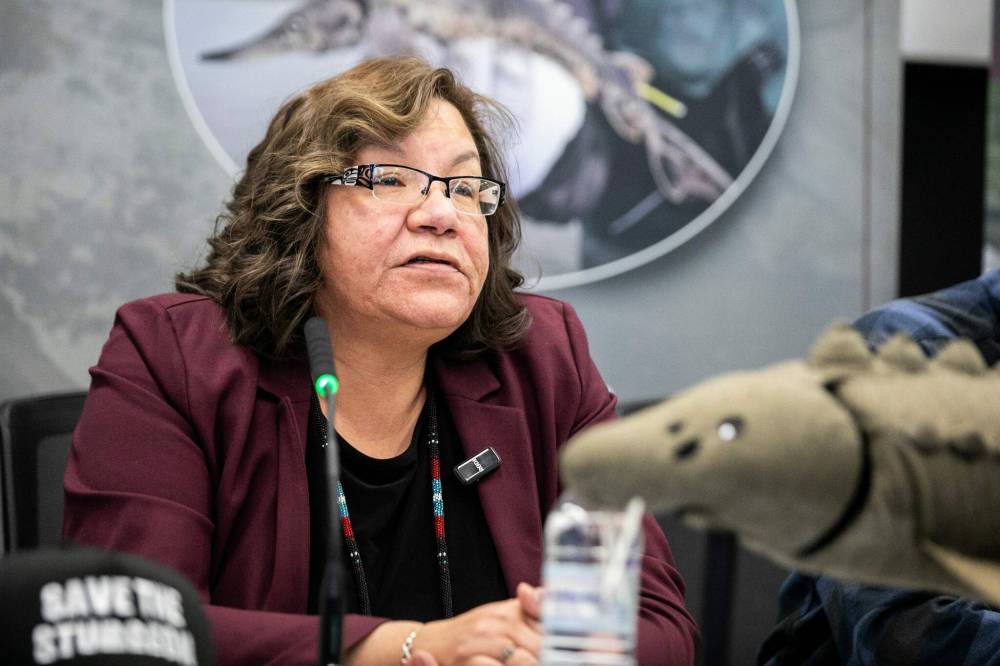
MIKAELA MACKENZIE / FREE PRESS
Tataskweyak Cree Nation Chief Doreen Spence speaks at a news conference about Manitoba Hydro’s negative impact on sturgeon in the Churchill River on Jan. 22.
Instead, we, the citizens of Tataskweyak Cree Nation, have watched our Treaty rights be violated repeatedly. No more. We are standing firm and insisting our Treaty rights be respected, our role as stewards to the land, water, and all living beings be respected, and that our voices be heard at the decision-making tables.
In 1976, the Missi Falls control structure went into operation as part of the Churchill River Diversion. Concerns for the health of the river water, its ecosystem, and namao (lake sturgeon) were raised at the time; regardless, the project ploughed forward. Now, 50 years later, we are witnessing the impact of ignoring those early warnings, as lake sturgeon have all but disappeared on the lower Churchill River.
Manitoba Hydro will tell you it is restocking some northern rivers in an effort to manage lake sturgeon populations. What officials at the corporation don’t tell you is the fact lake sturgeon don’t reproduce until they are around 25 years old. If the rivers cannot sustain the introduced fingerlings for at least 20 years, then all is for naught. Stable populations are not being created,
Hydro is simply restocking again, and again, and again.
While restocking is not currently happening on the Churchill, if this were to be considered, the move would not be successful until Hydro alters its operations to re-establish the river’s and sturgeon’s natural ecosystem.
Hydro will also tell you they are operating within their licence. What they don’t tell you is that the Churchill River Diversion has never had an environmental assessment despite its disastrous impacts. We now know definitively that the conditions of that licence are detrimental to the lower Churchill River and all who rely on her for life. The Churchill River Diversion licence is up for renewal this fall providing an opportunity for Manitoba to reexamine its conditions and bring them in line with what First Nations always knew and knowledge that is now supported by new western science.
Tataskweyak hired independent scientists, biologists, and hydrologists to study the river and the impact Missi Falls might have on it. What we found, what we as First Nations and stewards of the land have always known, is that the Churchill River Diversion is causing irreparable damage to the entire ecosystem of the lower Churchill River. There is just one population of namao remaining and it lives where the lower Churchill and Little Churchill meet to flow north to the Hudson Bay. Manitoba Hydro knows this population exists. It claims the population is stable but refuses to admit that this last population is incredibly vulnerable to drought, habitat disruption, and any harvesting. What Hydro won’t say aloud is that the river once teemed with sturgeon.
Since time immemorial, First Nation citizens harvested sturgeon for food and more. But no more, as Tataskweyak has been living under a self-imposed moratorium on harvesting namao to ensure they don’t disappear.
We are doing our part and now insist Hydro do its part. The results of our six-year study show by altering operation of the Churchill River Diversion, Hydro can play a positive role in recovering the ecosystem of the lower Churchill. The research shows if Hydro chooses to alter its operations of Missi Falls to mimic the natural rhythm of the river and stop the practice of creating dramatically low flows and sudden historically high rushes of water, the land can start to heal. All the while still providing power to the province and beyond.
The Department of Fisheries and Oceans must also do its part concerning operation of the Churchill River Diversion. The federal government has a duty to protect fish and fish habitat under the Fisheries Act. It also has obligations to uphold the Crown’s Treaty promise and ensure we are able to continue to fish for sturgeon. In 1974, the department commissioned its own study which warned the lower water levels and reduced area of the rivers and lakes entailed the “risk of probable violations of the Federal Fisheries Act.” Yet in 50 years the department has never officially weighed in on Hydro operations in Manitoba. It is time for the Department of Fisheries to step up and do its job and protect the namao of the lower Churchill River.
The lake sturgeon population on the lower Churchill River is the proverbial canary in the coal mine. Its near demise in half a century of Hydro operations proves mistakes or miscalculations were made. Hydro has had 50 years to understand the devastating impact of the Churchill River Diversion.
Hydro must change how it operates, not only out of respect for First Nations’ knowledge and the new scientific research, but also out of a responsibility to uphold the clean green power it publicly claims to champion. Be part of reconciliation, demonstrate that your corporate position of caring for the environment is real. The sturgeon have almost been lost, what is next? If operations aren’t altered under the new licence, which animals will be gone in the next 50 years never to return because the First Nations’ knowledge and the new science are ignored?

That’s the past 50 years, and as I said at the start, we are now looking at major changes to northern Manitoba as the province and federal governments imagine new growth in our Treaty lands. We are saying to Hydro, let’s do this together in the spirit of reconciliation, in a way that protects nature, in a way that respects our Treaty rights. We are asking for shared stewardship,
Hydro can continue to operate, but it must do so in a way that respects the river, the fish, and our Treaty relationship.
Time is running out. In discussions for the new Churchill River Diversion operating license, Tataskweyak’s new independent research must be considered in the process , and we must be at the decision-making table in earnest.
Let’s do this right. And let’s not land in court, again.
Doreen Spence is Chief of the Tataskweyak Cree Nation.