

Who calls the shots on city land use?
Advertisement
Read this article for free:
or
Already have an account? Log in here »
To continue reading, please subscribe:
Monthly Digital Subscription
$0 for the first 4 weeks*
- Enjoy unlimited reading on winnipegfreepress.com
- Read the E-Edition, our digital replica newspaper
- Access News Break, our award-winning app
- Play interactive puzzles
*No charge for 4 weeks then price increases to the regular rate of $19.95 plus GST every four weeks. Offer available to new and qualified returning subscribers only. Cancel any time.
Monthly Digital Subscription
$4.99/week*
- Enjoy unlimited reading on winnipegfreepress.com
- Read the E-Edition, our digital replica newspaper
- Access News Break, our award-winning app
- Play interactive puzzles
*Billed as $19.95 plus GST every four weeks. Cancel any time.
To continue reading, please subscribe:
Add Free Press access to your Brandon Sun subscription for only an additional
$1 for the first 4 weeks*
*Your next subscription payment will increase by $1.00 and you will be charged $16.99 plus GST for four weeks. After four weeks, your payment will increase to $23.99 plus GST every four weeks.
Read unlimited articles for free today:
or
Already have an account? Log in here »
Everybody thinks it, but no one wants to say it out loud — the fact that for decades, our city council and its administration have, to a large degree, been in thrall to the construction and development industries.
And on one level, you can understand why. After all, these are the folks who build things — everything from high rises, homes and sewer plants to the endless kilometres of roads that service our over-expanded city.
But while the construction and development sectors do, indeed, build our city, they frequently destroy natural lands and intact forests to do it, often with impunity. Winnipeg does little to limit their activities or penalize them for the ecologically sensitive land they destroy.
MIKAELA MACKENZIE / WINNIPEG FREE PRESS
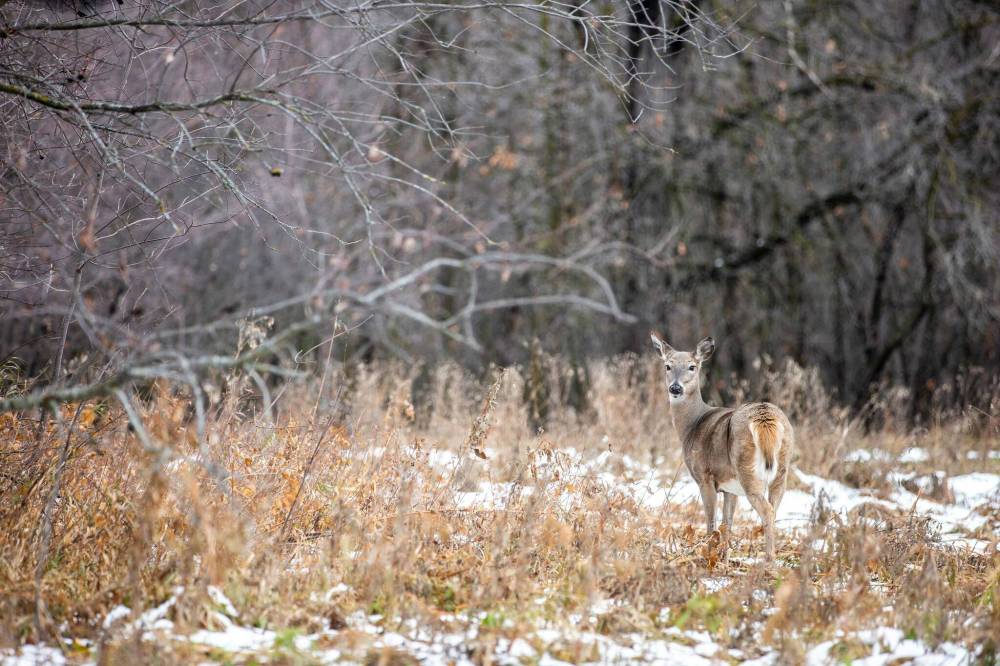
A deer in the Lemay Forest. Erna Buffie takes issue with the city’s willingness to allow tree-cutting on environmentally valuable land.
Nor are they compelled — beyond a 10 per cent land dedication — to fully compensate taxpayers for the mature trees they destroy, the wetlands they pave over or the entire forests they mow down, often for no better reason than that it’s expedient and keeps profit margins high.
Indeed, our city representatives seem so concerned about the needs of builders and developers that they’re poised to delete an amendment requiring bird friendly windows on new builds because developers opposed it.
Worse still, council is stalling on the development of a private tree bylaw that would protect as many mature trees as possible on private land.
Instead, the city makes it easier for developers to clear-cut their forests by issuing tree cutting permits. That’s what happened in the case of the Lemay Forest. Tree removal by the developer there was only halted by the efforts of protestors and the province’s decision to expropriate the land.
In fact, while the city counts the number of trees lost to disease and attrition, it doesn’t count the ones destroyed to make way for construction. So we don’t even know how many trees we’re losing or how those losses jeopardize the goal to expand our protective tree canopy cover from 17 per cent to 24 per cent.
Ditto for the 100s of hectares of heat-busting, water-guzzling natural lands that have been paved over in recent decades. No one’s keeping track of those losses either.
Even more telling, while the city’s property and development department is responsible for establishing the city’s land use plans, developers can pay a fee to submit their own plans or amendments for areas where they own land, which can then be approved by council.
And if that doesn’t sound like a conflict of interest to you, it certainly does to me.
So why are developers given that much power and influence, when the people affected by their actions can only voice their concerns during “public engagements” or at committee meetings, where they’re often ignored?
Take the changes made to the St. Vital Perimeter South land use plan to accommodate a subdivision on a floodplain property owned by A&S Homes.
After the developer requested changes, councillors agreed to their amendment, and a subdivision of 23, two- to three-acre housing lots was approved. This, rather than upholding the city’s original land use plan, which specified that lots should be a minimum of five acres, in order to protect the aquifer that provides water to 1,800 Winnipeg residents.
To make matters worse, councillors then waived a land dedication to protect a five-acre oak forest, in favour of cash.
An appeal of those decisions, to which some 120 residents spoke or wrote in opposition, was subsequently rejected.
And even when the city does have policies to protect natural land of ecological and heritage value, like its environmentally sensitive lands policy, it has no regulatory teeth. So it isn’t worth the paper it’s written on, unless the mayor, council and developers choose to honour it.

Which sometimes happens but often doesn’t. Witness the destruction of the 24-acre Parker Lands forest and wetland. When the city traded that land to a developer in exchange for a mere 2.4 acres of serviced land, the forest subsequently destroyed had already been rated as a Grade A heritage ecosystem.
Now, it’s not my intention to characterize the development and construction sectors as the big bad wolf here. They just have well-paid lobbyists and do what they’re allowed to do by city hall. And while some act in good faith, others don’t.
So, here’s the thing — is it sufficient to rely on the goodwill of developers to protect natural lands, when their primary goal is maximizing profit? Shouldn’t we have bylaws and incentives in place to ensure they all do their best to protect as many of our trees and natural assets as possible, or more fully compensate taxpayers for the trees and greenery they destroy?
They’re important questions, and the answers impact us all.
Erna Buffie is a writer and environmental activist. Read more@ https://www.ernabuffie.com/