

Razor-thin vote margins in some areas lead to calls for automatic recounts

Advertisement
Read this article for free:
or
Already have an account? Log in here »
To continue reading, please subscribe:
Digital Subscription
One year of digital access for only $1.44 a week*
- Enjoy unlimited reading on winnipegfreepress.com
- Read the E-Edition, our digital replica newspaper
- Access News Break, our award-winning app
- Play interactive puzzles
*Billed as $5.77 plus GST every four weeks. After 52 weeks, price increases to the regular rate of $19.95 plus GST every four weeks. Offer available to new and qualified returning subscribers only. Cancel any time.
To continue reading, please subscribe:
Add Free Press access to your Brandon Sun subscription for only an additional
$1 for the first 4 weeks*
- Enjoy unlimited reading on winnipegfreepress.com
- Read the E-Edition, our digital replica newspaper
- Access News Break, our award-winning app
- Play interactive puzzles
*Your next Brandon Sun subscription payment will increase by $1.00 and you will be charged $17.95 plus GST for four weeks. After four weeks, your payment will increase to $24.95 plus GST every four weeks.
Read unlimited articles for free today:
or
Already have an account? Log in here »
Six new leaders of Manitoba municipal councils beat their closest competitors by less than 10 votes in recent elections, including one race decided by a single ballot.
Mayors and reeves were elected Oct. 28 with the following narrow margins in the rural municipalities/communities of La Broquerie (nine votes), Melita (five votes), Minitonas-Bowsman (five votes), Minto-Odanah (five votes), Mountain (seven votes) and Yellowhead (one vote).
The race in the Rural Municipality of Yellowhead saw incumbent mayoral candidate Merv Starzyk win with 376 votes to Jim Garlick’s 375.
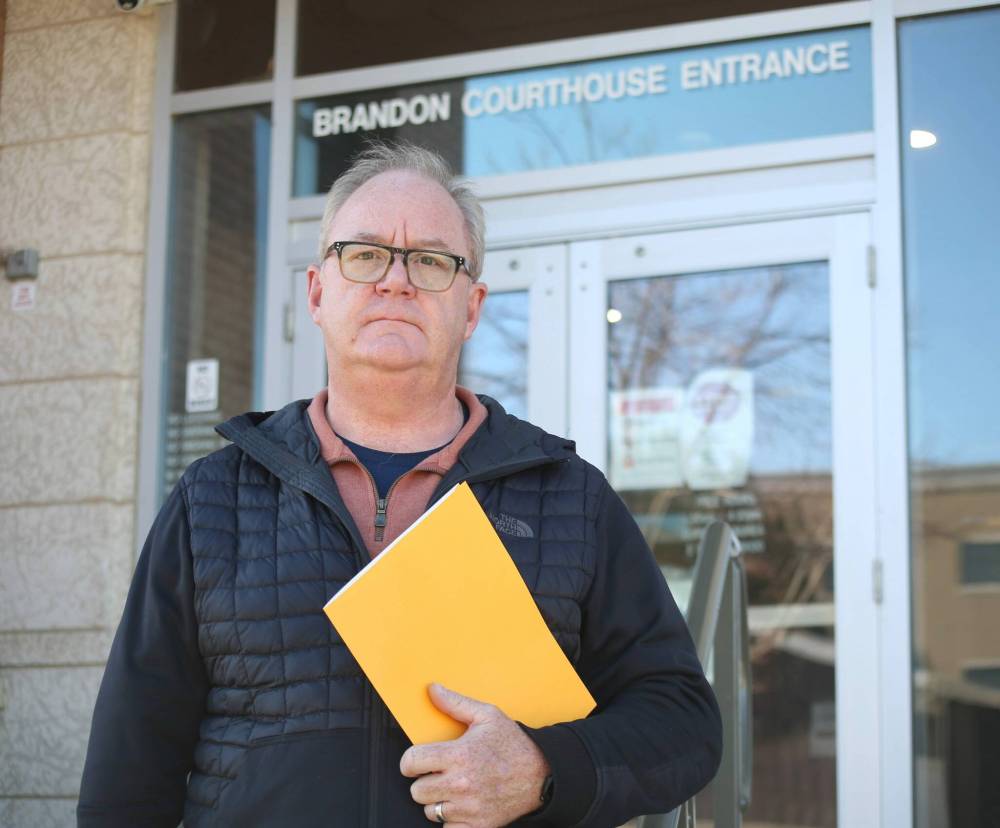
Jim Garlick stands outside the Brandon Courthouse on Wednesday afternoon. (Connor McDowell/The Brandon Sun)
Garlick has applied for a judicial recount in that race, which he said included 13 spoiled ballots.
“Being with one vote difference, that’s pretty close. Even if it becomes a tie, there’s another election,” he said.
Such a close race in the community about 80 kilometres northwest of Brandon leaves room for doubt, said Garlick, noting multiple supporters asked him to seek a second count.
An application for a judicial recount has also been filed for the vote in the Rural Municipality of La Broquerie.
Provincial legislation requires a judge to conduct a recount within two weeks, or “as soon as practicable,” after an application is received.
Garlick said the province should consider requiring a recount every time there are 10 or fewer votes between leading candidates.
“I know this (Yellowhead vote), for sure, raised a lot of questions,” he said.
Kirsty Jones, a senior election official for Yellowhead, said she can’t recall a previous vote this close, calling this one “a bit of a shock.”
She welcomed the recount.
“There’s definitely been some unrest about it. It would be nice to put it to bed,” said Jones.
She stressed she has no reason to doubt the initial count but also suggested the province could consider allowing a minimum number of votes between leading candidates to trigger a recount in the future.
“I certainly hope the province looks at the legislation after this,” said Jones.
Provincial legislation sets rules for municipal and school board elections that do not require an automatic recount when the difference in votes among top candidates falls below a minimum threshold. A senior election official is required to apply for a judicial recount if there’s a tied vote and the official received a related objection.
Manitoba Municipal Relations Minister Glen Simard said mechanisms are in place for those who want a recount to seek one, while several checks and balances ensure results are accurate.
“We have strong electoral officers and they conduct the elections in a real fair manner,” said Simard.
In an email, a provincial spokesperson said several safeguards help ensure vote counts are accurate. Those include requiring at least two election officials to perform the count and letting candidates and scrutineers observe the count and object to decisions to accept or reject ballots.
A candidate or other voter can also apply for a judicial recount on grounds that there were errors in decisions to accept or reject ballots.
“The act balances this protection with respect for the time and resources of the courts by limiting recounts to circumstances where a voter or candidate believes there is an issue,” the statement said.
Simard said the province could consider automatic recounts in very close races, if there was high demand to do so.
“If this is something municipalities are clamouring for us to take a look at revising, we’ll take a serious look at it,” he said.
The election rules for provincial MLAs are different; a returning officer must “immediately apply” to the court for a judicial recount when the plurality is less than 50 votes, Elections Manitoba confirmed.
Simard noted those races are based on much larger vote counts and there is a “significant cost” to count votes a second time.
A blanket rule to trigger recounts among all Manitoba municipal elections could be quite complicated, some political experts say.
“The size of the electorate for each of the villages and towns varies so much that it’s hard to set (a threshold number)… for an automatic recount,” said Christopher Adams, an adjunct professor of political science at the University of Manitoba.
However, in rare cases where 10 votes or fewer divide two leading candidates, another count seems logical, he said.
“When it’s almost too close to call, a recount just seems like common sense,” said Adams.
University of Winnipeg political science professor Aaron Moore said thresholds for automatic recounts are often set for senior levels of government where political parties are involved.
At the Manitoba municipal level, that partisan influence is not present and the decision on when to recount votes is complicated by the fact even 50 or 100 ballots can account for a significant share of voters in the smallest communities, he said.
“You might end up with a lot of unnecessary recounts in smaller municipalities…. There’s money and time involved with these things,” said Moore. “I don’t think there needs to be a change.”
The Association of Manitoba Municipalities shared information on election results but declined an interview request.
In an email, AMM noted only four per cent of 135 municipalities that held elections this year saw races decided by 10 voters or fewer, while the number of overall candidates increased.

“Municipalities are the order of government closest to the people and these results are a strong reflection of local democracy in action,” wrote Denys Volkov, executive director of AMM.
The province said exact ties in municipal votes are infrequent, though one took place in the City of Thompson in 2018.
In that case, two people tied in a city councillor race and candidates objected to a ballot that was rejected. The matter went to a judicial recount, where a judge upheld the ballot rejection and the tie, leading the city to run a byelection to fill the seat.
joyanne.pursaga@winnipegfreepress.com
X: @joyanne_pursaga
Born and raised in Winnipeg, Joyanne loves to tell the stories of this city, especially when politics is involved. Joyanne became the city hall reporter for the Winnipeg Free Press in early 2020.
Our newsroom depends on a growing audience of readers to power our journalism. If you are not a paid reader, please consider becoming a subscriber.
Our newsroom depends on its audience of readers to power our journalism. Thank you for your support.
Advertisement Advertise With Us
Advertisement Advertise With Us