

Canada vs. the U.S.: A tale of two gun debates

Advertisement
Read this article for free:
or
Already have an account? Log in here »
To continue reading, please subscribe:
Digital Subscription
One year of digital access for only $1.44 a week*
- Enjoy unlimited reading on winnipegfreepress.com
- Read the E-Edition, our digital replica newspaper
- Access News Break, our award-winning app
- Play interactive puzzles
*Billed as $5.77 plus GST every four weeks. After 52 weeks, price increases to the regular rate of $19.95 plus GST every four weeks. Offer available to new and qualified returning subscribers only. Cancel any time.
To continue reading, please subscribe:
Add Free Press access to your Brandon Sun subscription for only an additional
$1 for the first 4 weeks*
- Enjoy unlimited reading on winnipegfreepress.com
- Read the E-Edition, our digital replica newspaper
- Access News Break, our award-winning app
- Play interactive puzzles
*Your next Brandon Sun subscription payment will increase by $1.00 and you will be charged $17.95 plus GST for four weeks. After four weeks, your payment will increase to $24.95 plus GST every four weeks.
Read unlimited articles for free today:
or
Already have an account? Log in here »
In an odd and somewhat disturbing convergence of events, the highest courts in both Canada and the United States will almost simultaneously consider legal challenges to governments’ ability to restrict the use of military-style assault weapons.
In Canada, a coalition of gun rights advocates, individuals and sympathetic provinces will argue the federal government exceeded its constitutional authority to ban semi-automatic assault weapons in 2020. The ban prohibits the use, sale or importation of 1,500 types of firearms including the AR-15 and Ruger Mini-14.
The ban was initiated in May 2020, one month after a Nova Scotia mass killing that left 22 people dead and three others seriously wounded. To move quickly, the federal government activated the ban by regulation rather than through legislation.
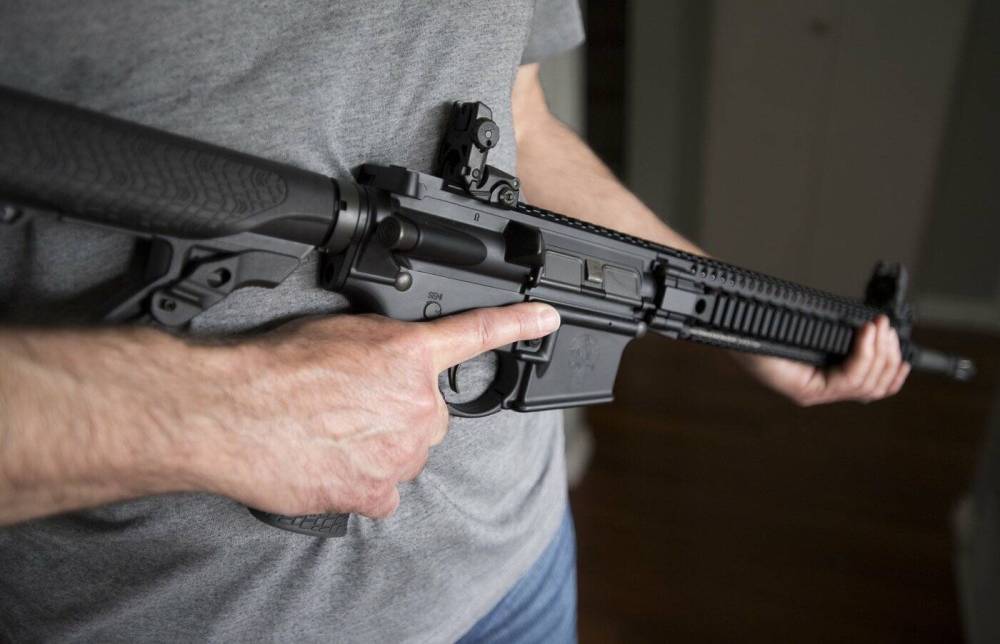
JONATHAN HAYWARD / THE CANADIAN PRESS FILES
Legal challenges involving gun rights are ongoing in Canada and the U.S. Although the legal contexts are different, plaintiffs in the two cases share an aggressively ideological mindset.
In the United States, a different but philosophically aligned coalition of gun rights advocates will appear next month in front of the Supreme Court of the United States (SCOTUS) to challenge state and local government prohibitions on the same class of semi-automatic, military-style weapons. The plaintiffs will argue the bans violate their constitutional rights to own firearms as guaranteed in the U.S. constitution’s infamous second amendment.
It is quite likely the two high-court cases will end with much different results.
SCOTUS is stuffed with far-right literalists who are likely to use the second amendment as a blanket to quash gun bans of any kind. In Canada, there is no constitutional guarantee of gun rights, a point made abundantly clear when the federal court and federal appeals court dismissed the challenge on the basis that public safety outweighed any perceived gun rights.
Although the legal contexts are different, plaintiffs in the two cases share a deeply committed, aggressively ideological mindset.
In the U.S., the Second Amendment has been so powerful that legal debates have typically focused on who can own firearms, whether they can carry them at all times, how much screening and oversight there should be in granting licenses to own firearms, and what types of firearms should be legally permitted.
Notwithstanding the differences between the two cases and countries, it’s fascinating how many of the arguments used by American gun activists have leaked across the border into the narrative offered by their Canadian brothers and sisters in arms. Arguments that have not been persuasive in any court in this country.
The current legal debate in Canada focuses on whether Ottawa was permitted to invoke a ban through order-in-council, in essence a policy proclaimed by the prime minister and federal cabinet. Secondarily, plaintiffs will argue the Criminal Code prevents Ottawa from prohibiting weapons “if they are deemed reasonable for hunting or sporting purposes.”
This argument about the use of a cabinet decree is interesting but should it be a problem, the federal government has a majority and can pass legislation.
The latter argument about hunting and sport shooting does not appear, on its own, to be enough to get the court to strike down the federal ban. Although AR-15s and other military-style weapons are used for hunting and competitive shooting, they are merely one type in a broad spectrum of firearms that are used for these purposes.
The decision by gun activists to cling to competitive shooting as a justification for owning high-velocity, high-capacity military-style weapons is particularly curious given that there are many alternatives that can be used. For the record, both the International Practical Shooting Confederation and the International Shooting Sport Federation (which oversees Olympic competitions) do not allow military-style weapons.
You can really see the influence of the U.S. gun lobby on Canadian advocates when the latter mistakenly slides into the domain of personal and property rights.
The plaintiffs in the Canadian case long ago stopped trying to make a cogent argument about why they should be allowed to own assault rifles; now, they’ve retreated to making an ill-informed argument on why Ottawa should not be allowed to take them.
Tracey Wilson, spokeswoman for the Canadian Coalition for Firearm Rights, told the CBC earlier this year the most important question before the Supreme Court is whether “the government can step into your life, into your home, and confiscate your legally acquired property that you’ve owned for decades, if not generations, without issue.”
In that one comment, the fallacious mindset of the pro-gun lobby is revealed.
Gun owners would like you to believe assault rifles are just like any kind of other property, notwithstanding their potential for lethal and nefarious actions.
Gun owners argue ownership is about culture, when in fact it’s really just a hobby.

Gun owners argue they have a right to own any gun they want, when in fact they are merely afforded the privilege of owning certain kinds of guns.
Gun owners argue they will be prevented from hunting or competing in shooting competitions without assault rifles, when we know that there are less-lethal alternatives.
Strip away all of the fallacious reasoning and libertarian conspiracy theories, and the case before the Supreme Court is about a group of people who want something and refuse to believe anyone can tell them otherwise.
In any other context, we would call that plain childish.
dan.lett@winnipegfreepress.com
Born and raised in and around Toronto, Dan Lett came to Winnipeg in 1986, less than a year out of journalism school with a lifelong dream to be a newspaper reporter.
Our newsroom depends on a growing audience of readers to power our journalism. If you are not a paid reader, please consider becoming a subscriber.
Our newsroom depends on its audience of readers to power our journalism. Thank you for your support.
Advertisement Advertise With Us
Advertisement Advertise With Us