

Desperate Poilievre wants Canadians to believe the sky is falling when it’s just cloudy outside

Advertisement
Read this article for free:
or
Already have an account? Log in here »
To continue reading, please subscribe:

Digital Subscription
One year of digital access for only $205*
- Enjoy unlimited reading on winnipegfreepress.com
- Read the E-Edition, our digital replica newspaper
- Access News Break, our award-winning app
- Play interactive puzzles
*First annual payment billed as $205.00 + GST for one year. This annual subscription will automatically renew at $233.00 + GST every 52 weeks (10% off the regular annual price of $259.35). Offer available to new and qualified returning subscribers only. Cancel any time.
To continue reading, please subscribe:
Add Free Press access to your Brandon Sun subscription for only an additional
$1 for the first 4 weeks*
- Enjoy unlimited reading on winnipegfreepress.com
- Read the E-Edition, our digital replica newspaper
- Access News Break, our award-winning app
- Play interactive puzzles
*Your next Brandon Sun subscription payment will increase by $1.00 and you will be charged $17.95 plus GST for four weeks. After four weeks, your payment will increase to $24.95 plus GST every four weeks.
Read unlimited articles for free today:
or
Already have an account? Log in here »
Pierre Poilievre has a problem.
Canadians just don’t seem to be paying much attention to him anymore.
So, naturally, the Conservative Opposition leader has decided to turn up the volume.
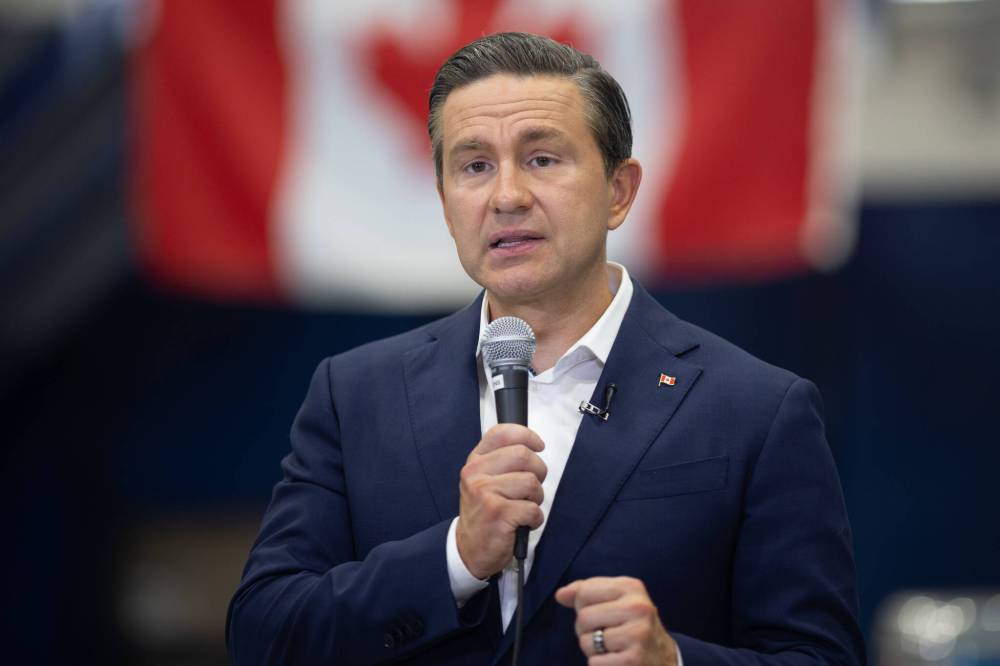
Conservative Leader Pierre Poilievre (The Canadian Press files)
At a recent party caucus retreat in Penticton, B.C., Poilievre delivered the familiar message: Canada is in trouble, Canadians are hurting and the Liberal government is making everything worse.
“People can’t afford their bills, are losing their jobs, the economy is flat, crime is worsening, and our economy is facing unfair tariffs,” he told his MPs.
It’s a bleak picture. There’s just one problem: most of it doesn’t square with the numbers.
That’s becoming a recurring problem for Poilievre — when the facts aren’t sufficiently alarming, he seems perfectly willing to manufacture a little extra alarm.
Let’s start with crime. Poilievre says crime is worsening.
But Statistics Canada’s latest numbers show the national crime severity index fell in 2025 for the second consecutive year, dropping to 75.01 from 81.27 in 2023. The violent crime severity index also fell, to 97.19 from 101.01 in 2023.
That doesn’t mean crime has disappeared. It doesn’t mean Canadians don’t have legitimate concerns about public safety. Of course they do. They always do.
But there’s a difference between saying crime remains a serious concern and declaring that crime is worsening when the national statistics show otherwise.
Then there’s the job market. Poilievre says Canadians are “losing their jobs.” It’s unclear what that even means.
There are always people who are losing their jobs. And there are always people gaining jobs. What statisticians measure is what the net overall employment change is and what the unemployment rate is over time.
Employment did fall by 42,000 jobs in August. But that is hardly the whole story.
Employment increased by a cumulative 181,000 from April through July. Over the past year, employment is up by 217,000, or one per cent.
Saying people are losing their jobs implies that overall employment numbers are falling and that the unemployment rate is rising. But the data tells a different story.
Canada’s unemployment rate fell from 6.9 per cent in April to 6.4 per cent in August. It’s down from 7.1 per cent in August of last year. The employment picture is clearly improving.
No one is denying that Canada faces real economic challenges. There is no shortage of uncertainty, particularly with Donald Trump’s tariffs hanging over businesses and consumers.
But “Canadians are losing their jobs” is not an accurate description of what is happening in the labour market.
And then there is the economy. Poilievre says it’s flat. Flat means there’s no growth in the gross domestic product.
But Statistics Canada says real GDP increased 0.8 per cent in the second quarter of 2026, following a first-quarter increase that was revised upward to 0.1 per cent.
That is not an economic boom. Nobody is suggesting it is. But it isn’t flat, either.
In fact, real GDP per capita increased by one per cent in the second quarter.
This is the problem with Poilievre’s approach. He keeps describing a Canada that is considerably darker than the one reflected in the basic economic and crime statistics.
And perhaps he thinks that is what opposition leaders are supposed to do.
There is certainly nothing wrong with an opposition leader highlighting economic pain, criticizing the government or arguing that Canadians could be doing better. That is the job.
But opposition is supposed to be about holding governments accountable, not holding reality hostage.
Poilievre used to have a very simple political proposition: Canadians were angry, Justin Trudeau was the problem and the Conservatives were going to give them something different.
That message had considerable resonance at the time.
But the political landscape changed. Trudeau is gone, Mark Carney is prime minister and the United States is engaged in a damaging trade confrontation with Canada.
The economy is facing genuine uncertainty and voters are being asked to think about a much different set of problems than the ones Poilievre spent years talking about.
Yet he often sounds as if he is still fighting the last election.
The same slogans, the same outrage and the same certainty that everything is getting worse.
Except Canadians are not necessarily seeing it that way. That helps explain why the Conservatives are struggling to recapture the political momentum they once enjoyed.
Poilievre insists his party has a duty to tell Canadians about their struggles.
Fine. But Canadians don’t need a politician to tell them everything is terrible when the evidence doesn’t support it.
They need someone who can tell them what is actually happening.
There is a legitimate Conservative argument to be made about affordability. There is a legitimate argument to be made about government spending, productivity, housing, taxes, trade and the long-term competitiveness of the economy.

Poilievre could make those arguments. Instead, he seems determined to make Canada sound like it’s falling apart.
There’s nothing wrong with telling Canadians their country has problems. But there is something wrong with telling them things are getting worse when the available evidence says otherwise.
If Poilievre wants Canadians to start listening to him again, he might try giving them something more valuable than another exaggerated crisis.
He could start with the truth.
tom.brodbeck@freepress.mb.ca
Tom has been covering Manitoba politics since the early 1990s and joined the Winnipeg Free Press news team in 2019.
Our newsroom depends on a growing audience of readers to power our journalism. If you are not a paid reader, please consider becoming a subscriber.
Our newsroom depends on its audience of readers to power our journalism. Thank you for your support.
Tom has been covering Manitoba politics since the early 1990s and joined the Winnipeg Free Press news team in 2019.
Our newsroom depends on a growing audience of readers to power our journalism. If you are not a paid reader, please consider becoming a subscriber.
Our newsroom depends on its audience of readers to power our journalism. Thank you for your support.
Advertisement Advertise With Us
Advertisement Advertise With Us