

Nothing wrong with planting trees, but it won’t get province very far on path to net zero

Advertisement
Read this article for free:
or
Already have an account? Log in here »
To continue reading, please subscribe:

Digital Subscription
One year of digital access for only $205*
- Enjoy unlimited reading on winnipegfreepress.com
- Read the E-Edition, our digital replica newspaper
- Access News Break, our award-winning app
- Play interactive puzzles
*First annual payment billed as $205.00 + GST for one year. This annual subscription will automatically renew at $233.00 + GST every 52 weeks (10% off the regular annual price of $259.35). Offer available to new and qualified returning subscribers only. Cancel any time.
To continue reading, please subscribe:
Add Free Press access to your Brandon Sun subscription for only an additional
$1 for the first 4 weeks*
- Enjoy unlimited reading on winnipegfreepress.com
- Read the E-Edition, our digital replica newspaper
- Access News Break, our award-winning app
- Play interactive puzzles
*Your next Brandon Sun subscription payment will increase by $1.00 and you will be charged $17.95 plus GST for four weeks. After four weeks, your payment will increase to $24.95 plus GST every four weeks.
Read unlimited articles for free today:
or
Already have an account? Log in here »
Manitoba’s new plan to achieve net zero carbon emissions by 2050 is a lot of things.
It’s detailed. It’s certainly comprehensive in scope. But when it is all said and done, it is still very much a work in progress.
There are 90 individual actions listed in the Path to Net Zero action plan released last week. Together, the government is pledging to put up to $350 million toward what it calls “current forecast government investments.” In short, it is a term that captures actual approved expenditures and additional spending that is not yet approved but which the government would like to make in the future.
MIKAELA MACKENZIE / FREE PRESS FILES
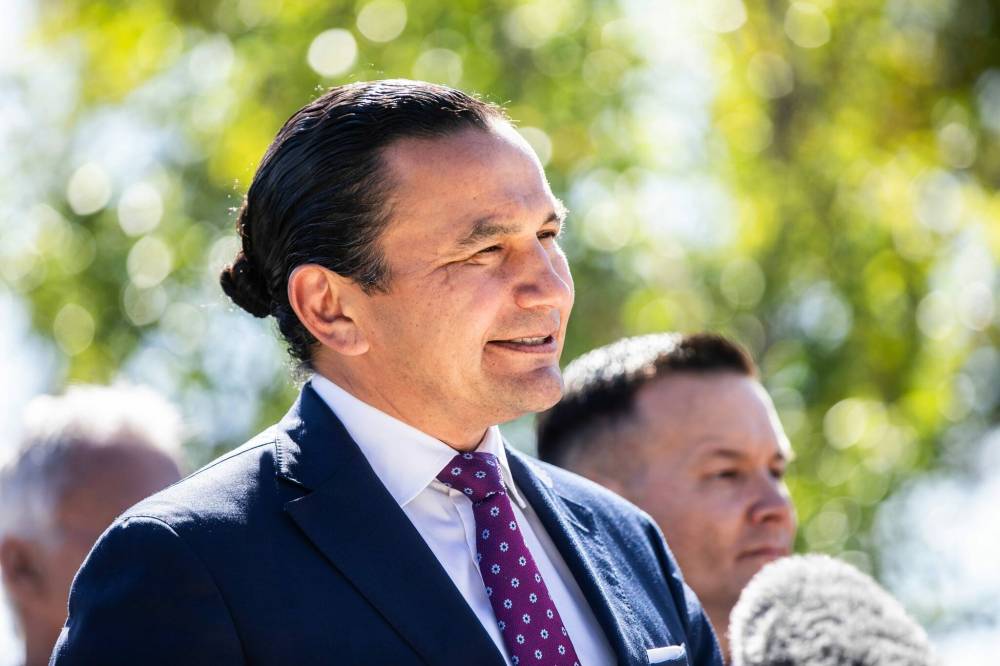
Premier Wab Kinew speaks at last week’s net-zero action plan announcement at Southwood Circle.
Is that all new money? Not really.
In fact, $265 million of those “current forecast government investments” are accounted for by annual spending through Efficiency Manitoba, which offers an array of subsidies to help homeowners, businesses and First Nations communities to improve energy efficiency. Given that, and the fact that timelines and target dates have yet to be produced, the plan is broad, but shallow.
That is not to say there isn’t some meat on the bone of this plan.
Premier Wab Kinew and Environment and Climate Change Minister Mike Moyes announced the province is contributing $4 million to install zero-emission geothermal heating and cooling for an estimated 1,000 homes to built in Southwood Circle, a private residential and mixed-use development near the University of Manitoba.
Beyond planks like that, far too many of the 90 actions in the plan are purely aspirational. Words like “developing,” “collaborating,” “establishing” and “advancing” dominate the document.
In fact, if you just take the document released last week at face value, the NDP government’s net zero action plan narrative reads a lot like the one offered by the former Progressive Conservative government six years ago.
The Tories — who were in power from 2016 to 2023 — made several ultimately unsuccessful attempts to greenwash their policies by putting a broad array of environmental-adjacent policies in a blender and calling it a climate change action plan.
The PC government offered up some interesting ideas on climate change, including a promising but ultimately abandoned carbon levy. However, the “Made in Manitoba Climate and Green Fund” introduced in 2019 by then-premier Brian Pallister also tried to add weight to its plan by lumping in things that didn’t have a direct impact on climate change, including flood mitigation, emergency preparedness, plastic bag bans, cleaning up abandoned mines and wetland preservation.
In short, this strategy — practised by both the Tories and NDP — is a triumph of quantity over quality.
An excellent example of the problem can be seen in the way both governments claim reforestation as a principal tool to lower carbon emissions.
Natural carbon sinks, the term that scientists use to describe how trees and other natural foliage absorb carbon, are good for mitigating carbon emissions. They are not, however, an effective way to reduce them in the long term.
Climate scientists have complained for many years now about the tendency of governments to change the definition of “net zero” to include things that do not really lower overall greenhouse-gas emissions. This extends to the wild and woolly world of carbon emission offsets, which often are tied directly to things such as tree planting.
Andrew Weaver, head of the School of Earth and Ocean Sciences at the University of Victoria, described this policy trend in a 2025 article in Canadian Geographic, in which he noted that “trees alone won’t stop global warming, and nature-based climate solutions are not a licence to keep emitting.”
Most climate scientists agree.
The same week Kinew released his path to net zero, the United Nations Environment Program issued a report that bluntly said the only way to stop the planet from warming further is to end — not reduce — our use of fossil fuels while simultaneously developing technology to capture and store carbon emissions.
Can tree planting play a role? The UN report noted that aggressive, global tree planting could, at most, reduce temperatures by a tenth of a degree. When you have to lower temperatures by 1.5 degrees, you can see how trees aren’t going to get it done.
Tree planting is not the only measure prescribed by the Manitoba’s new net zero action plant, which also includes tangible efforts to increase the use of solar and wind power generation and the aforementioned geothermal development. But it’s inclusion suggests the NDP is playing just as loose and fast with the definition of net zero as its predecessor.

And then there are the omissions.
Astoundingly, there is no commitment to public transit, even though aggressive investment and expansion of bus and rail systems could make a massive dent in Manitoba’s carbon emissions.
Nor is there any acknowledgement of the Kinew government’s plans to build gas-fired generators to backstop our hydroelectric-dominated grid. Climate scientists are clear: we don’t have the luxury of adding gas-powered anything to a world that is dying from rising temperatures.
There’s nothing bad about Manitoba’s new net zero action plan. But in its entirety, and taking into account the lack of specific targets, funding and accounting for all of the things Manitoba is doing to increase its reliance on fossil fuels, it’s just not good enough.
dan.lett@freepress.mb.ca
Born and raised in and around Toronto, Dan Lett came to Winnipeg in 1986, less than a year out of journalism school with a lifelong dream to be a newspaper reporter.
Our newsroom depends on a growing audience of readers to power our journalism. If you are not a paid reader, please consider becoming a subscriber.
Our newsroom depends on its audience of readers to power our journalism. Thank you for your support.
Born and raised in and around Toronto, Dan Lett came to Winnipeg in 1986, less than a year out of journalism school with a lifelong dream to be a newspaper reporter.
Our newsroom depends on a growing audience of readers to power our journalism. If you are not a paid reader, please consider becoming a subscriber.
Our newsroom depends on its audience of readers to power our journalism. Thank you for your support.
Advertisement Advertise With Us
Advertisement Advertise With Us