

Toothless federal regulations leave airline passengers to fight — and lose — their own battles

Advertisement
Read this article for free:
or
Already have an account? Log in here »
To continue reading, please subscribe:

Digital Subscription
One year of digital access for only $205*
- Enjoy unlimited reading on winnipegfreepress.com
- Read the E-Edition, our digital replica newspaper
- Access News Break, our award-winning app
- Play interactive puzzles
*First annual payment billed as $205.00 + GST for one year. This annual subscription will automatically renew at $233.00 + GST every 52 weeks (10% off the regular annual price of $259.35). Offer available to new and qualified returning subscribers only. Cancel any time.
To continue reading, please subscribe:
Add Free Press access to your Brandon Sun subscription for only an additional
$1 for the first 4 weeks*
- Enjoy unlimited reading on winnipegfreepress.com
- Read the E-Edition, our digital replica newspaper
- Access News Break, our award-winning app
- Play interactive puzzles
*Your next Brandon Sun subscription payment will increase by $1.00 and you will be charged $17.95 plus GST for four weeks. After four weeks, your payment will increase to $24.95 plus GST every four weeks.
Read unlimited articles for free today:
or
Already have an account? Log in here »
My heart and stomach sank when I looked at my phone and saw multiple texts and emails from Air Canada.
I was supposed to travel from Toronto to Winnipeg and the flight we had booked — a hideously early departure from Pearson International Airport — had been cancelled. We had been rebooked on a late-evening flight.
The delay meant missing out on some important family events and really putting a damper on our entire trip. Plus, there was the not-so-simple matter of having to spend 12 torturous hours in the airport.
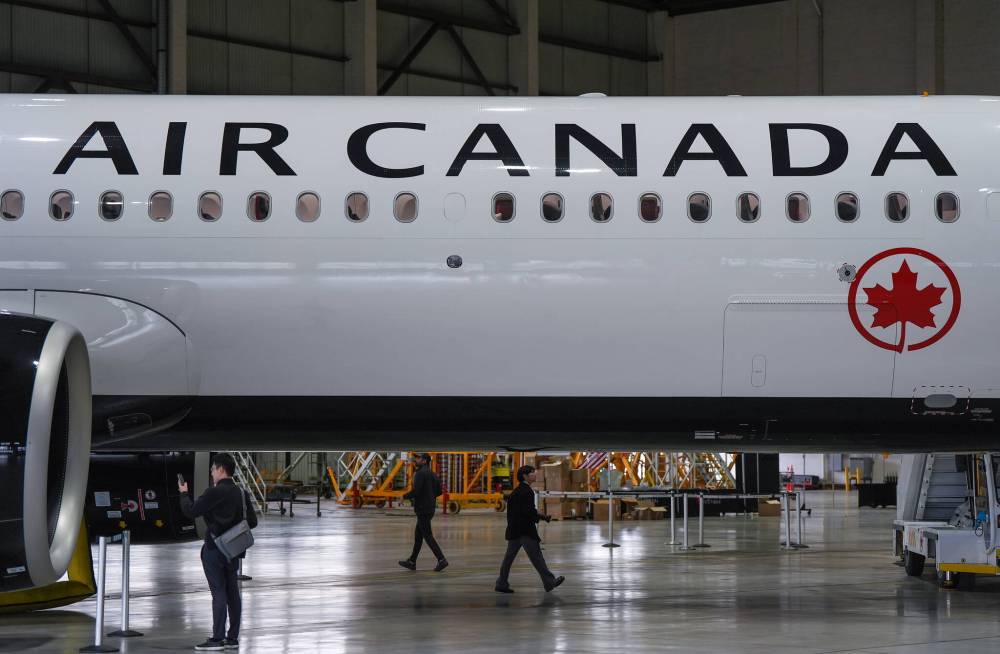
DARRYL DYCK / THE CANADIAN PRESS FILES
Air passenger protection regulations are supposed to protect us from unjust treatment in the event of cancellations or delays.
Long story quite short: I sparred with Air Canada customer service for more than two hours, asking if they would transfer me to another airline. All airlines are allowed to do that but almost never offer it as an option unless you let them know that you know that there are agreements between carriers to absorb passengers on cancelled flights.
At first, they denied that they transfer passengers to another airline. Then, after finally conceding that they do inter-airline swaps, they refused to book me a seat on an early afternoon Porter flight that definitely had space because the seat classes did not match up perfectly. Then, the airline magically relented and booked me on the Porter flight once I asked for a full refund instead of accepting the airline’s offer of a late-night flight.
It was a thoroughly unenjoyable, enormously stressful experience.
Pop-quiz time: should I have been eligible for compensation? The answer to that question — Winston Churchill famously said — is a riddle, wrapped in a mystery, inside an enigma.
Air passenger protection regulations, first imposed in 2019 by the Canadian Transportation Agency, are supposed to protect us from unjust treatment in the event of cancellations or delays. The regulations are reasonably clear when it comes to cancelled flights; passengers must be given refunds, booked on a new flight within 48 hours and be provided with emergency accommodation.
But what about situations when a flight is cancelled for no clear reason and the airline makes little effort to find the best possible alternative arrangement? Or, when a passenger has to book a much more expensive alternative on another airline to keep their travel plans intact?
The current regulations allow for airlines to “explain” away delays or cancellations with little in the way of explanation, while passengers who may be eligible for compensation are forced to endure a completely dysfunctional appeal process with the CTA.
How dysfunctional? At last count, the CTA is sitting on nearly 100,000 unresolved complaints, with each taking about three years to resolve.
The entire air passenger protection regime in this country is broken, and nobody — not the airlines and not the federal government — seem to be able to do anything about it.
There was likely an expectation on Ottawa’s part that airlines — which face fines up to $1 million for not compensating passengers in accordance with the regulations — would do right by their customers rather than suffer the damage to their commercial brand and pay financial penalties. The enormous size of the complaint queue and the number of fines levelled by the CTA suggest airlines find it less onerous or costly to deny fair compensation to their customers rather than adhere to the regulations.
In the 2025-26 fiscal year, which ended in March, the CTA assessed $1.4 million in fines on airlines that did not honour traveller-protection rules. This included a fine of $426,000 against Air Canada, which committed 71 violations of passenger protection regulations for not offering, at the passenger’s choice, a refund or space on the next available flight.
The types of offences in that single fiscal year will resonate with most frequent flyers: failure to inform passengers when they are eligible for compensation; refusing to give passengers a choice between refund and rebooking; failure to provide accommodation or adequate food vouchers that are commensurate with the length of delay; failure to provide a full explanation for a delay or cancellation.
It would appear the costs associated with ignoring the regulations are considerably less than the cost of providing adequate compensation. And while that makes airlines look exceedingly cynical, it makes the federal government look utterly foolish for continuing to put any faith in the airlines’ capacity to voluntarily do the right thing.

The federal government has not done nothing. Ottawa has provided the CTA with an additional $73 million in supplementary funding since 2023 to address the backlog. It has also promised to increase fines to the point where airlines might consider the penalties more costly than voluntarily helping their customers.
However, decisive action has been lacking. Proposed changes to the regulations introduced in 2024 have not been enacted. And a proposal to get airlines to pay a $790 fee per complaint to cover the costs of the CTA’s administration has also never been implemented.
The lack of action on the part of the airlines and the federal government would be disheartening in any context. But in a country with a shortage of airline options, it’s downright gutting.
It would be refreshing if the airlines and government just did what they promised to do all along: return some dignity to air travel.
dan.lett@freepress.mb.ca
Born and raised in and around Toronto, Dan Lett came to Winnipeg in 1986, less than a year out of journalism school with a lifelong dream to be a newspaper reporter.
Our newsroom depends on a growing audience of readers to power our journalism. If you are not a paid reader, please consider becoming a subscriber.
Our newsroom depends on its audience of readers to power our journalism. Thank you for your support.
Born and raised in and around Toronto, Dan Lett came to Winnipeg in 1986, less than a year out of journalism school with a lifelong dream to be a newspaper reporter.
Our newsroom depends on a growing audience of readers to power our journalism. If you are not a paid reader, please consider becoming a subscriber.
Our newsroom depends on its audience of readers to power our journalism. Thank you for your support.
Advertisement Advertise With Us
Advertisement Advertise With Us