COVID-19 by the numbers

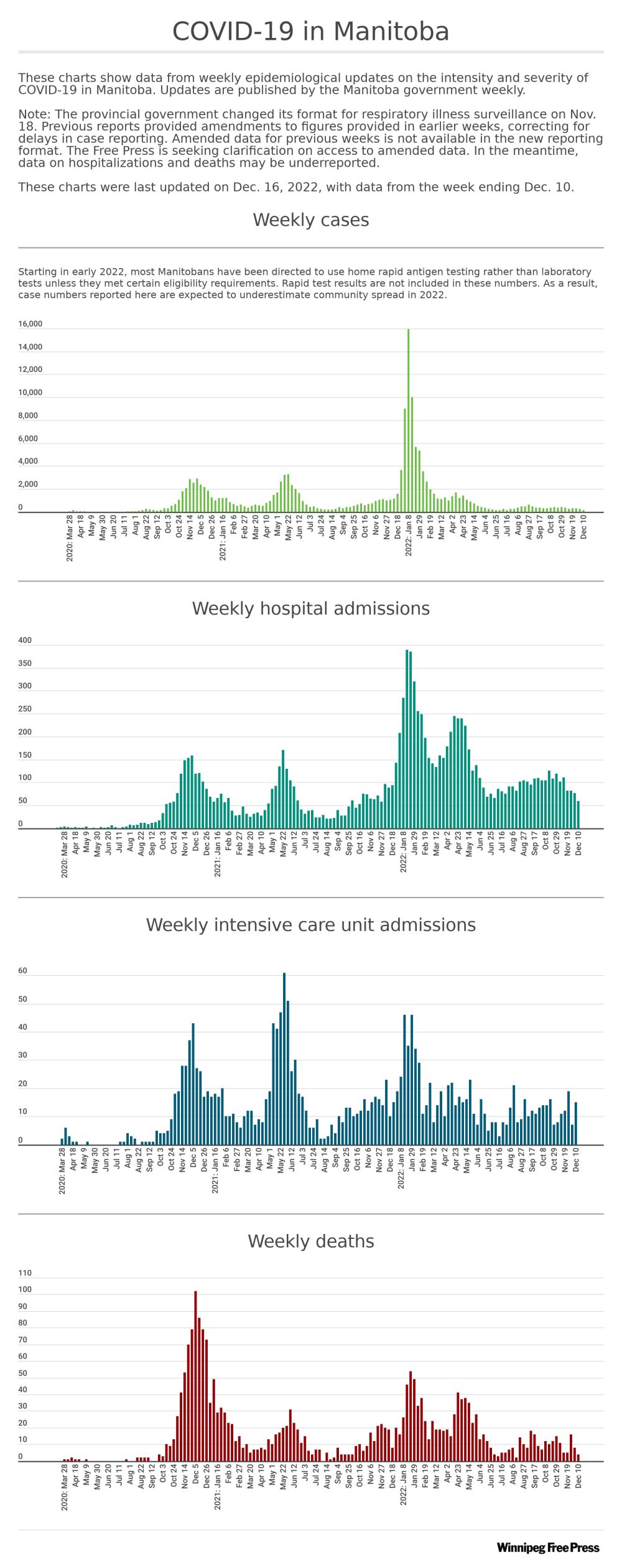
The Winnipeg Free Press is tracking the status of COVID-19 in Manitoba, as reported by provincial and federal health authorities.

Read this article for free:


or

Already have an account? Log in here »

To continue reading, please subscribe:

Subscribe and receive a limited-edition Free Press branded hat or tote.

Digital Subscription

One year of digital access for only $205*

  • Enjoy unlimited reading on winnipegfreepress.com
  • Read the E-Edition, our digital replica newspaper
  • Access News Break, our award-winning app
  • Play interactive puzzles

*First annual payment billed as $205.00 + GST for one year. This annual subscription will automatically renew at $233.00 + GST every 52 weeks (10% off the regular annual price of $259.35). Offer available to new and qualified returning subscribers only. Cancel any time.

To continue reading, please subscribe:

Add Free Press access to your Brandon Sun subscription for only an additional

$1 for the first 4 weeks*

  • Enjoy unlimited reading on winnipegfreepress.com
  • Read the E-Edition, our digital replica newspaper
  • Access News Break, our award-winning app
  • Play interactive puzzles
Start now

*Your next Brandon Sun subscription payment will increase by $1.00 and you will be charged $17.95 plus GST for four weeks. After four weeks, your payment will increase to $24.95 plus GST every four weeks.

The Winnipeg Free Press is tracking the status of COVID-19 in Manitoba, as reported by provincial and federal health authorities.
Wastewater surveillance

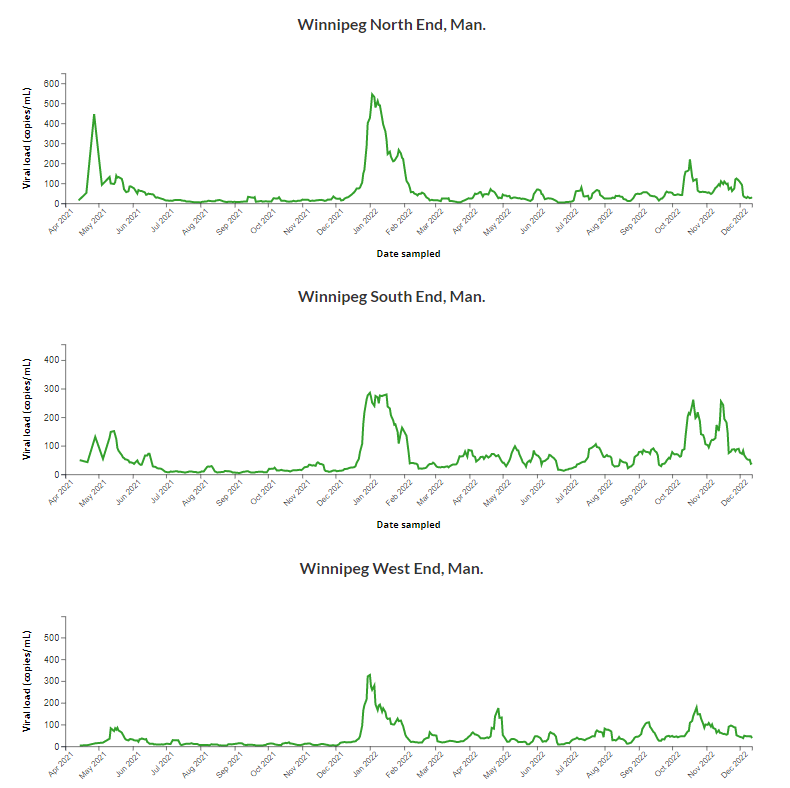
Health Canada’s wastewater dashboard shows the concentration of COVID-19 in wastewater samples from different sites.

The green line shows the seven-day rolling average of the viral load for each site. Health Canada calculates the seven-day rolling average by averaging the viral loads from each day with the previous six days.

An ongoing increase or decrease in the viral load is more reliable for indicating trends. If the wastewater signals are high or increasing, this may indicate a high level of COVID in the community.

The chart below shows wastewater surveillance in Winnipeg as reported from April 2021 — when data first became available in Winnipeg — to Dec. 12, 2022.
Vaccine uptake

The chart below shows the cumulative percentage of all people in Manitoba who have received a COVID-19 vaccine, by vaccination status.  The chart is updated every four weeks.

Cumulative percent of people who have received a COVID-19 vaccine in Manitoba, by vaccination status, as of Dec. 4, 2022. (Health Canada)
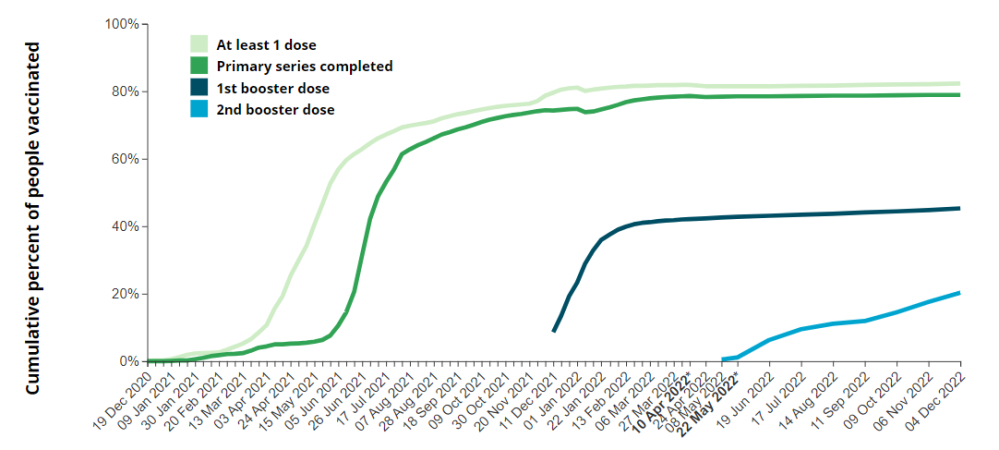
Cumulative percent of people who have received a COVID-19 vaccine in Manitoba, by vaccination status, as of Dec. 4, 2022. (Health Canada)


History

Updated on Wednesday, August 3, 2022 5:08 PM CDT: Removes charts that are no longer being updated.

Report Error Submit a Tip

More Stories

Downtown records net zero business loss

Free Press staff 2 minute read 2:00 AM CDT

Downtown Winnipeg counted the same number of business openings as closures this spring.

It’s the first time in at least five years the Downtown Winnipeg BIZ hasn’t tracked a second quarter net loss.

Three businesses opened in the city’s core, while three closed, according to a recent BIZ report. Last year, six more businesses closed than opened during the second quarter.

Securian Canada, The Grumpy Chicken and Haydar Pasha Pizza opened this April through June.

Quiet opening fitting for controversial site

Melissa Martin 5 minute read Preview

Quiet opening fitting for controversial site

Melissa Martin 5 minute read 2:00 AM CDT

One of this city’s most loudly debated facilities — after all the angst, all the opposition and all the vocal support — began operations in the most low-key way possible.

There was none of the usual fanfare that accompanies a new social or medical offering, no news conference, no speeches. Only a quiet Tuesday, around which was woven a lot of hope, and a great deal of worry.

Winnipeg’s first supervised drug consumption site has been a long time in the making. It’s been just over two years since the province first announced it would partner with the Aboriginal Health and Wellness Centre to design and open the site; advocates had been calling for a supervised consumption facility for years.

But the launch, originally eyed for 2025, was repeatedly delayed as the province and service providers sorted out approvals and negotiated community concerns. In the meantime, the drug crisis in Winnipeg kept growing, with paramedics burdened by a skyrocketing number of overdose calls.

Read
2:00 AM CDT

Surgery backlog, St. Boniface ER big-ticket items in health budget

Danielle Da Silva 5 minute read Preview

Surgery backlog, St. Boniface ER big-ticket items in health budget

Danielle Da Silva 5 minute read Tuesday, Apr. 12, 2022

The provincial government will spend more than $200 million this year to tackle the massive backlog of surgeries and expand emergency room capacity, while slashing its COVID-19 response budget.

Finance Minister Cameron Friesen said his government will spend a combined $7.2 billion to deliver health care, mental health and addictions services, a new seniors strategy and deliver promised improvements to long term care in 2022-23, representing a 2.5 per cent spending increase over last year.

The provincial budget, unveiled Tuesday, includes $9 million to fund 28 new critical care beds provincewide; $100 million for the redevelopment of the St. Boniface Hospital emergency department; and $110 million to expedite an estimated 167,000 surgical and diagnostic cases that were delayed due to the pandemic.

“Our government is very serious about driving down these times that were elongated as a consequence of a global pandemic,” Friesen said. “That’s why we’re putting a very significant effort into combating that.”

Read
Tuesday, Apr. 12, 2022

First Inuk GG sparks hope for new relationship

Teresa Wright, The Canadian Press 5 minute read Preview

First Inuk GG sparks hope for new relationship

Teresa Wright, The Canadian Press 5 minute read Tuesday, Jul. 6, 2021

More than five years after he refused to intervene in a young man’s death by suicide in High Park, then lied about being on another call, a Toronto police officer has been demoted in rank for two years for his “serious” misconduct.

Read
Tuesday, Jul. 6, 2021

Time to consider Indigenous names

Reanna Merasty 5 minute read Preview

Time to consider Indigenous names

Reanna Merasty 5 minute read Monday, Aug. 23, 2021

Indigenous people have had a long connection to the land on which our city is built. Traditional place names were descriptive of the land and practised through a complete and meaningful understanding of locality. The names reflected the animate tendencies within Indigenous languages, which were illustrative of nature.

When colonialism forcibly displaced Indigenous people, Indigenous lands and their names were either modified or removed. Places were renamed after settlers, or assumed names taken directly from Europe to reflect the settlers’ own culture and history. Names were altered from Indigenous languages to English or French adaptations, such as in the case of Winnipeg, which derived from the Cree word “Win-nipi” or “murky waters.”

The loss of Indigenous place names contributed to the loss of Indigenous languages and traditions, including oral histories.

Today, the reclamation of space, land, culture and language has risen for Indigenous people. Histories and contributions of Indigenous people within our city are moving toward being recognized and restored. Additionally, the city has begun to acknowledge the hurt caused by place names and monuments that represent colonial figures who advocated for the erasure of Indigenous people.

Read
Monday, Aug. 23, 2021

Grim outlook for airport authority

Temur Durrani 5 minute read Preview

Grim outlook for airport authority

Temur Durrani 5 minute read Thursday, Apr. 29, 2021

The Winnipeg Airports Authority revealed a particularly grim outlook of their consolidated financial statements at their annual public meeting Thursday morning.

A year marred by COVID-19, executive members from the airports authority said urgent support is needed from the federal government to save them from their dire future beyond the pandemic, outlining the many ways in which Ottawa has failed regional airports like Winnipeg's so far.

Nicole Stefaniuk, vice-president of finance and administration, said 2020 was the worst year in the airport's history — mostly because passengers typically make up about 90 per cent of airport revenue and because almost 80 per cent of costs are fixed items the authority has to continue paying (such as utilities, personnel employment and taxes).

Passenger traffic fell from an average of 12,300 travellers per day to less than 250 people on a good day for Winnipeg's airport — a symptom of mandated lockdowns, border closures and travel restrictions across Canada.

Read
Thursday, Apr. 29, 2021