Tangled up in blue
Advertisement
Read this article for free:
or
Already have an account? Log in here »
To continue reading, please subscribe:
Digital Subscription
One year of digital access for only $1.44 a week*
- Enjoy unlimited reading on winnipegfreepress.com
- Read the E-Edition, our digital replica newspaper
- Access News Break, our award-winning app
- Play interactive puzzles
*Billed as $5.77 plus GST every four weeks. After 52 weeks, price increases to the regular rate of $19.95 plus GST every four weeks. Offer available to new and qualified returning subscribers only. Cancel any time.
To continue reading, please subscribe:
Add Free Press access to your Brandon Sun subscription for only an additional
$1 for the first 4 weeks*
- Enjoy unlimited reading on winnipegfreepress.com
- Read the E-Edition, our digital replica newspaper
- Access News Break, our award-winning app
- Play interactive puzzles
*Your next Brandon Sun subscription payment will increase by $1.00 and you will be charged $17.95 plus GST for four weeks. After four weeks, your payment will increase to $24.95 plus GST every four weeks.
Read unlimited articles for free today:
or
Already have an account? Log in here »
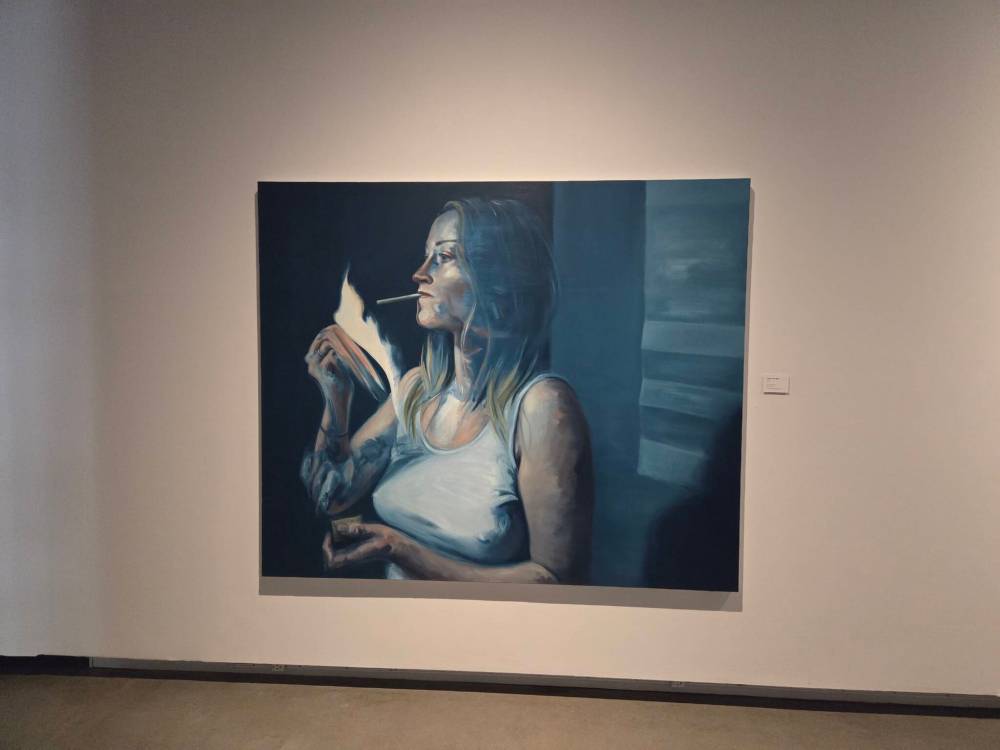
WHAT IT IS: Fade Into Blue is an enigmatic, evocative oil-on-canvas painting by Laura Lewis, a queer visual artist originally from Halifax and now based in Winnipeg. This large-scale work (183-by-152 cm) is currently on view at Plug In ICA as part of Lewis’s solo exhibition One eye filled with night.
WHAT IT’S ABOUT: This is a show of paintings, often really gorgeous paintings, but Lewis is also using the medium in a conceptual way. Taken together, these pieces are in a tricky critical conversation with the long history of figurative painting. They explore the expressive and esthetic possibilities of the medium, while taking on subjects that have often been sidelined or oversimplified.
The people in these paintings aren’t passive objects but active collaborators. Lewis works with the sitters, who are friends, sometimes fellow artists and members of the LGBTTQ+ community, in long preparatory photo shoots. She shows them in their own private spaces, in poses and postures that simultaneously reveal and conceal. These are not definitive portraits but open-ended explorations, diving into questions about the construction of identity, especially queer identity.
Some of the works in the show make sideways references to historical artists such as Edouard Manet and Marcel Duchamp, but Lewis is also using painting to reference photography and film. Those three mediums have been in an “it’s complicated” relationship since the 19th century, and Lewis continues that productive tension. In style, her works are painterly, with brushy texture and sudden shards of colour. In terms of content, they often call up images associated with vintage film stills.
Lewis is especially drawing on 1940s and ’50s film noir. Several paintings riff on the visual markers of that genre, with venetian blinds, red lipstick, matches and cigarettes. (So many cigarettes.) There are moody cast shadows and the neon nocturnes of city streetlights. There are mirror images and doppelgangers.
Fade Into Blue suggests a noirish vibe, with its dark background and deep-blue illumination, with its solitary figure standing near a window. The subject could seem aloof, but maybe she’s just focused on the practised gesture of lighting her cigarette. Lewis underlines this action with the blurred motion of that one hand, with the match flaring up into a long yellow-white plume.

In film noir, women are usually dangerous femmes fatales or haloed good girls. This woman defies any kind of easy categorization.
The content may feel cinematic, but the style brings us back to painting. Fade Into Blue’s surface is built up with marks of paint that assert themselves as paint, while also — rather tenderly — suggesting the variations and vulnerabilities of flesh, especially along the subject’s bare arms.
WHY IT MATTERS: There’s a deliberate push-pull to Lewis’s work. The painting’s scale and dark glamour draw viewers in. But something about the subject — so self-contained and singularly herself — confounds and complicates the voyeurism of the usual film noir setup.
Under this cool blue surface is something that eludes us, which is why we look harder.
alison.gillmor@winnipegfreepress.com