

Uncertainty bakes costs into CUSMA chain

Advertisement
Read this article for free:
or
Already have an account? Log in here »
To continue reading, please subscribe:
Digital Subscription
One year of digital access for only $1.44 a week*
- Enjoy unlimited reading on winnipegfreepress.com
- Read the E-Edition, our digital replica newspaper
- Access News Break, our award-winning app
- Play interactive puzzles
*Billed as $5.77 plus GST every four weeks. After 52 weeks, price increases to the regular rate of $19.95 plus GST every four weeks. Offer available to new and qualified returning subscribers only. Cancel any time.
To continue reading, please subscribe:
Add Free Press access to your Brandon Sun subscription for only an additional
$1 for the first 4 weeks*
- Enjoy unlimited reading on winnipegfreepress.com
- Read the E-Edition, our digital replica newspaper
- Access News Break, our award-winning app
- Play interactive puzzles
*Your next Brandon Sun subscription payment will increase by $1.00 and you will be charged $17.95 plus GST for four weeks. After four weeks, your payment will increase to $24.95 plus GST every four weeks.
Read unlimited articles for free today:
or
Already have an account? Log in here »
Despite all the melodramatic hype and handwringing leading up to it, the July 1 timeline for renewing the Canada-United States-Mexico Agreement on trade passed without a U.S. commitment to extend its 2036 sunset.
The sun still rose the next day. Trucks and trains are still crossing the border carrying Canadian commodities (albeit not on that new bridge named after a famous hockey player). Grocery stores still carry imported fruits and vegetables from the south, and Canadians in several provinces still can’t buy American liquor.
Nothing changed, except everything.
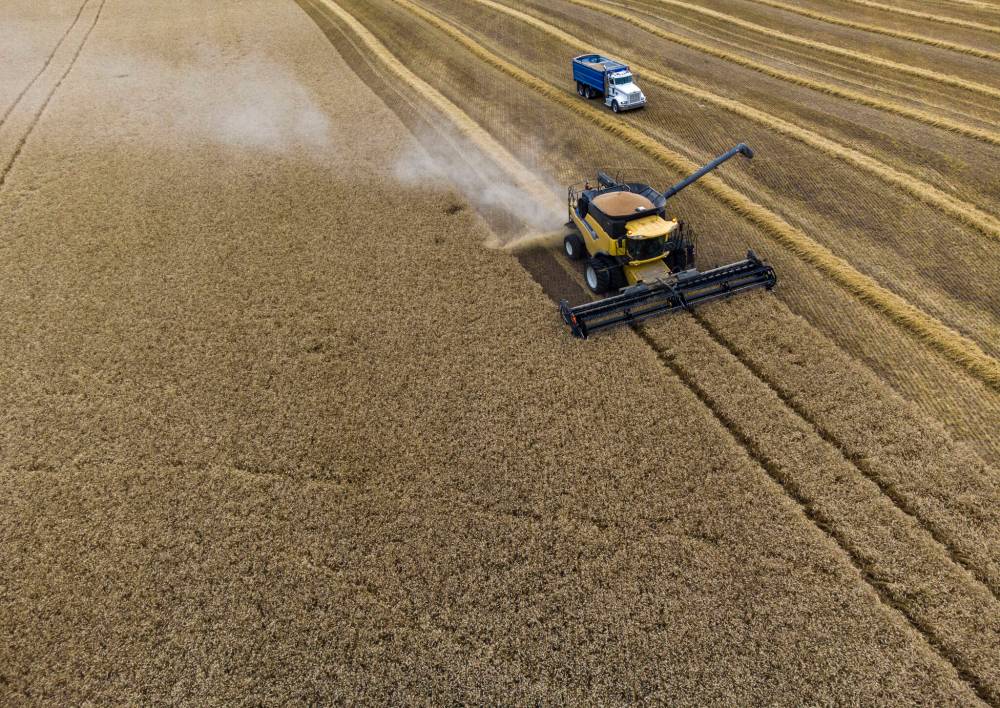
JEFF MCINTOSH / THE CANADIAN PRESS FILES
A wheat crop is harvested near Cremona, Alta. Canada is one of the world’s largest exporters of wheat.
We must now accept the certainty of continued uncertainty as Canada, along with the rest of the world, considers how to deal with the increasingly erratic leadership at the helm of the world’s largest economy.
The inability to secure a long-term commitment to the deal that allows tariff-free access for about 98 per cent of Canada’s agricultural exports to the U.S. puts the three signatories into a perpetual state of negotiation — whether it’s passive, as in the current “what next?” waiting game, or active dialogue aimed at ironing out the issues.
It seems unlikely any of the three will give their six months’ notice and withdraw, although one may threaten it. The treaty has proven to be too mutually beneficial economically, despite U.S. posturing to the contrary.
The U.S. buys more than 60 per cent of Canada’s agricultural exports — because it wants them — and Canada buys about 17 per cent of those from the U.S.
Agricultural groups on both sides of the Canada-U.S. border have come out solidly in support of CUSMA. A Purdue University study commissioned by U.S. commodity groups found the deal saves U.S. households about $500 per year in food costs, which equates with nearly one-fifth the annual budget in a low-income home.
However, economics isn’t the sole driver in this new operating environment.
Keeping everyone at the table for these annual reviews is a way for the U.S. to keep the other two signatories off-balance and to nip away at the terms with the goal of gaining concessions rather than shredding the deal entirely. One concession begets attempts at more.
Relying on the U.S. as a trading partner is even more risky. Regardless of whether it imposes tariffs, the terms of market access will be more volatile. Risk increases the cost of doing business.
Even price discovery becomes more difficult as the U.S. becomes more isolated, protectionist and trigger-happy with tariffs.
“If the North American market in agri-food is fragmenting, it undermines the integrity of a U.S. pricing mechanism applied in Canada,” Agri-Food Economic Systems agricultural economist Al Mussell said in a policy note last summer.
Canadian marketers have traditionally used U.S. futures markets as the key reference for publicly traded agricultural commodities because of their scale and liquidity. U.S. prices are adjusted for currency differences and the local freight, elevation and handling to reflect Canadian conditions.
For futures markets to work effectively, there must be a credible threat of delivery against a contract, even though the likelihood is low. But for that to exist, there must be secure market access. Access to third-party markets must be similar.
In an environment where irrational tariffs and tit-for-tat retaliations disrupt trade, the made-in-America price may not reflect conditions outside the U.S.
“By itself, the prospect of the value of tariffs being pushed back onto the border price creates important ‘noise’ in the disciplined price arbitrage over time and space required for U.S. futures prices to effectively value Canadian products,” Mussell wrote.

That potentially makes it harder for Canadian farmers, marketers and processors to use U.S.-based forward contracts for price discovery and hedging risk.
Managing prolonged uncertainty bakes additional costs into the entire value chain because the only way buyers and sellers can manage risk is to widen their margins. Farmers can’t increase their prices, they can only look for ways to cut costs.
Canadian farmers and exporters can hope the current U.S. trade stance fades into obscurity when U.S. President Donald Trump’s term is up, but they can’t afford to wait and see.
The economic dis-integration of North America has begun.
Laura Rance-Unger is editor emeritus for Glacier FarmMedia. She can be reached at lrance@farmmedia.com
Laura Rance is editorial director at Farm Business Communications.
Our newsroom depends on a growing audience of readers to power our journalism. If you are not a paid reader, please consider becoming a subscriber.
Our newsroom depends on its audience of readers to power our journalism. Thank you for your support.
Laura Rance is editorial director at Farm Business Communications.
Our newsroom depends on a growing audience of readers to power our journalism. If you are not a paid reader, please consider becoming a subscriber.
Our newsroom depends on its audience of readers to power our journalism. Thank you for your support.
Advertisement Advertise With Us
Advertisement Advertise With Us