

Berkshire Hathaway, Manitoba-style
Winnipeg-based Exchange Income Corp.’s formula of buying great companies, helping them grow for long term resonates with investors
Advertisement
Read this article for free:
or
Already have an account? Log in here »
To continue reading, please subscribe:

Digital Subscription
One year of digital access for only $205*
- Enjoy unlimited reading on winnipegfreepress.com
- Read the E-Edition, our digital replica newspaper
- Access News Break, our award-winning app
- Play interactive puzzles
*First annual payment billed as $205.00 + GST for one year. This annual subscription will automatically renew at $233.00 + GST every 52 weeks (10% off the regular annual price of $259.35). Offer available to new and qualified returning subscribers only. Cancel any time.
To continue reading, please subscribe:
Add Free Press access to your Brandon Sun subscription for only an additional
$1 for the first 4 weeks*
- Enjoy unlimited reading on winnipegfreepress.com
- Read the E-Edition, our digital replica newspaper
- Access News Break, our award-winning app
- Play interactive puzzles
*Your next Brandon Sun subscription payment will increase by $1.00 and you will be charged $17.95 plus GST for four weeks. After four weeks, your payment will increase to $24.95 plus GST every four weeks.
Read unlimited articles for free today:
or
Already have an account? Log in here »
Omaha, Neb., has its “Oracle,” but Manitoba has its market miracle.
The legendary Warren Buffett transformed Berkshire Hathaway Inc. from a textile company into a wildly successful conglomerate that acquires great companies and generally takes a hands-off approach, letting them do what they do best.
And it’s been a very profitable strategy.
MIKE DEAL / FREE PRESS files
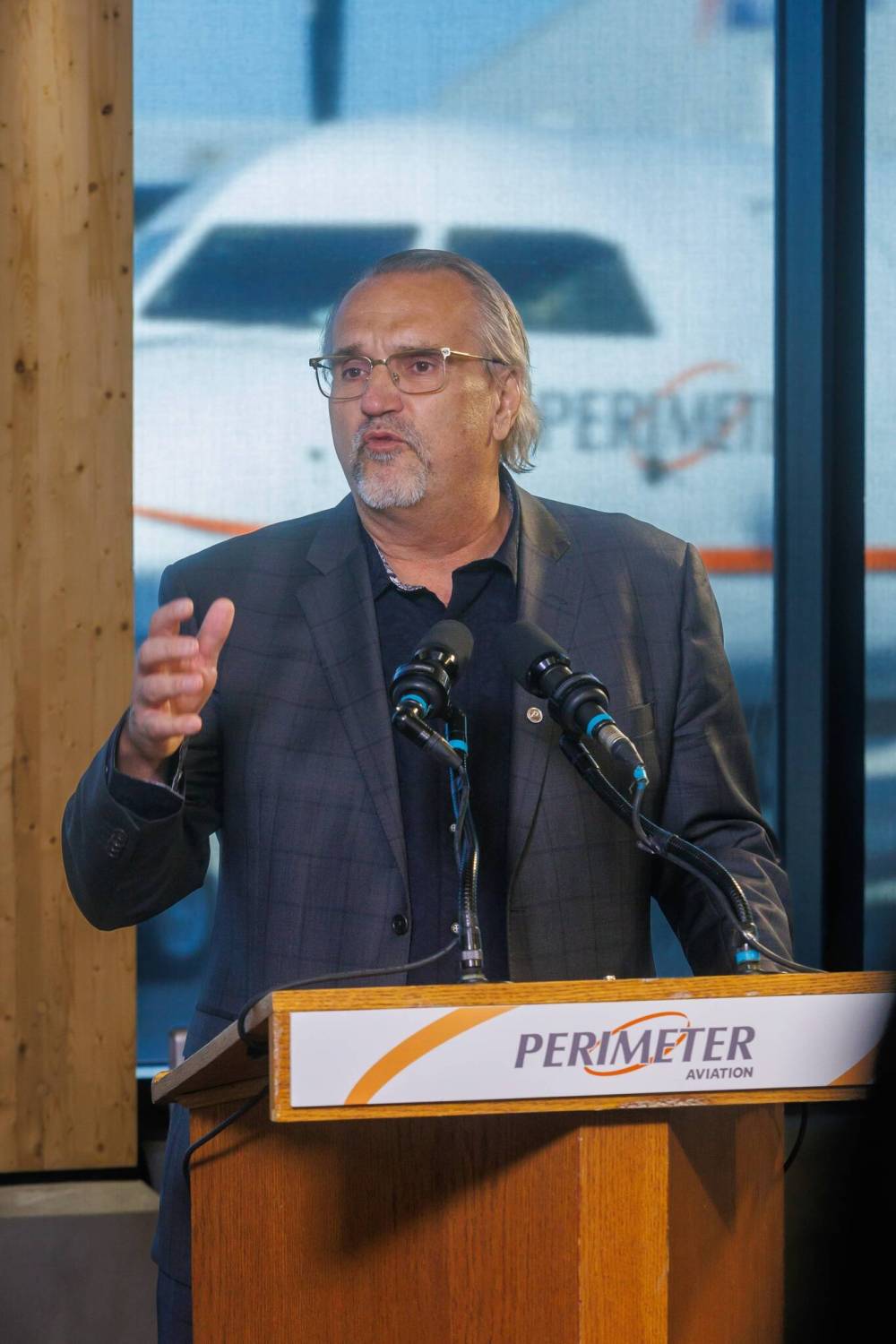
EIC’s track record is ‘exceptionally rare’ and supported ‘by a good business model that’s well executed,’ says Michael Pyle, CEO of Exchange Income Corp.
Manitoba’s market miracle is Exchange Income Corp. (TSX: EIF). A publicly traded conglomerate on the Toronto Stock Exchange, it has a similar strategy.
It acquires and owns great companies for the long term, while investing in them so they can become even more successful and profitable.
Its companies include a mix of well-known and lower-profile names in Canadian aerospace, defence and manufacturing. Among the better known companies, at least in Manitoba, are Perimeter Aviation and Calm Air.
Berkshire Hathaway’s “model is looking for great businesses with strong market niches, competitive moats and dependable cash flows,” says Travis Muhr, chief administrative officer with Exchange Income Corp.
The formula is much the same for EIC since its founding in 2004 by its executive vice-chairman and director, Duncan Jessiman, and Michael Pyle, its chief executive officer.
“The premise of EIC was really, ‘How can we create a platform to acquire great businesses and invest in them to become even more successful?’” Muhr adds.
Of course, to those at EIC, its success is no miracle. Rather, its success is founded on a winning formula of finding great companies and letting them continue to do great things.
What started with the acquisition of Perimeter for $18 million more than 20 years ago has resulted in EIC today being the parent company of more than 20 firms, including many key aviators serving the North.
“We’re bigger than Air Canada in terms of market capitalization,” says Pyle, who previously was president of the Arctic Glacier Income Fund.
He points to EIC’s total value of all its shares, worth roughly $7.3 billion, versus Canada’s largest airline, worth about $6 billion.
“Air Canada is a great business, but they do different things than we do,” he says. “We’ve become really good at flying into difficult places.”
In EIC’s eyes, its companies serving the North are not traditional airlines, they are essential infrastructure.
“These airlines provide an essential service,” Muhr says. “When you think about communities in northern Manitoba and Nunavut, the airlines serving them are important lifelines.”
Most of these communities rely on winter roads for transport of goods and people, and are mostly only accessible by air during the warmer months.
EIC also owns Keewatin Air, which specializes in medivac from remote communities.
The Manitoba conglomerate owns more than aircraft operators. For example, it owns a diversified aerospace firm PAL Group of Companies. The Newfoundland-based company has a footprint in the defence industry, operating special mission aircraft for maritime surveillance.
Other EIC subsidiaries include Ben Machine Products in Vaughn, Ont., that provides metal components for defence and aerospace. It also owns a specialized climate control manufacturer, custom industrial fabricators, industrial mat manufacturers and providers, a telecom infrastructure company and a window manufacturer for high-rises.
For more than two decades, EIC had grown quietly, largely under the radar of more investors. That is until the last year, becoming among the top-performing, mid-sized stocks by percentage share price growth on the Toronto Stock Exchange.
Its share price is up more than 100 per cent over the last year, and has frequently topped $130 while paying a dividend yield of about two per cent.
EIC’s growing dividend has long attracted equity investors favouring income, but it is no slouch when it comes to growth either, averaging about a 23 per cent compounding return over its history, Pyle says.
By comparison, the TSX Composite Index’s long-term annualized return is about eight per cent.
EIC’s track record is “exceptionally rare,” he adds. Investor demand may drive share price growth, but that is supported “by a good business model that’s well executed,” Pyle says. “Most importantly, it’s driven by really good management in the field.”
From the start, EIC has acquired well-managed companies in Canada and the U.S. It then lets them continue to do just that under their own brands, while providing support — including capital — to become more successful, Pyle says.
Where EIC plies its trade is fertile ground. Canada and the U.S. are home to many privately owned, medium-sized businesses with aging owners facing retirement with limited succession choices.
“It’s a silver tsunami where a bunch of baby boomers and Gen Xers, who have built fantastic businesses, don’t have exit plans,” Muhr says.
Still, it is a competitive landscape. EIC’s main competitors are private equity, but the Winnipeg company often wins out over these generally higher bidders.
PAL Aerospace is an example, Pyle says. “The owner had retired already … and there were four offers that he deemed acceptable.”
But the owner asked his management team who they wanted, “and they picked us.”
That was a result of EIC’s reputation for not operating like private equity.
Often private equity firms acquire a company using debt, implement efficiencies — often cutting jobs and less profitable business lines — and then sell it at a higher price.
EIC is different. It purchases companies to hold them long term.
“When we’re buying a business, we want to make sure the management teams stick around and become part of the EIC family,” Muhr says.

Although EIC’s recent success with share price growth might prove a hard act to follow, Pyle is confident its proven formula has a long runway of providing value for investors. “It’s just a matter of us remaining patient, finding the right deals and not overpaying.”
EIC has many great private companies in Canada, the U.S. and even Europe on its radar to build on its success, he adds.
“We’re just scratching the surface of what’s out there.”
Joel Schlesinger is a Winnipeg-based freelance journalist
joelschles@gmail.com