

Report on state of rural Manitoba’s economy ‘exciting work’

Advertisement
Read this article for free:
or
Already have an account? Log in here »
To continue reading, please subscribe:
Digital Subscription
One year of digital access for only $1.44 a week*
- Enjoy unlimited reading on winnipegfreepress.com
- Read the E-Edition, our digital replica newspaper
- Access News Break, our award-winning app
- Play interactive puzzles
*Billed as $5.77 plus GST every four weeks. After 52 weeks, price increases to the regular rate of $19.95 plus GST every four weeks. Offer available to new and qualified returning subscribers only. Cancel any time.
To continue reading, please subscribe:
Add Free Press access to your Brandon Sun subscription for only an additional
$1 for the first 4 weeks*
- Enjoy unlimited reading on winnipegfreepress.com
- Read the E-Edition, our digital replica newspaper
- Access News Break, our award-winning app
- Play interactive puzzles
*Your next Brandon Sun subscription payment will increase by $1.00 and you will be charged $17.95 plus GST for four weeks. After four weeks, your payment will increase to $24.95 plus GST every four weeks.
Read unlimited articles for free today:
or
Already have an account? Log in here »
Declining municipal populations and workforce-bound immigrants are highlighted in a first-of-its-kind report detailing Manitoba’s rural communities.
The Pulse of Rural Manitoba: 2026, a 142-page document, is “the beginning of a marathon,” said Margot Cathcart, who heads Rural Manitoba Economic Development. It partnered with Brandon University’s Rural Development Institute to compile demographic, economic and other data on Manitoba’s 125 rural municipalities.
The report was released this week, coinciding with the Association of Manitoba Municipalities’ (AMM) spring convention.
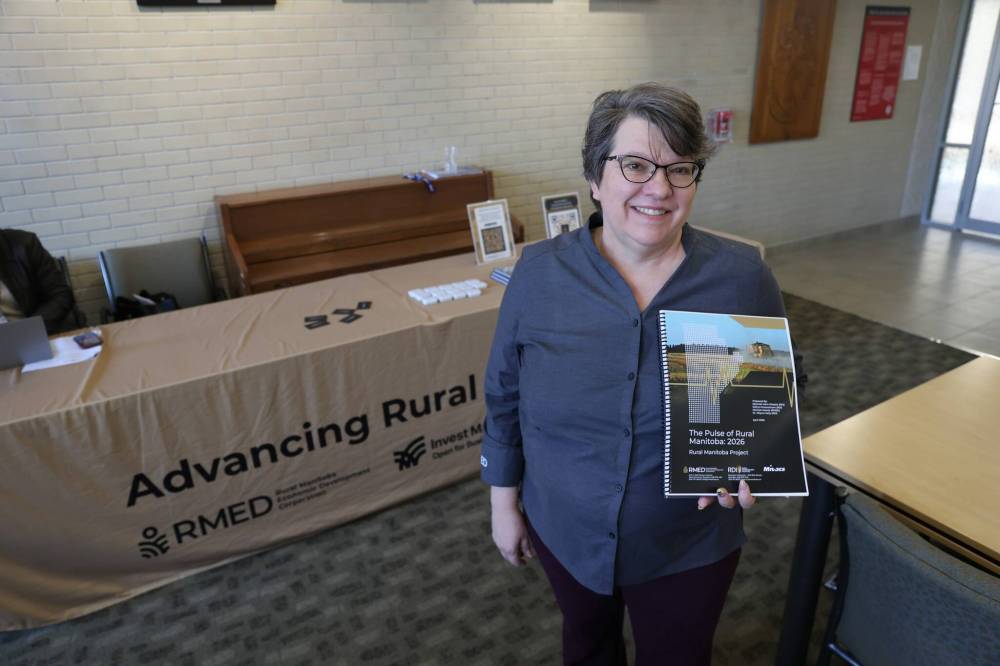
Connor McDowell / Brandon Sun
Margot Cathcart with a copy of the Pulse of Manitoba: 2026 report, commissioned by Rural Manitoba Economic Development.
“This is such exciting work, and has the potential to be really intergenerational, in terms of its impact,” Cathcart said Tuesday.
“It’s critical for municipalities, first and foremost, to understand the starting point of where they’re growing from.”
Some communities lack resources to sift through data before making planning decision, which has led to frustration among decision makers, said Gary McNeely, a Rural Development Institute researcher who worked on the report.
“All communities are concerned about their well-being and their future opportunities,” he said.
The report will support policymakers’ data use, he added. The document compiles information from Statistics Canada, Rural Manitoba Economic Development and municipalities.
Already, researchers have flagged areas for followup — namely, depopulation. The Parkland region logged a 0.2 per cent drop in residents between 2016 and 2021.
Manitoba’s six other rural regions followed Canada’s trend of a growing population, though some gains were slow: the southwest (which includes Virden, Brandon and Carberry) had a one per cent population increase; north central (which encompasses Portage la Prairie and St. François Xavier) grew by 1.4 per cent.
McNeely attributed Parkland’s decline to fewer immigrants, limited economic opportunities and youth leaving for school and jobs elsewhere.
McCreary, Dauphin and Lakeshore joined the municipalities with reductions.
Rural Manitoba drew one-fifth of the province’s newcomer pool; it was disproportionately high in attracting economic immigrants.
A majority of its newcomers — 71.3 per cent — came for economic reasons, surpassing national and Winnipeg statistics.
“(Immigrants are) very skilled, and they come because they’ve already found jobs,” said Michael Asante, a researcher who worked on the report for Rural Manitoba Economic Development.
The immigrant mix is diverse, he noted: Filipinos, Germans, Mexicans, Brits and East Indians rounded out the top five groups coming to rural Manitoba.
The report breaks down immigration numbers and newcomers’ birth countries by Manitoba community.
Rural Manitoba Economic Development held two workshops showcasing parts of the report and other data tools it offers during the AMM’s spring convention on Tuesday.
The morning session was packed, said Cathcart in a phone interview. She estimated 180 policymakers and municipal staff would attend throughout the day.
This is just the beginning, she said.
Report researchers aim to study rural communities’ depopulation and digital connectivity, among other things. Updated Pulse reports could be published every couple of years, with the next following Canada’s 2026 census results.
Rural Manitoba Economic Development has a goal of being rural Manitoba’s data hub in the next three to five years, Cathcart said. The entity launched interactive online regional profiles Tuesday.
Swan River Mayor Lance Jacobson planned to attend RMED’s afternoon session.
“We’re very interested in economic development. The more that we can learn from economic development to better our community, to grow our community, the better it is for us,” he said.
Swan River is in the Parkland region, 475 kilometres northwest of Winnipeg. The 2026 report says the town’s population grew 0.5 per cent between 2016 and 2021.

Council is considering hiring an economic development officer to tackle jobs and housing, Jacobson said, adding there is a lack of apartment space in Swan River, causing people to settle elsewhere.
Most Manitoba rural municipalities have few or no apartments, the report found.
Thirty-seven per cent of Manitobans live in rural Manitoba. Overall, the province’s rural population had a 4.3 per cent growth rate between 2016 to 2021 — slower than Winnipeg’s 6.3 per cent and Canada’s 5.2 per cent.
Rural Manitoba also counts fewer businesses than Winnipeg: 19,259 compared to 23,255. Its population is older: people aged 65 and up accounted for 21.8 per cent of the area’s population, compared to 17 per cent in Winnipeg and 19 per cent across Canada.
gabrielle.piche@winnipegfreepress.com
Gabby is a big fan of people, writing and learning. She graduated from Red River College’s Creative Communications program in the spring of 2020.
Our newsroom depends on a growing audience of readers to power our journalism. If you are not a paid reader, please consider becoming a subscriber.
Our newsroom depends on its audience of readers to power our journalism. Thank you for your support.
Gabby is a big fan of people, writing and learning. She graduated from Red River College’s Creative Communications program in the spring of 2020.
Our newsroom depends on a growing audience of readers to power our journalism. If you are not a paid reader, please consider becoming a subscriber.
Our newsroom depends on its audience of readers to power our journalism. Thank you for your support.
Advertisement Advertise With Us
Advertisement Advertise With Us