

New stamp book immortalizes Chinese Canadian war hero
Advertisement
Read this article for free:
or
Already have an account? Log in here »
To continue reading, please subscribe:
Digital Subscription
One year of digital access for only $1.44 a week*
- Enjoy unlimited reading on winnipegfreepress.com
- Read the E-Edition, our digital replica newspaper
- Access News Break, our award-winning app
- Play interactive puzzles
*Billed as $5.77 plus GST every four weeks. After 52 weeks, price increases to the regular rate of $19.95 plus GST every four weeks. Offer available to new and qualified returning subscribers only. Cancel any time.
To continue reading, please subscribe:
Add Free Press access to your Brandon Sun subscription for only an additional
$1 for the first 4 weeks*
- Enjoy unlimited reading on winnipegfreepress.com
- Read the E-Edition, our digital replica newspaper
- Access News Break, our award-winning app
- Play interactive puzzles
*Your next Brandon Sun subscription payment will increase by $1.00 and you will be charged $17.95 plus GST for four weeks. After four weeks, your payment will increase to $24.95 plus GST every four weeks.
Read unlimited articles for free today:
or
Already have an account? Log in here »
Gordon Lee did not talk about his service in the Second World War.
Terry Lee says he knew his dad, who died in 2005, had served in some capacity, but he didn’t say much, so Terry didn’t ask.
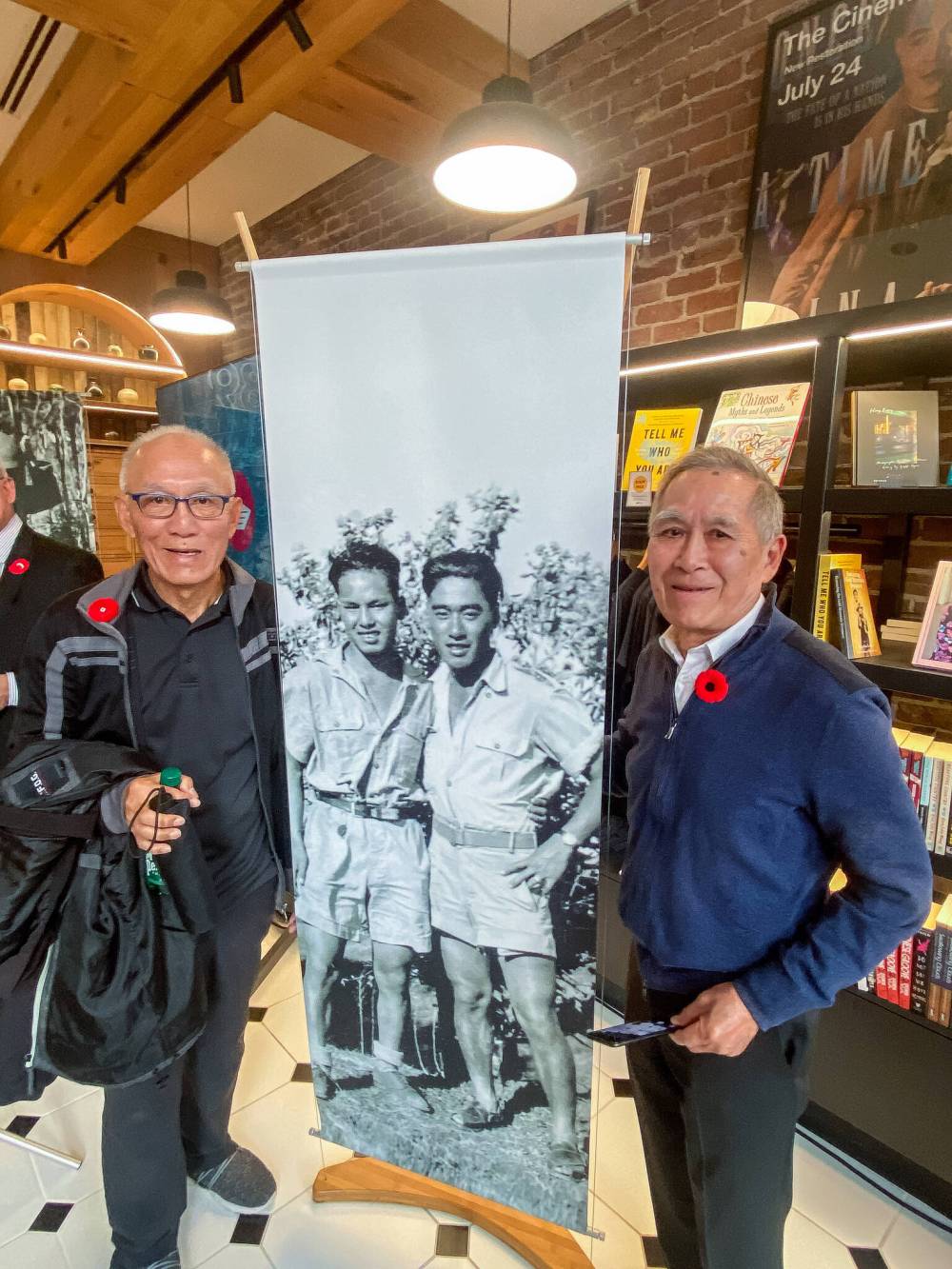
In March, Terry got a phone call from Canada Post asking if it could use his father’s image.
Supplied
Craig Lee (left) and Terry Lee with a poster of their father, Gordon Lee (man on right in poster), at the ceremony in Vancouver.
The spokesperson said Gordon and several others would be honoured on this year’s Remembrance Day stamp booklet for their service on Force 136, a military crew whose mission was to infiltrate enemy lines in Japanese-held territories, train resistance fighters and carry out sabotage operations.
“I knew he was based in India because of the photos we had of him back then, but that was it,” Terry, 75, said Tuesday in Vancouver, where a special ceremony at the Chinese Canadian Museum was held to unveil the annual commemorative stamp.
The revelation surprised Lee and his brother: “We were quite astounded.”
Gordon was born to immigrant parents in Winnipeg in 1926.
Despite the discrimination they faced during the era of the Chinese Immigration Act, which banned virtually all Chinese immigration to Canada between 1923 until 1947, Chinese Canadians enlisted in the army to show their loyalty to Canada and gain more rights as citizens.
Gordon was recruited to Force 136, a British special operations unit that was sent to Japanese-held territories. They were considered the perfect undercover operatives because they could blend in with locals.
“Many of the men couldn’t even swim because they weren’t allowed in public pools at the time, yet they were taught to do things no other soldiers were,” said Catherine Clement, a Chinese Canadian historian based in B.C. “They were really good and then started to recruit more men.”
The men were taught to climb trees and navigate terrain that was unique to the missions they would carry out. After training in India, some were sent to missions in Burma (which later became Myanmar), while others were shipped to Australia to attack the enemies from the south.
Some came home with malaria, but were often misdiagnosed because they were sworn to secrecy about their work overseas. The men had been directed to shoot themselves or swallow cyanide capsules if they were caught. That struck enough fear in them that many never spoke about their time with Force 136.
In all, 150 men served with the special unit.
Terry and his brother knew about Force 136 and knew about his father serving in the war effort, but never connected the two.
In another twist, Terry learned that his father had been on Force 136 with his brother-in-law Billy, but the two men never realized they were related.
“I talked to my cousin who’s the daughter of uncle Billy and we’re not certain that dad and uncle Billy knew each other at the time,” Terry said. “It’s the 1940s, it’s not like today where you can go in the computer and find out different relationships. (Billy) was from Dauphin, my dad was from Winnipeg.”
His dad’s recognition has motivated Terry to learn more about Force 136 and connect with other Manitoba families whose relatives served alongside him.
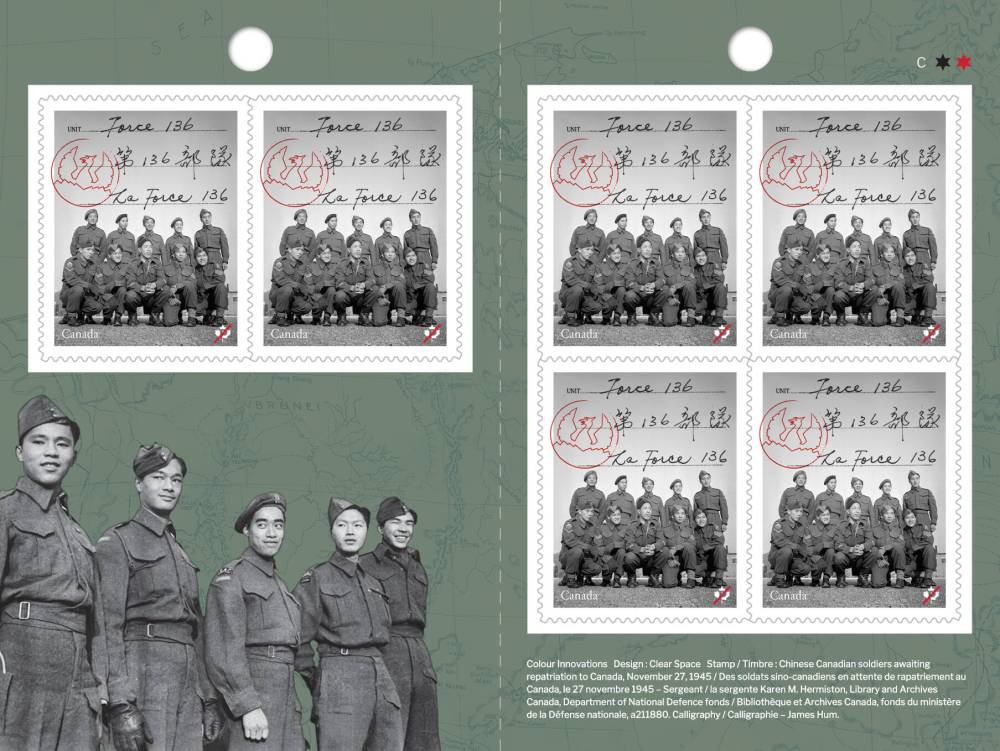
While Gordon and Billy aren’t featured on the stamp itself, they are shown prominently on the stamp booklet. In the photo, Gordon stands in the midst of five other Manitobans who were recruited to Force 136.
Supplied Canada Post
Gordon Lee is pictured in the centre of the group of soldiers not on the stamp, but on the booklet containing the stamps.
Gordon and his mates were honoured at the ceremony in Vancouver where family and loved ones of the soldiers gathered to meet and learn more about the special operatives.
Canada Post’s annual Remembrance Day stamp has been a tradition since 1968. Each year, it receives emails, calls and letters from people pitching ideas for the stamp.
The submissions are reviewed by an advisory committee of 12 people who have experience working with arts, history, culture and design.
“We’ll look at not just the depth and the breadth of a contribution, but also how it fits into the program overall because we’re blessed with such a varied and diverse history in Canada. We want to make sure that we are really exploring that full richness, not just across time and different communities, but across the country itself,” said Bronwyn Graves, Canada Post’s director of stamp services.
Last year’s stamp commemorated Sikh enlistees, while others have paid tribute to the three First World War soldiers who lived on the same block in Winnipeg and each received the Victoria Cross, the British Commonwealth’s highest award for military bravery, as well as Mona Parsons, the only Canadian woman to be imprisoned by the Nazis.
Graves said the story of Force 136 struck the panel as notable.
“It speaks to a remarkable story of service, in the face of the discrimination that the members of Force 136 were facing at home, of their commitment to serve their country,” she said.

The return of soldiers after the war propelled a civil rights movement among Chinese Canadians. Voting and citizenship rights were extended to them and Ottawa repealed the Chinese Immigration Act in 1947.
Despite that, full family reunification was out of reach and only Chinese Canadians who had Canadian citizenship were allowed to sponsor a spouse and unmarried children under the age of 18. It took until 1967 for Canada to change its immigration system to include broad family reunification and eliminate racial bias.
The last known member of Force 136 died last year, but their story is cemented into history and is carried on by people such as Clement, Graves said.
“That’s the work we do. What they wouldn’t tell us, what they didn’t want to remember, we’re going to remember, and we’re going to tell other people about it,” she said.
nicole.buffie@winnipegfreepress.com