

U of W marks 10 years of Indigenous education requirement

Advertisement
Read this article for free:
or
Already have an account? Log in here »
To continue reading, please subscribe:

Digital Subscription
One year of digital access for only $205*
- Enjoy unlimited reading on winnipegfreepress.com
- Read the E-Edition, our digital replica newspaper
- Access News Break, our award-winning app
- Play interactive puzzles
*First annual payment billed as $205.00 + GST for one year. This annual subscription will automatically renew at $233.00 + GST every 52 weeks (10% off the regular annual price of $259.35). Offer available to new and qualified returning subscribers only. Cancel any time.
To continue reading, please subscribe:
Add Free Press access to your Brandon Sun subscription for only an additional
$1 for the first 4 weeks*
- Enjoy unlimited reading on winnipegfreepress.com
- Read the E-Edition, our digital replica newspaper
- Access News Break, our award-winning app
- Play interactive puzzles
*Your next Brandon Sun subscription payment will increase by $1.00 and you will be charged $17.95 plus GST for four weeks. After four weeks, your payment will increase to $24.95 plus GST every four weeks.
Read unlimited articles for free today:
or
Already have an account? Log in here »
The University of Winnipeg is collecting course outlines, historic concerns about systemic racism on campus and related records to mark the 10-year anniversary of mandating Indigenous studies.
The unveiling of a new archive drew nearly 200 people to Centennial Hall on Thursday afternoon to reflect on how the Indigenous course requirement, also known as “the ICR,” came to be.
University archivist Brett Lougheed told the crowd its inception is “an amazing story” of student activism that, until now, wasn’t accurately reflected in U of W records.
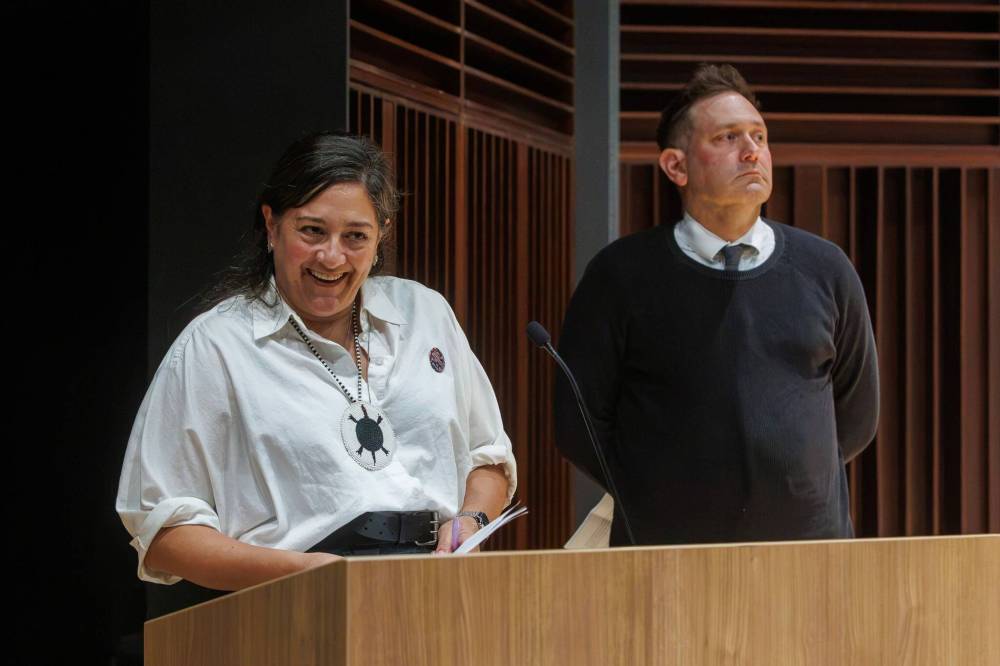
MIKE DEAL / FREE PRESS
ICR Collection project leads, Dr. Mary Jane Logan McCallum (left) and Brett Lougheed (right), discuss the importance of the collection during an event at the University of Winnipeg Thursday.
“What little material we had told the story of administration’s role in developing the ICR as though it was the ultimate driver… and not a student-led response to racism,” Lougheed said.
History professor Mary Jane Logan McCallum and Lougheed are the project leads of the ICR Collection.
The pair secured approximately $200,000 to conduct analysis, preservation and celebration work related to the introduction of mandatory learning about First Nations, Métis and Inuit people at U of W.
Their employer was one of the first post-secondary institutes in North America to require that, as of 2016-17, all undergraduate students complete at least one eligible three-credit-hour course about Indigenous history, culture, languages or contemporary issues.
Based on a proposal made by the University of Winnipeg Students’ Association and Aboriginal Students’ Council, U of W’s senate approved the requirement in March 2015.
The ICR Collection encompasses syllabi, student poll results and news coverage, among numerous materials that document its first decade of existence.
“Archives are vitally important places. They’re where evidence is preserved and, it’s hoped, made accessible to the public,” said McCallum, a Canada Research Chair in Indigenous People, History and Archives.
They also document policies and activities of institutions so the public can hold them to account, she said.
McCallum said a highlight of the ongoing research project was getting the opportunity to review a student activist’s journal entries between 2013 and 2016.
“This kind of record is gold — it gives us a window into which to view the life, works, speeches and concerns of a student at the time,” she said.
The Truth and Reconciliation Commission of Canada, which would issue 94 calls to action, some of which address record-keeping, officially began its work in 2008.
Interim president Jino Distasio recalled being part of the senior group of academic leaders who witnessed students mobilize for change.
“Collectively, we felt that it was, in fact, overdue,” said Distasio, then-director of U of W’s Institute of Urban Studies.
University leaders were keen to take action and “work through the complexities of a university system” so these courses could change opinions and lives, he said.
“The ICR encouraged me to listen, reflect and better understand the responsibilities we share in advancing reconciliation,” said Cannan Daree, an UWSA executive who is an international student from Ireland.
Students have more than 100 courses to choose from to complete this graduation requirement. That’s more than four times the roster when the ICR was introduced ahead of the 2016-17 school year.
The faculty of arts all but exclusively oversees the ICR. Two-thirds of eligible three-credit-hour courses are either in the history or Indigenous studies department.
Cree elder Sharon Pelletier said she’s witnessed “so much change,” as well as “truths coming out” about the negative impacts of colonization, during her lifetime.
“I’m sure that a lot of it is happening because of these courses. People get to start to understand each other, get to know who we are as (Indigenous) people isn’t bad. We were just made to look bad so that it was easy to take what they thought we had,” Pelletier said.
The celebration took place one week after U of W administration sent a mass email to students, staff and faculty members to condemn a potential visit from Frances Widdowson, a high-profile figure in the residential school denialism movement.
“This individual is not invited to and not welcome on our campus,” senior administration wrote in the Sept. 17 memo.
“We stand with residential school and day school survivors and their families. We unequivocally denounce any attempts to deny or downplay the harms that residential schools, day schools, and other acts of genocide against Indigenous peoples have caused.”
Aysia Mechor, 22, said she was impressed by her school’s swift response and its subsequent notices after Widdowson showed up last week.

The fourth-year psychology student said she continues to be appalled by the disgraced academic’s lack of empathy.
“Mind your own business and leave us alone,” Mechor said of Widdowson, adding that these activities reinforce the need for the ICR and initiatives like it.
McCallum and Lougheed are actively seeking donations, including physical and virtual items, for the ICR Collection.
Its contents are available at wfp.to/vanityicr.
maggie.macintosh@freepress.mb.ca
Maggie Macintosh reports on education for the Winnipeg Free Press. Funding for the Free Press education reporter comes from the Government of Canada through the Local Journalism Initiative.
Our newsroom depends on a growing audience of readers to power our journalism. If you are not a paid reader, please consider becoming a subscriber.
Our newsroom depends on its audience of readers to power our journalism. Thank you for your support.
Maggie Macintosh reports on education for the Winnipeg Free Press. Funding for the Free Press education reporter comes from the Government of Canada through the Local Journalism Initiative.
Our newsroom depends on a growing audience of readers to power our journalism. If you are not a paid reader, please consider becoming a subscriber.
Our newsroom depends on its audience of readers to power our journalism. Thank you for your support.
Advertisement Advertise With Us
Advertisement Advertise With Us