

We’re not falling back, springing forward anymore; Manitoba staying on daylight time

Advertisement
Read this article for free:
or
Already have an account? Log in here »
To continue reading, please subscribe:

Digital Subscription
One year of digital access for only $205*
- Enjoy unlimited reading on winnipegfreepress.com
- Read the E-Edition, our digital replica newspaper
- Access News Break, our award-winning app
- Play interactive puzzles
*First annual payment billed as $205.00 + GST for one year. This annual subscription will automatically renew at $233.00 + GST every 52 weeks (10% off the regular annual price of $259.35). Offer available to new and qualified returning subscribers only. Cancel any time.
To continue reading, please subscribe:
Add Free Press access to your Brandon Sun subscription for only an additional
$1 for the first 4 weeks*
- Enjoy unlimited reading on winnipegfreepress.com
- Read the E-Edition, our digital replica newspaper
- Access News Break, our award-winning app
- Play interactive puzzles
*Your next Brandon Sun subscription payment will increase by $1.00 and you will be charged $17.95 plus GST for four weeks. After four weeks, your payment will increase to $24.95 plus GST every four weeks.
Read unlimited articles for free today:
or
Already have an account? Log in here »
Time’s up for the time change in Manitoba.
Manitobans won’t be setting their clocks back an hour when daylight time comes to an end elsewhere on Nov. 1.
After surveying residents on the twice annual clock adjustment, the province announced Thursday that it will no longer spring forward and fall back, as has been the case for the majority of the past 110 or so years.
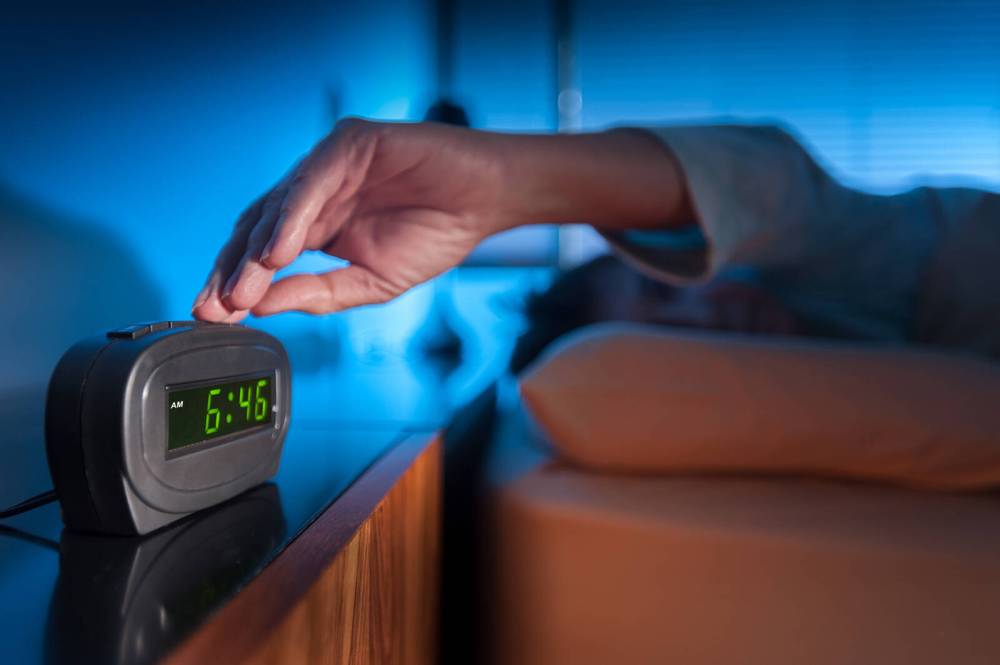
Manitobans will no longer fall back or spring forward, as the province will remain on central daylight time. (Dreamstime / TNS files)
“We heard from Manitobans loud and clear — no more changing the clocks in Manitoba,” Premier Wab Kinew said in a news release Thursday. “Permanent daylight saving time is good for our health, good for business and good for parents… This change means one less adjustment families have to deal with each spring and fall. That’s why this November, your clocks won’t be changing.”
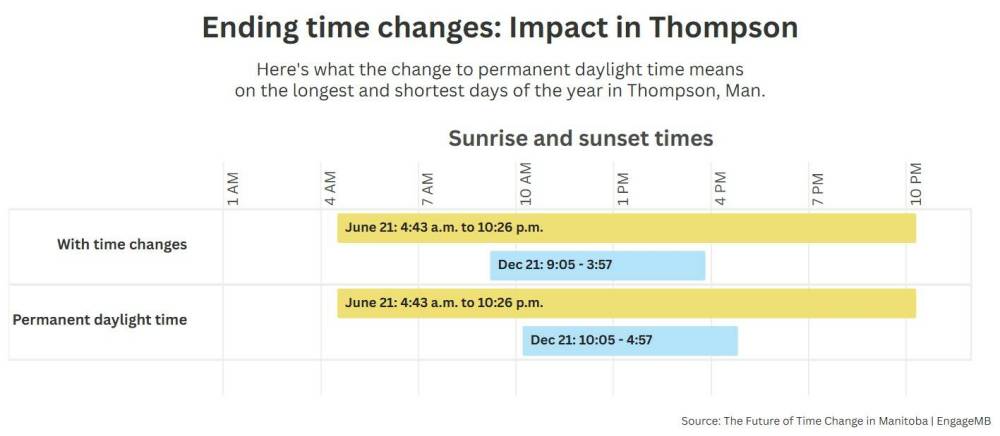
More than half of the people who took part in an online EngageMB survey said they would like to see the practice end. The survey asked if they preferred earlier sunrises in winter with standard time or the later sunsets in summer with daylight time.
Manitoba arrived at the decision after Saskatchewan, Yukon, British Columbia and Alberta.
After the announcement in March that B.C. would stick to daylight time year-round, Kinew said Manitoba would not follow suit.
“Everybody’s got an opinion on it, but we only have so many hours in a day, and we’re going to spend those hours on health care and lowering your cost of living,” he said at the time.
But after hearing from many Manitobans who were tired of the practice, a few weeks later Kinew announced the online survey.
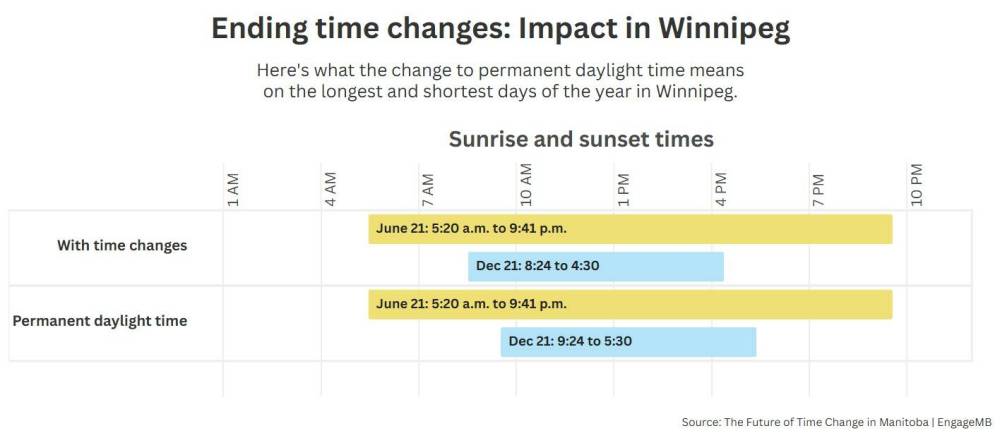
At the time, the premier referenced a 2025 study by researchers at California’s Stanford University, who concluded that adopting one time for the entire year is better for human health. That study, which was cited in the Manitoba survey, suggested permanent standard time would bring the most health benefits, including a reduction in obesity and strokes.
However, a public opinion poll in May indicated that Manitobans preferred year-round daylight time. That survey, conducted by Winnipeg-based Prairie Research Associates, found roughly three in four Manitobans supported an end to seasonal time changes.
It has been a perennial issue on both sides of the political aisle.

In 2019, while in opposition, the New Democrats launched public consultations; Kinew hasn’t said what became of them.
In 2022, under the Tories, the provincial government considered moving to year-round daylight time. A bill before the legislature was tied to the United States changing its seasonal time change, and Manitobans would’ve needed to support the idea. The U.S. bill has repeatedly stalled, including last October in the Senate.
Progressive Conservative MLA Ron Schuler introduced a private member’s bill in March to move Manitoba to permanent daylight time.
The daylight saving time transition in spring originated during the First World War to boost productivity, conserve energy and extend daylight leisure time.
carol.sanders@freepress.mb.ca
Report on health implications of time change
Our newsroom depends on a growing audience of readers to power our journalism. If you are not a paid reader, please consider becoming a subscriber.
Our newsroom depends on its audience of readers to power our journalism. Thank you for your support.
Our newsroom depends on a growing audience of readers to power our journalism. If you are not a paid reader, please consider becoming a subscriber.
Our newsroom depends on its audience of readers to power our journalism. Thank you for your support.
Advertisement Advertise With Us
Advertisement Advertise With Us
History
Updated on Thursday, September 17, 2026 9:55 AM CDT: Adds graphics, PDF.