

Transit safety drives first mayoral debate
Incumbent Scott Gillingham absent as other candidates call for full shields, better security
Advertisement
Read this article for free:
or
Already have an account? Log in here »
To continue reading, please subscribe:

Digital Subscription
One year of digital access for only $205*
- Enjoy unlimited reading on winnipegfreepress.com
- Read the E-Edition, our digital replica newspaper
- Access News Break, our award-winning app
- Play interactive puzzles
*First annual payment billed as $205.00 + GST for one year. This annual subscription will automatically renew at $233.00 + GST every 52 weeks (10% off the regular annual price of $259.35). Offer available to new and qualified returning subscribers only. Cancel any time.
To continue reading, please subscribe:
Add Free Press access to your Brandon Sun subscription for only an additional
$1 for the first 4 weeks*
- Enjoy unlimited reading on winnipegfreepress.com
- Read the E-Edition, our digital replica newspaper
- Access News Break, our award-winning app
- Play interactive puzzles
*Your next Brandon Sun subscription payment will increase by $1.00 and you will be charged $17.95 plus GST for four weeks. After four weeks, your payment will increase to $24.95 plus GST every four weeks.
Read unlimited articles for free today:
or
Already have an account? Log in here »
The safety of Winnipeg Transit drivers was front and centre Monday as the first mayoral debate of the 2026 election focused on public transit.
Kevin Klein, the most experienced of the 10 candidates at the Amalgamated Transit Union 1505-hosted debate, said the time for partial safety shields has passed.
“The partial shields have failed drivers. That’s why we need change,” the former PC MLA and city councillor said, adding driver safety is not a staffing issue, but a “protection failure.”
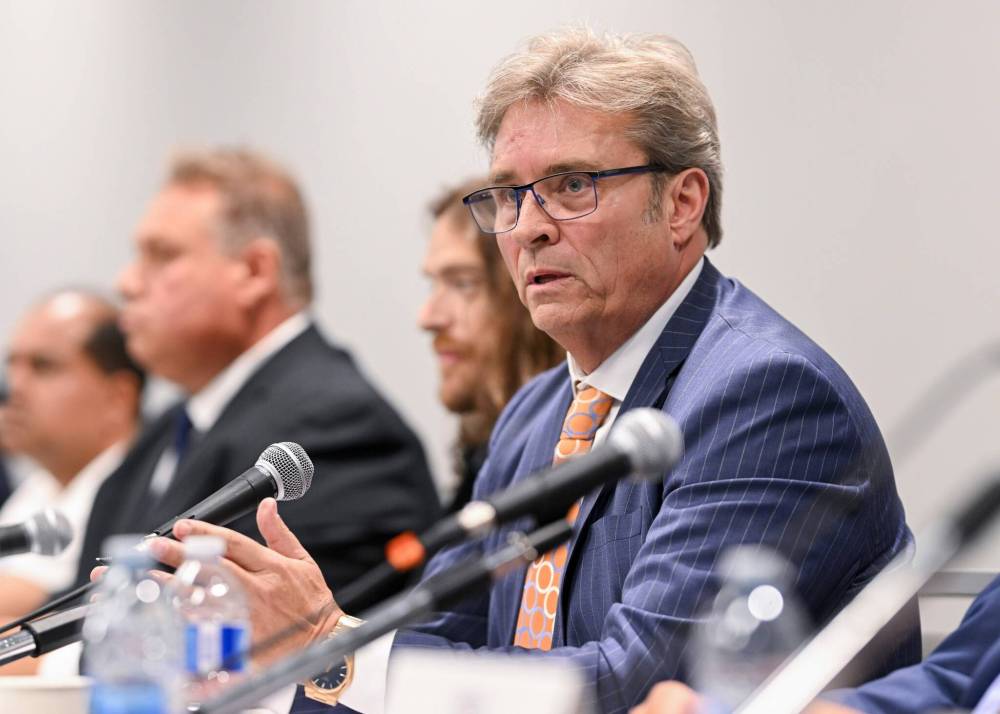
Mike Sudoma / Free Press
Mayoral Candidate Kevin Klein told the Amalgamated Transit Union’s debate it’s time for full safety shields.
If elected, Klein said he will bring in full-shield implementation across the city within two years and start a nine-bus pilot project immediately.
“A fleet-wide plan will be funded and scheduled in the first budget cycle,” he said.
Klein said he would work with stakeholders such as the ATU 1505 and others on how to fund the project.
The debate, hosted at the Union Centre on Broadway, drew 10 of 14 candidates seeking the city’s top office, but alongside incumbent mayor, Scott Gillingham, who had an undisclosed previously planned campaign event, Zac Uminski, Tracey Drexler and Gagandeep Bawa, were absent.
Other candidates took runs at the new route structure and governance issues, but safety was a recurring theme.
Michael Vogiatzakis, a funeral home director who previously said he would restore transit to a route system that works, called the new network a failure.
Alongside transit police, he wants cameras installed at bus shelters and to have passengers require a special transit I.D. to access buses and shelters, similar to liquor marts, and panic buttons at various stops. He wants to install lighting at stops to prevent crime.
“We need to make Winnipeg safe again, and we need to use common sense to do it,” he said.
Don Woodstock, a security company owner who has run for mayor twice in 2018 and 2022, wants the creation of a transit driver advisory board and plain-clothes police officers on buses.
Woodstock has been married to a transit operator and a driver for 10 years, he said, adding he’s the only candidate who has experience dealing with abuse experienced by drivers.
“Shields are great, but it goes beyond that. We have to look at the other problems that are affecting this to happen. To talk about this in isolation to the homeless issue, or to talk about this in isolation to the drug addiction issue, is futile,” he said.
Brad Gross said he wants to increase transit revenue for security by advertising on the new protective shields and have a full-security team on buses, which would put an end to fare evasion.
“We’re not talking old people. We’re talking some big guys who are just going to handle things properly, and respectfully of course,” said Gross.
Software developer Noah Redden said he would develop a team made up of uniformed police and mental health and addictions specialists to respond to violent emergencies and overdose calls.
“I do believe that a lot of people in the city who are behind a lot of the incidents are at a very low point in their lives, so I would want to treat them with compassion while respecting the safety of people on the bus,” Redden said.
West Kildonan resident Joshua Pagdato said he would like to see direct radio lines between police and transit operators. Just this week, his godson was assaulted while riding the bus, he said.
Real estate agent Umar Hayat wants to eliminate transit fares for seniors and youth under 20, and hire 200 cadets to ride buses as part of his safety initiative.
Hardeep Dhaliwal, who has been working as a transit driver for two years, said he felt Monday’s debate was critical.

“My reason for coming here is because I want to have a safer place to work at,” he said, noting he felt Klein and Redden had the best approaches to safety.
“Somebody is actually talking about what we go through every day, and every hour of the day. Having this debate, at this level, is great.”
While the union and bus drivers can constantly raise concerns, it’s the people involved in the debate who might be able to make change, he said.
A full broadcast of the debate can be found on the ATU 1505 Facebook page.
morgan.modjeski@freepress.mb.ca