

No reason to panic about city’s projected $29-M shortfall: councillor
High fuel prices, snow-clearing cost cited in finance report

Advertisement
Read this article for free:
or
Already have an account? Log in here »
To continue reading, please subscribe:

Digital Subscription
One year of digital access for only $205*
- Enjoy unlimited reading on winnipegfreepress.com
- Read the E-Edition, our digital replica newspaper
- Access News Break, our award-winning app
- Play interactive puzzles
*First annual payment billed as $205.00 + GST for one year. This annual subscription will automatically renew at $233.00 + GST every 52 weeks (10% off the regular annual price of $259.35). Offer available to new and qualified returning subscribers only. Cancel any time.
To continue reading, please subscribe:
Add Free Press access to your Brandon Sun subscription for only an additional
$1 for the first 4 weeks*
- Enjoy unlimited reading on winnipegfreepress.com
- Read the E-Edition, our digital replica newspaper
- Access News Break, our award-winning app
- Play interactive puzzles
*Your next Brandon Sun subscription payment will increase by $1.00 and you will be charged $17.95 plus GST for four weeks. After four weeks, your payment will increase to $24.95 plus GST every four weeks.
Read unlimited articles for free today:
or
Already have an account? Log in here »
The City of Winnipeg expects to end this year with a nearly $29-million shortfall in its tax-supported operating budget, as costs for fuel, snow-clearing and other expenses pile up.
The financial outlook is based on data up to June 30 and projects a deficit that is $8.5 million larger than the city’s first-quarter forecast.
“It’s obviously going in the wrong direction but … I wouldn’t necessarily consider it (reason for) panic at this point. It’s not surprising with fuel prices, in particular, being higher than forecast,” said Coun. Jeff Browaty (North Kildonan), city council’s finance chairman.
MIKE DEAL / FREE PRESS FILES
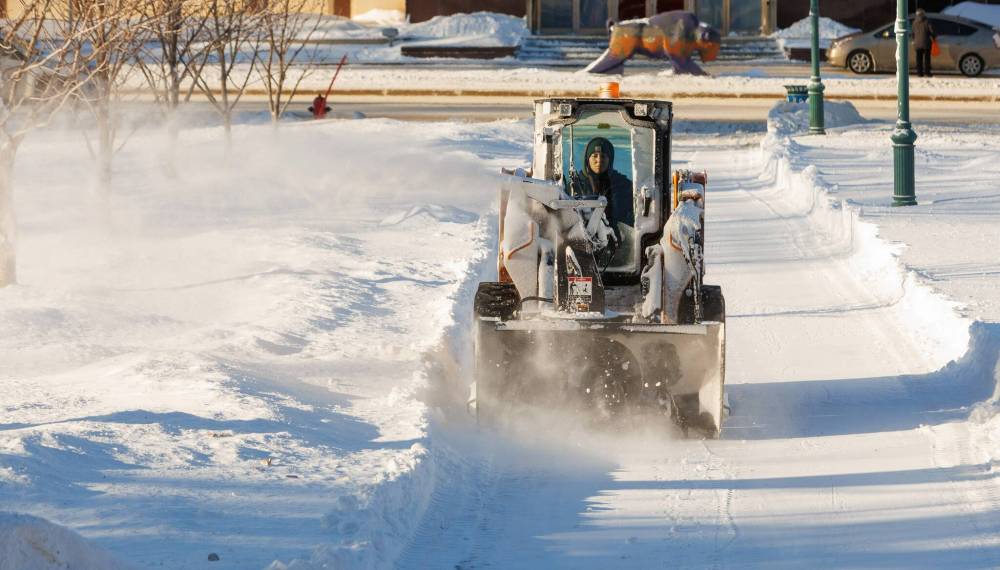
The city’s public works department expects a $16.1-million shortfall by the end of this year, in part because of high costs for snow removal.
Traditionally, the city’s finances often improve in later months of the year, though there is no guarantee that will happen.
The public works department expects a $16.1-million shortfall by the end of this year, mostly due to high costs for snow removal and ice control, spring cleaning and roadway construction/maintenance, a finance report notes.
“Even with our larger budget for snow-clearing that we’ve increased over time to more closely match what it costs to remove snow … (we) do have it in a deficit position,” said Browaty, noting snow-clearing contract prices also increased.
The city may need to consider a further budget hike to cover that seasonal cost in future years, he said.
“I believe that’s probably the case. The contracts are up for very obvious reasons, the higher cost of fuel, the higher costs of equipment and, potentially … the higher costs of tariffs on that equipment,” said Browaty.
Winnipeg Fire Paramedic Service expects a $7.4-million shortfall, largely due to overtime costs, while the city’s planning, property and development department predicts a $4.3-million shortfall, mostly due to lower-than-expected fee revenues and higher salary costs.
Winnipeg Police Service expects to end the year $4.5 million in the red, mainly because it has yet to achieve a city council-directed target to save $7 million during the year.
Losses and gains in other city departments affect the final figure.
As a paid service, Winnipeg Transit finances are counted separately. Transit expects to end the year with a $20.7-million deficit, due to higher fuel costs (partly due to the U.S. war with Iran), rising overtime, increased Workers Compensation Board claims and reduced ridership.
“Even with (Transit’s) normal conservative budget, we are consistently above and beyond what was in the budget for (fuel) this year … So that is certainly one of the stresses on transit,” said Browaty.

City finance officials predict the municipal government will have a “consolidated shortfall” of $18.8 million by the end of the year. That broader figure includes the operating budget projection, as well as the financial outlook for city utilities and special operating agencies.
“I think it paints a better picture of the entire city organization, when you include things like Transit, water and sewer utility. It’s just a more consistent look at the entire operation,” said Browaty.
Winnipeg water and waste, for example, expects to earn $33.2 million more than its budget predicted. However, Browaty noted that revenue was raised to help fund billions of dollars of required sewage treatment upgrades.
joyanne.pursaga@freepress.mb.ca
X: @joyanne_pursaga
Born and raised in Winnipeg, Joyanne loves to tell the stories of this city, especially when politics is involved. Joyanne became the city hall reporter for the Winnipeg Free Press in early 2020.
Our newsroom depends on a growing audience of readers to power our journalism. If you are not a paid reader, please consider becoming a subscriber.
Our newsroom depends on its audience of readers to power our journalism. Thank you for your support.
Born and raised in Winnipeg, Joyanne loves to tell the stories of this city, especially when politics is involved. Joyanne became the city hall reporter for the Winnipeg Free Press in early 2020.
Our newsroom depends on a growing audience of readers to power our journalism. If you are not a paid reader, please consider becoming a subscriber.
Our newsroom depends on its audience of readers to power our journalism. Thank you for your support.
Advertisement Advertise With Us
Advertisement Advertise With Us