

AI fears voiced during public consultation in Brandon
Advertisement
Read this article for free:
or
Already have an account? Log in here »
To continue reading, please subscribe:

Digital Subscription
One year of digital access for only $205*
- Enjoy unlimited reading on winnipegfreepress.com
- Read the E-Edition, our digital replica newspaper
- Access News Break, our award-winning app
- Play interactive puzzles
*First annual payment billed as $205.00 + GST for one year. This annual subscription will automatically renew at $233.00 + GST every 52 weeks (10% off the regular annual price of $259.35). Offer available to new and qualified returning subscribers only. Cancel any time.
To continue reading, please subscribe:
Add Free Press access to your Brandon Sun subscription for only an additional
$1 for the first 4 weeks*
- Enjoy unlimited reading on winnipegfreepress.com
- Read the E-Edition, our digital replica newspaper
- Access News Break, our award-winning app
- Play interactive puzzles
*Your next Brandon Sun subscription payment will increase by $1.00 and you will be charged $17.95 plus GST for four weeks. After four weeks, your payment will increase to $24.95 plus GST every four weeks.
Read unlimited articles for free today:
or
Already have an account? Log in here »
BRANDON — Security against cybercriminals, safeguards against being tracked or monitored and limiting the role of artificial intelligence in people’s lives were some of the concerns raised during a public consultation in Brandon Monday.
Innovation and New Technology Minister Mike Moroz said it was essential to give people an opportunity to speak about what AI means in a “Manitoba context.”
He was a teacher, he said, when cellphones started becoming a part of daily life, and now governments are being forced to double back and implement regulations years later.
Matt Goerzen/The Brandon Sun
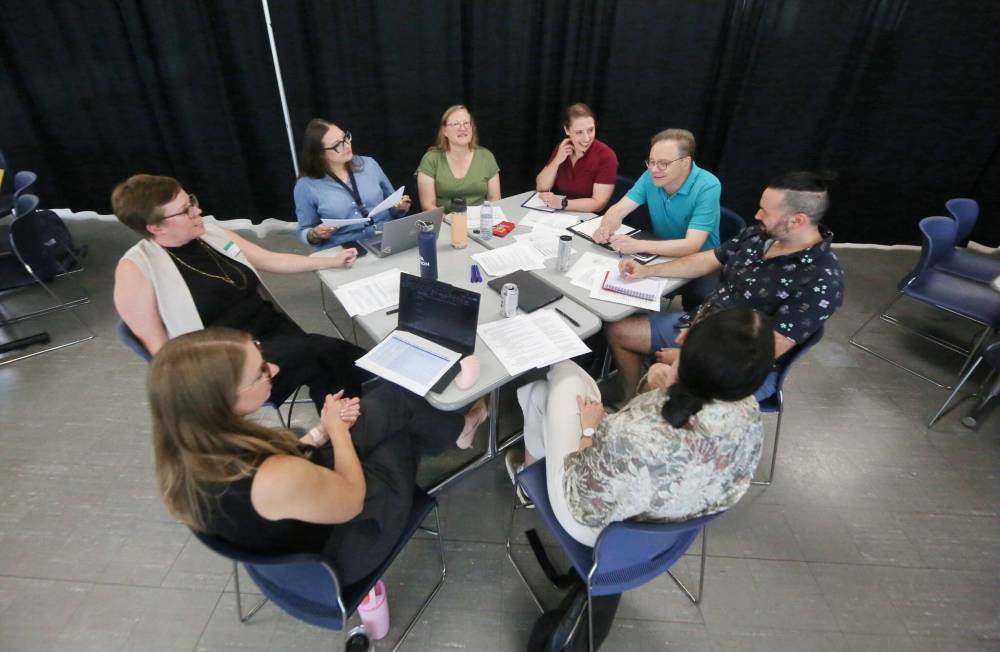
Participants chat at one of several tables set up at Brandon University for a public listening session organized by the province to gather perspectives on the governance and responsible use of artificial intelligences, cybersecurity and the protection of Manitobans’ data.
“We can’t afford to have that same pattern or follow that same pattern with AI. It is so much more pervasive, so much more dominant and has so many more potential ramifications than what we’ve experienced at this point in time,” Moroz, the MLA for River Heights, told attendees.
“It’s critically important that we gather as a community early in the process and start to map out what it is we want.”
The public outreach was part of the government’s process to draft regulations for Bill 51, the Public Sector Artificial Intelligence and Cybersecurity Governance Act, which came into effect in June. Another engagement session is set for Wednesday in Winnipeg.
Speaking to attendees at the session, Moroz said the “right to be forgotten” is a very common topic that he’s heard, with some people saying they prefer no data collection or tracking at all. But he added that can pose problems in areas such as health care, where keeping data can help save someone’s life.
Another point raised by participants was that companies should only be allowed to track the minimum data possible, and the impact of AI on youth was also an issue.
Matteo Di Muro, a professor at Brandon University’s faculty of education, said he would have liked to see more talk about how the province will address AI in the K-12 school system.
Democratic participation, he added, hinges on people knowing how the world works, and there isn’t a framework in place for kids on how to use the technology safely and effectively.
“Now you’ve got AI running rampant without a lot of controls,” Di Muro said. “So, the only way to defend ourselves, you know, besides making laws for these companies, is to educate the youth about it.”
He said the discussion was a good start, but that the process felt a bit filtered.
Fellow attendee Rhoni Mohanraj described the rise of AI as a “fundamental moment” for the next 25 years, and said he was there for that reason and as a business owner.
“What interests me is in understanding how this applies from a business perspective and what the legislation and the government is doing about it, and then from a personal perspective, where sort of the world is going for the future,” he said.
Moroz said before the meeting that AI has introduced anxiety for everyone, and the public discussions are important to strike a balance.
“How do we thread the needle between putting up sufficient guardrails so that people feel secure in their lives with their data, in their futures, while at the same time taking full advantage of a technology that could revolutionize things like medical research?” he said.

Moroz said Manitoba is “well ahead” of other jurisdictions when it comes to regulating AI.
He said as AI evolves, the regulations will need to continue to evolve as well.
Premier Wab Kinew announced in April a plan to ban social media for youth under the age of 16. At the start of the 2024 school year, Manitoba banned cellphones in the classroom.
Winnipeggers can have their say Wednesday from 7 p.m. to 9 p.m. at Norberry-Glenlee Community Centre.
— Brandon Sun