

Community gardens, urban farms more than hobby spaces, report authors say

Advertisement
Read this article for free:
or
Already have an account? Log in here »
To continue reading, please subscribe:
Digital Subscription
One year of digital access for only $1.44 a week*
- Enjoy unlimited reading on winnipegfreepress.com
- Read the E-Edition, our digital replica newspaper
- Access News Break, our award-winning app
- Play interactive puzzles
*Billed as $5.77 plus GST every four weeks. After 52 weeks, price increases to the regular rate of $19.95 plus GST every four weeks. Offer available to new and qualified returning subscribers only. Cancel any time.
To continue reading, please subscribe:
Add Free Press access to your Brandon Sun subscription for only an additional
$1 for the first 4 weeks*
- Enjoy unlimited reading on winnipegfreepress.com
- Read the E-Edition, our digital replica newspaper
- Access News Break, our award-winning app
- Play interactive puzzles
*Your next Brandon Sun subscription payment will increase by $1.00 and you will be charged $17.95 plus GST for four weeks. After four weeks, your payment will increase to $24.95 plus GST every four weeks.
Read unlimited articles for free today:
or
Already have an account? Log in here »
The City of Winnipeg is being urged to make several changes to keep community gardens and urban farms in place longer.
A Pro Bono Students Canada report recommends encouraging mobile gardens in raised planters that can be set up temporarily on one lot and moved as needed, adding a “no-loss” principle to ensure each community garden that shuts down on city land is replaced with a nearby alternative and changing development policies to prioritize and preserve the green spaces.
Aaia Haji Hussein, one of the report’s two authors, said it’s important that community gardens are recognized as more than just spaces to pursue a hobby.
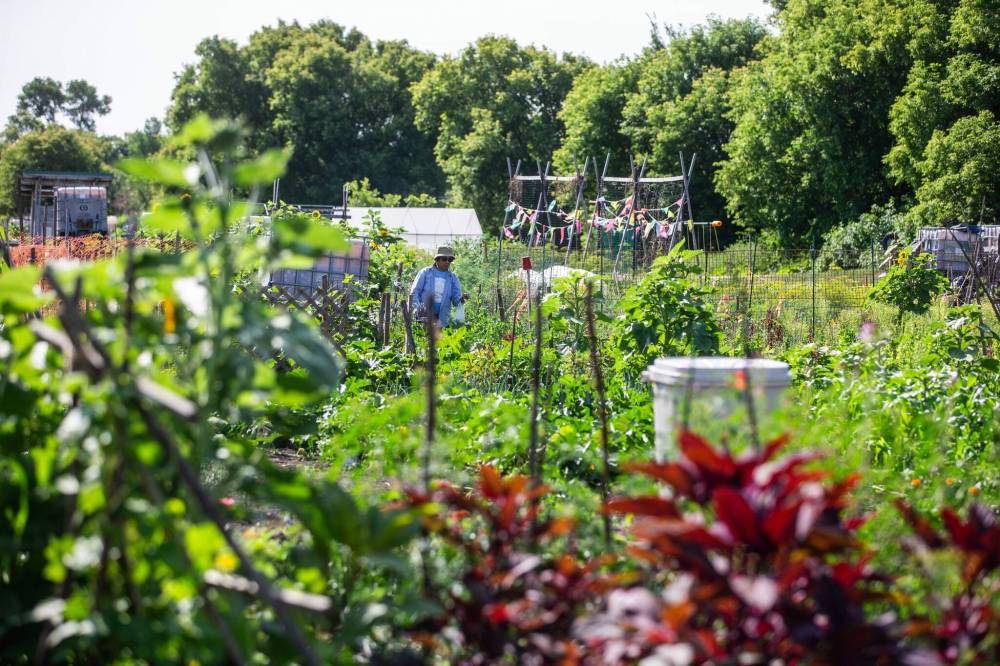
MIKAELA MACKENZIE / FREE PRESS FILES
A recent report suggests community gardens should be recognized as more than just spaces to pursue a hobby.
“They’re meant to address things like food security, public health, community infrastructure…. They’re a real way that communities get their food, where they spend time with one another, where they learn things,” said Haji Hussein.
She and Tiana Klippenstein produced the report as part of Pro Bono Students Canada, which provides free legal information and services to community organizations. The two authors are University of Manitoba law students.
The report recommends the city take the following actions to protect urban farms and community gardens:
— Manage land through leases for city-owned land, possibly lasting one to five years and remove the ability for land to be taken back with 30 days’ notice.
— Create low-cost annual business licences for urban farms, which would allow the city to better track them and support farmers seeking insurance or financing.
— Encourage mobile gardens in raised planters and containers that can be moved to new locations, so gardens removed to make space for land to take on a different use can continue growing.
— Follow a “no loss” principle that ensures a new community garden is added near each one on city land that shuts down.
— Update the city’s overarching development plan, OurWinnipeg 2045, to recognize community gardens as critical food infrastructure and include them in community development policies to help reduce food insecurity.
— Amend Winnipeg zoning bylaws to list community gardens as protected or prioritized uses in key zones, require redevelopment proposals to consider retaining the gardens and set minimum garden-protection timelines.
The report says the current warning period required before replacing a community garden isn’t conducive to longer-term projects, which is why longer leases are suggested.
“If we really want people to be investing in community gardens and caring about community gardens, they need to know that it’s not going to be taken away on 30 days’ notice. Just offering the longer-term leases allows people to feel more comfortable with putting their time and their effort and their money into community gardens,” said Klippenstein.
The call to focus on more “mobile gardens” reflects the fact cities must consider multiple uses for land, such as housing.
“It helps with the stability of community gardens because it ensures that even when the land is used for redevelopment… people aren’t starting from zero (with the relocated gardens),” said Klippenstein.
Haji Hussein said the series of proposed changes to OurWinnipeg aim to build on existing policies that support food access across income levels.
“They get the community involved in creating that healthy food…. It’s making sure that gardening isn’t only accessible to people who have land and backyards,” she said.
Haji Hussein hopes the variety of options helps ensure some changes can protect more gardens soon.
“We understand that there are competing interests at all times, in terms of needing affordable housing and commercial land,” she said.
Coun. Emma-Durand Wood, chairwoman of the Winnipeg Food Council, said it’s too early to say whether the council will propose recommendations from the report for city council to consider, since the report marks the “very beginning stages” of that process.
Durand-Wood (Elmwood-East Kildonan) said the food council’s co-ordinators referred all questions to her, as chairwoman, on Friday.
Coun. Brian Mayes, a former Winnipeg Food Council chairman, said the ideas are promising.
“Community gardens are an important environmental (program). We’re trying to reduce our carbon output and growing more food locally is an important part of that,” said Mayes (St. Vital).

The councillor said adding business licences, allowing longer term use of land plots, updating zoning bylaws and encouraging mobile gardens should all be considered.
“(Mobile gardens are) creative…. That’s different and it’s not super pricey, so I think that could be feasible,” said Mayes.
In 2020, the food council said there were at least 60 community gardens in Winnipeg managed by various groups, while the city rented out plots at another 11 garden allotment sites. An updated number was not available by deadline Friday.
joyanne.pursaga@freepress.mb.ca
X :@joyanne_pursaga
Born and raised in Winnipeg, Joyanne loves to tell the stories of this city, especially when politics is involved. Joyanne became the city hall reporter for the Winnipeg Free Press in early 2020.
Our newsroom depends on a growing audience of readers to power our journalism. If you are not a paid reader, please consider becoming a subscriber.
Our newsroom depends on its audience of readers to power our journalism. Thank you for your support.
Advertisement Advertise With Us
Advertisement Advertise With Us