

Université de Saint‑Boniface adds nursing spots thanks to provincial funding boost

Advertisement
Read this article for free:
or
Already have an account? Log in here »
To continue reading, please subscribe:

Digital Subscription
One year of digital access for only $205*
- Enjoy unlimited reading on winnipegfreepress.com
- Read the E-Edition, our digital replica newspaper
- Access News Break, our award-winning app
- Play interactive puzzles
*First annual payment billed as $205.00 + GST for one year. This annual subscription will automatically renew at $233.00 + GST every 52 weeks (10% off the regular annual price of $259.35). Offer available to new and qualified returning subscribers only. Cancel any time.
To continue reading, please subscribe:
Add Free Press access to your Brandon Sun subscription for only an additional
$1 for the first 4 weeks*
- Enjoy unlimited reading on winnipegfreepress.com
- Read the E-Edition, our digital replica newspaper
- Access News Break, our award-winning app
- Play interactive puzzles
*Your next Brandon Sun subscription payment will increase by $1.00 and you will be charged $17.95 plus GST for four weeks. After four weeks, your payment will increase to $24.95 plus GST every four weeks.
Read unlimited articles for free today:
or
Already have an account? Log in here »
Université de Saint‑Boniface is expanding its nursing training program — the only one of its kind delivered entirely in French in Western Canada — by 30 seats this fall.
The Manitoba government announced a one-time injection of funding for the bachelor of nursing program on Wednesday.
Over the next four years, the francophone university will receive a combined $220,000 to increase its incoming cohort of nursing students to 75.
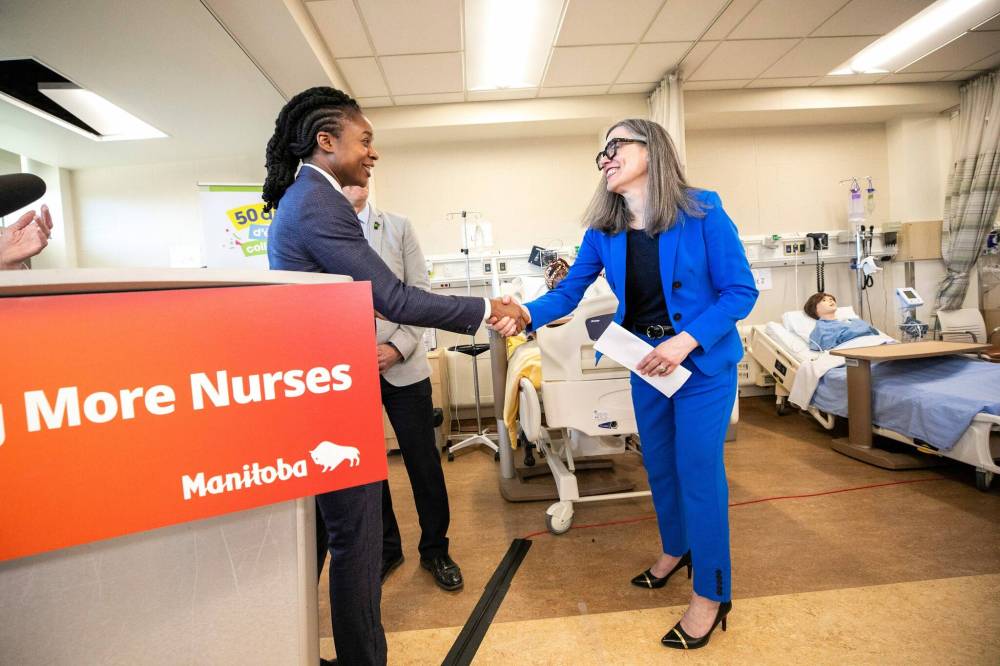
MIKAELA MACKENZIE / FREE PRESS
Health minister Uzoma Asagwara (left) and Sophie Bouffard, president of Université de Saint‑Boniface, at the news conference Wednesday.
“I have one big ask of all of these students, ‘Please stay in Manitoba. Please stay right here. We’re going to have jobs for you (in 2030),’” Health Minister Uzoma Asagwara told an afternoon news conference on the St. Boniface campus.
University president Sophie Bouffard welcomed the extra funding that she said she hopes will be renewed.
Bouffard said there was record interest in the four-year, direct-entry bachelor’s degree ahead of September. There was a wait list in 2025-26.
Flanked by Asagwara, Advanced Education Minister Renée Cable and others inside a university lab, the president said the announcement sends a strong message about the importance of bilingual health-care services.
“Language matters in health care. Being able to receive care in the official language of your choice has a direct impact on the accuracy of diagnosis, on trust, on safety, on quality of care, on recovery and on healing,” Bouffard said.
The Association of Manitoba Bilingual Municipalities, a collective representing 16 municipal governments in which there are 10 hospitals, met with Asagwara in late 2025 to share their concerns about care.
“A critical issue was raised regarding Hôpital Ste. Anne Hospital. The operating room and surgical services have been closed for a month due to a shortage of trained nurses and maternity leaves, forcing patients to travel to Steinbach for surgical care. This situation severely compromises safety and accessibility,” meeting minutes show.
A summary of the December 11 roundtable said municipal leaders also spoke about the importance of proactive planning to attract and retain staff, promoting health careers in French-language high schools and the need for French representation at Shared Health and within regional authorities.
Association president Ivan Normandeau noted the health care facility in Ste. Anne is moving toward regional designation. “To support that kind of vision, we need skilled, dedicated, well-trained bilingual professionals,” Normandeau said.

Université de Saint‑Boniface sets students up with clinical placements in French settings and prioritizes community-based work experiences, said Daniel Gagné, dean of health studies.
Gagné said 97 per cent of nursing graduates offer French services locally within the first six months of their career.
The majority of graduates find employment at St. Boniface Hospital, he said.
The health minister indicated close to 1,000 nurses graduate from local medical programs annually and more than nine in 10 of them join the local workforce.
maggie.macintosh@freepress.mb.ca
Maggie Macintosh reports on education for the Winnipeg Free Press. Funding for the Free Press education reporter comes from the Government of Canada through the Local Journalism Initiative.
Our newsroom depends on a growing audience of readers to power our journalism. If you are not a paid reader, please consider becoming a subscriber.
Our newsroom depends on its audience of readers to power our journalism. Thank you for your support.
Maggie Macintosh reports on education for the Winnipeg Free Press. Funding for the Free Press education reporter comes from the Government of Canada through the Local Journalism Initiative.
Our newsroom depends on a growing audience of readers to power our journalism. If you are not a paid reader, please consider becoming a subscriber.
Our newsroom depends on its audience of readers to power our journalism. Thank you for your support.
Advertisement Advertise With Us
Advertisement Advertise With Us