Misery loved company City's decision to raze tent community east of Main Street strip a devastating blow to people who found comfort and strength in numbers
Read this article for free:
or
Already have an account? Log in here »
To continue reading, please subscribe:
Digital Subscription
One year of digital access for only $1.44 a week*
- Enjoy unlimited reading on winnipegfreepress.com
- Read the E-Edition, our digital replica newspaper
- Access News Break, our award-winning app
- Play interactive puzzles
*Billed as $5.77 plus GST every four weeks. After 52 weeks, price increases to the regular rate of $19.95 plus GST every four weeks. Offer available to new and qualified returning subscribers only. Cancel any time.
To continue reading, please subscribe:
Add Free Press access to your Brandon Sun subscription for only an additional
$1 for the first 4 weeks*
- Enjoy unlimited reading on winnipegfreepress.com
- Read the E-Edition, our digital replica newspaper
- Access News Break, our award-winning app
- Play interactive puzzles
*Your next Brandon Sun subscription payment will increase by $1.00 and you will be charged $17.95 plus GST for four weeks. After four weeks, your payment will increase to $24.95 plus GST every four weeks.
Read unlimited articles for free today:
or
Already have an account? Log in here »
Hey there, time traveller!
This article was published 27/12/2020 (2120 days ago), so information in it may no longer be current.
”Sleeping on benches, bus stops, sometimes just the sunniest patch of grass to enjoy actual warmth from a hard night of just trying to stay alive. I’ve been to points where finding food in a garbage can was a blessing from my own thought of what a higher power is.”– Desirae
The cold is cruel and unrelenting.
An extreme weather warning has been declared in Western Canada, and in Winnipeg, the temperature is projected to hit -40 C with the windchill.
It is Jan. 15, 2020, and tonight, people sleep outside in tents.
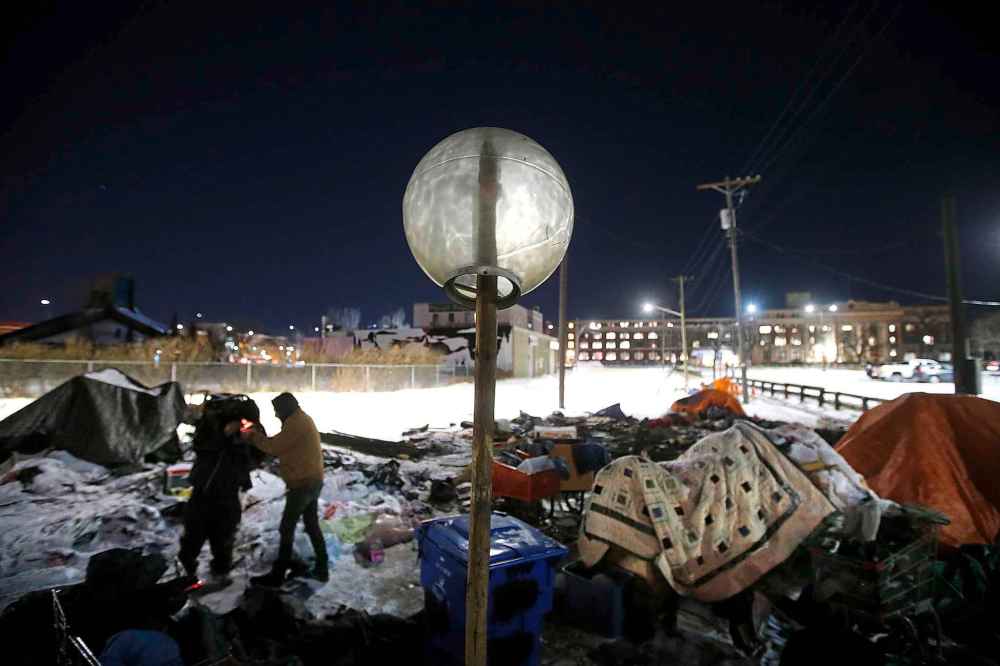
Half of the lights at the Salvation Army are illuminated. A police cruiser crawls down the block twice an hour, idling just long enough to peek at the homeless encampments off the Main Street strip before driving away.
Life on the Strip
The costs of homelessness — both in fiscal resources and human misery — are difficult to fathom. And the problem, which has has plagued Winnipeg for decades, is growing.
In order to better understand the issue, the Free Press spent the past year documenting life on the streets and in the shelters.
The costs of homelessness — both in fiscal resources and human misery — are difficult to fathom. And the problem, which has has plagued Winnipeg for decades, is growing.
In order to better understand the issue, the Free Press spent the past year documenting life on the streets and in the shelters, interviewing advocates, community activists and academics, reviewing research papers, shadowing social-service workers and consulting people with expertise gained through lived experience.
The result is Life on the Strip: A year-long examination of Main Street homelessness.
At the start of each instalment is a quote from Desirae, one of the people profiled in this series. She lives on the streets of Winnipeg in a tent. The quotes are excerpted from an essay she wrote and submitted to the Free Press.
This is chapter three of nine. It looks at the City of Winnipeg’s effort to dismantle homeless camps. See the full series at wfp.to/lifeonthestrip.
A man emerges from the mass of tents, cradling a box of belongings like an infant. His pants slip down his thin frame with each step. He hits a slick patch of ice and slides in short bursts like a curler tracking a heavy rock, his breath hanging in the air as if pollution pumped from smokestack lungs.
Word around the camp is the city plans to dismantle it come morning. But for many residents, confusion abounds. They don’t know what to believe or dismiss as rumour. It’s unclear what’s expected of them or whether they’ll be forced to leave.
Some pack their belongings fearing the worst, others seem less concerned. Whatever happens, none of this is new. They have done this before. It won’t be the first time, nor the last, they’ve been displaced. It won’t be the first time they’ve had to start from scratch.
● ● ●
The fires just wouldn’t stop burning.
For months, the camps off the Main Street strip — and less-visible camps scattered throughout the city — had been a source of tension. It was as if Winnipeg were a chessboard, with community organizers and activists on one side, and police and civic officials on the other.
The homeless were just pawns in a larger game.
The trouble began in the summer of 2019 when news broke the City of Winnipeg was seeking to hire a private company to dismantle the camps. The backlash from advocates was swift, and so — after some deliberation — the city backed off.
But then the fires started.
The first blaze sparked in October when a camp under the Osborne Street Bridge went up in flames after a candle set fire to a tent. Thick smoke belched from under the span, filling the sky and blanketing the neighbourhood.
On the street, in shelters
The 2018 Winnipeg Street Census found roughly 200 people sleeping unsheltered on the streets, and about 400 people staying temporarily in emergency shelters.
While there were no serious injuries, the dozen or so people who called the camp home found themselves with nowhere to go. Worst of all, the little community they’d forged under the bridge was broken up.
In November, a cold snap descended on the city, and a downtown advocacy group — worried about the safety of those living unsheltered — donated two wooden warming huts to a camp off the Main Street strip.
Within days, officials moved in and confiscated the huts, citing bylaw and fire-code breaches.
But soon enough, Indigenous activists countered by setting up a ceremonial teepee at the camp. This put the city in a tough spot: Removing the warming huts was one thing, but dismantling a teepee on the traditional homeland of the Métis was different. It would have been a public relations nightmare.

City officials said they understood the cultural significance of the teepee and would let it stand. Within a week, a second teepee was erected at the camp. It would come to be known as Matthew’s Place, and was donated by Walter Richard in honour of his nephew, Matthew Allen Sutherland.
Sutherland, 28, was Winnipeg’s 37th homicide victim of the year. He was fatally stabbed in the West End on Oct. 31. Prior to his slaying, he’d lived in transitional housing and accessed support services on the strip.
Forty-four people were murdered in 2019, making it the bloodiest calendar year in the city’s history.
On Jan. 3, 2020, a small tent fire broke out at the camp, sending one person to hospital. Again, the cause of the fire was believed to be a candle.
The next week, another fire sparked, this one in the first donated teepee. It was extinguished before the blaze got out of hand, and soon after residents dismantled the structure and repurposed the wood and materials.
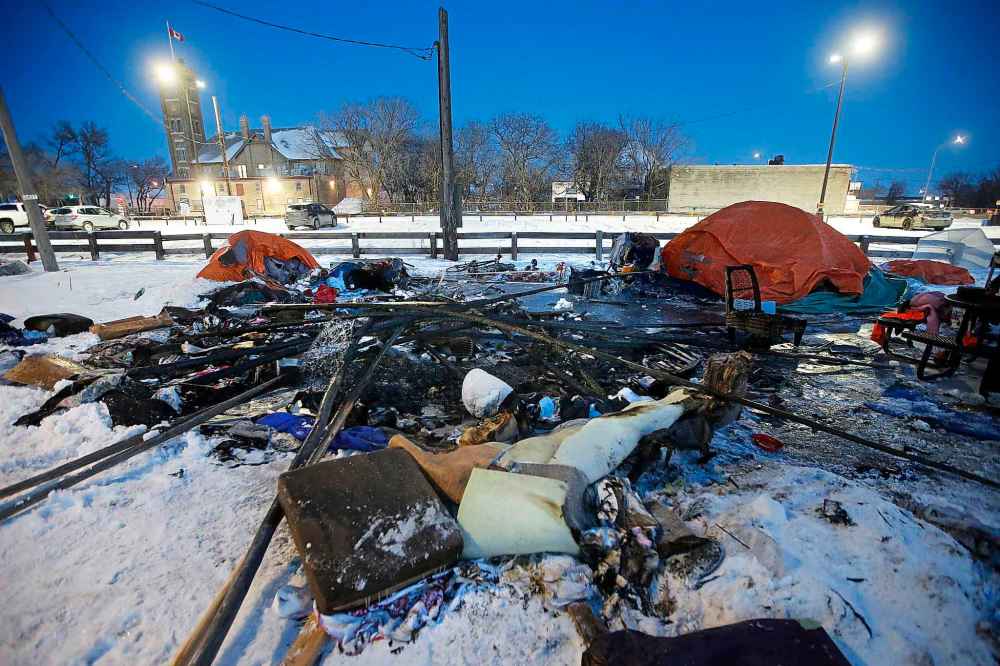
But on Jan. 15, flames licked high in the sky as Mathew’s Place burned to the ground. It was later revealed the person tasked with keeping watch on the fire had left his post. Before anyone knew something was wrong, black smoke was billowing out the top.
Within hours, city officials announced enough was enough: the next morning, the camp would be dismantled. Whether they knew it or not, the residents were officially on notice.
Kyle and Desirae do little more than shrug their shoulders at the news. They have more pressing matters to worry about, such as preparing for the long, cold night ahead.
“I don’t know what we’re going to do,” Desirae says, shivering outside her tent.
“If they come, they come.”
● ● ●
All is quiet at the camp, and the world around it is still.
Exhaust blasts from the tailpipe of a car as the engine sputters to life in the morning cold. The driver sits behind the wheel waiting for the vehicle to warm up a bit before pulling onto the road and disappearing around the corner.
Darkness blankets the sky like a pall, but ever so slowly, light seeps through and the city comes alive again.
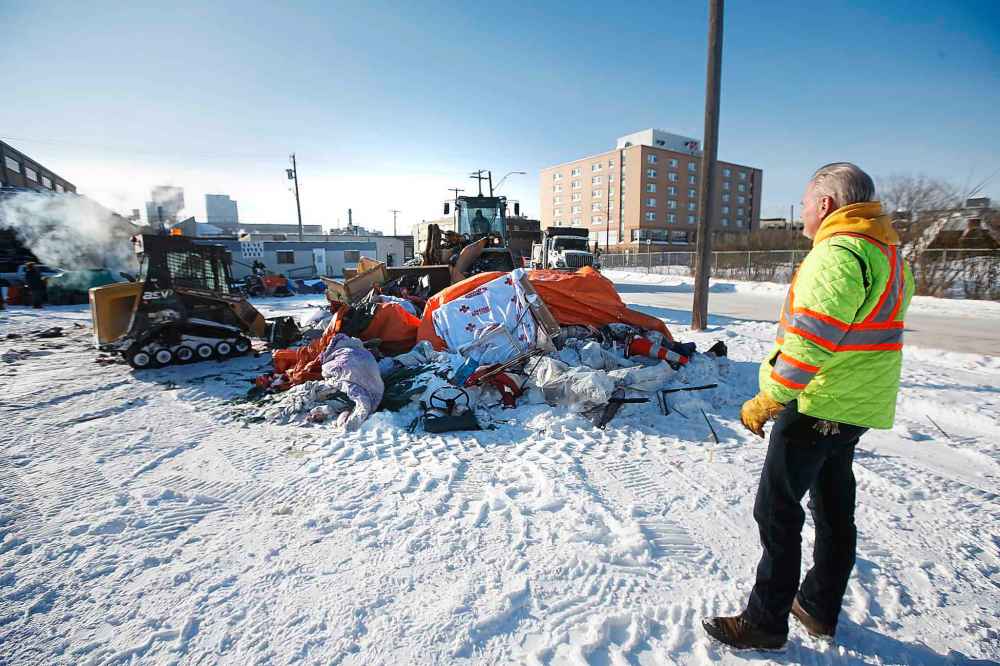
Most camp residents are still asleep. The tarps strapped atop their tents and makeshift shelters — orange and blue and shredded from the elements — flutter lazily in the wind. The camp, considered an intolerable eyesore by most, is the only place these people have to call home.
That their home, as ramshackle and insufficient as it may be, is about to be taken from them, is bad, but the fact people are sleeping outside in the first place seems like the real scandal.
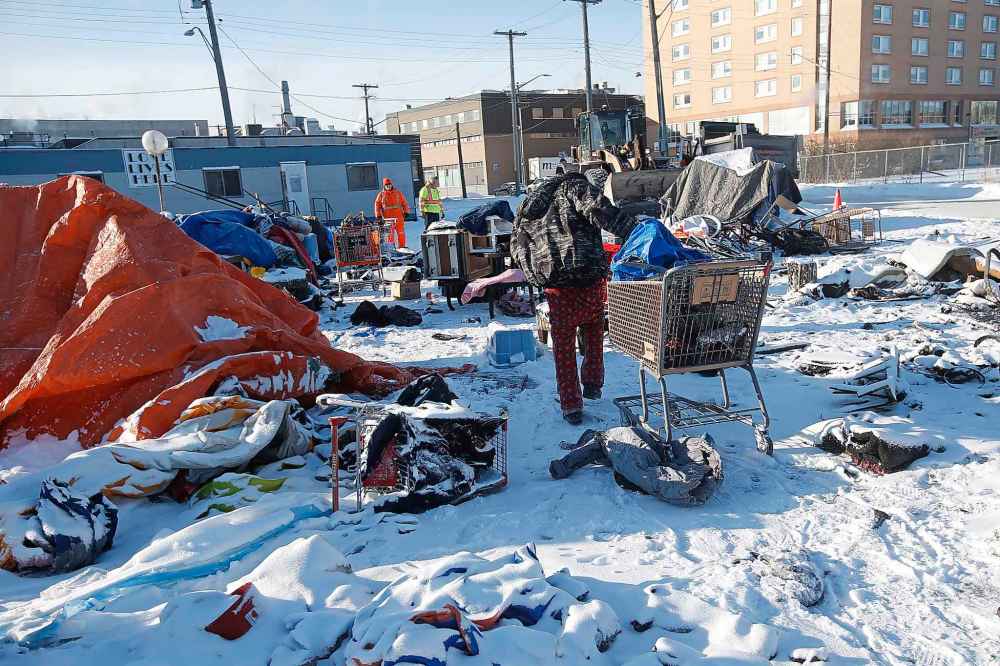
The clock strikes 9:30 a.m. and the police, accompanied by outreach workers from Main Street Project, begin rustling residents from their tents and telling them it’s time to go. A front-end loader idles nearby, waiting to begin the cleanup.
Civic officials claim the camp must come down because of the fires, saying the living conditions are neither safe nor humane. But many residents can’t help but suspect that’s just pretext. While the city promises to relocate them to a shelter, the truth is that many of them have no interest in that.
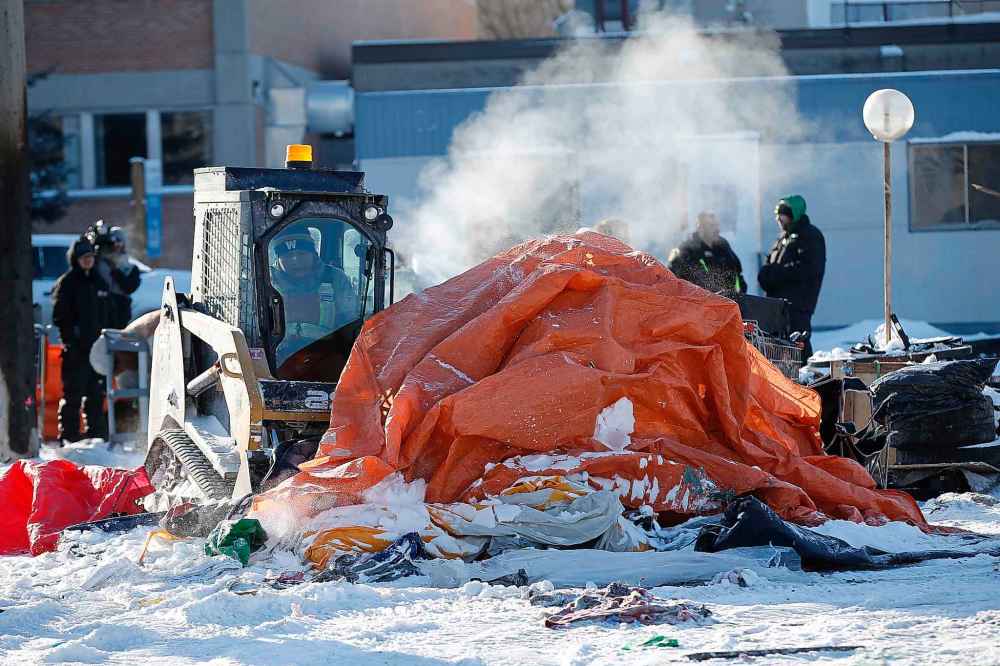
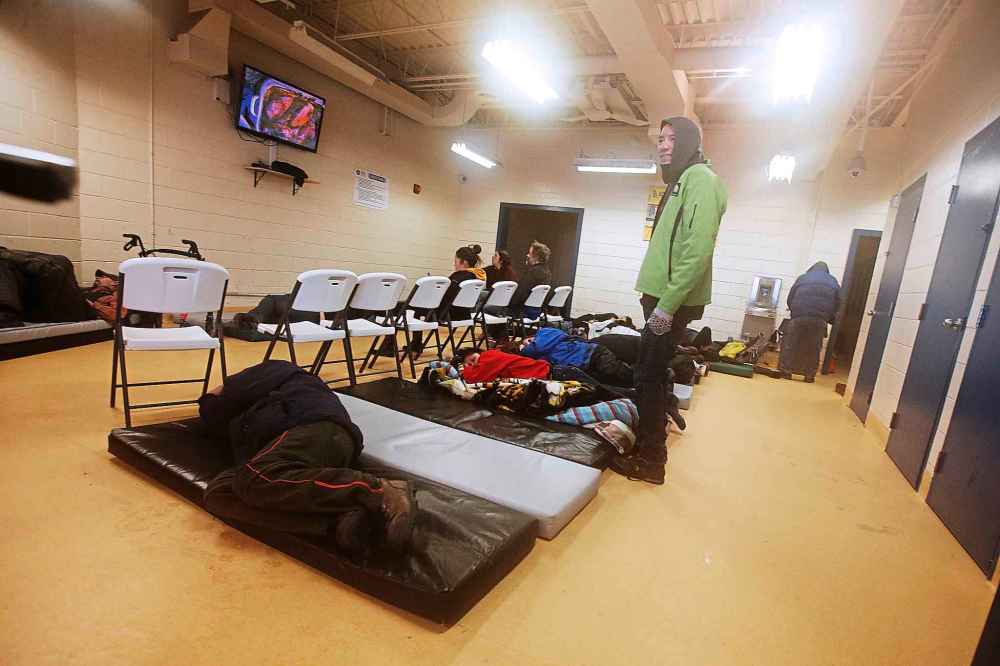
For some, particularly women, being in tight quarters with men who can act in erratic, violent ways doesn’t feel safe. For others, especially those struggling with addiction, staying at a dry shelter — such as Siloam Mission — is out of the question. For many, shelters just aren’t nice places to be.
And so, some residents can’t help but wonder what the city’s end game is. Those who refuse to go to the shelters will just move down the road and set up shop elsewhere, likely on their own, without safety in numbers, even further removed from the agencies offering help.
Kyle and Desirae figure that’s the point: the city doesn’t really care if people are sleeping outside in winter. They just want them pushed to the margins — out of sight, out of mind.
As they’re awoken, the people pack their belongings, if they haven’t already. When they’re finished, whatever is left behind is pushed into a pile by the front-end loader, dumped in the back of a truck and carted off.
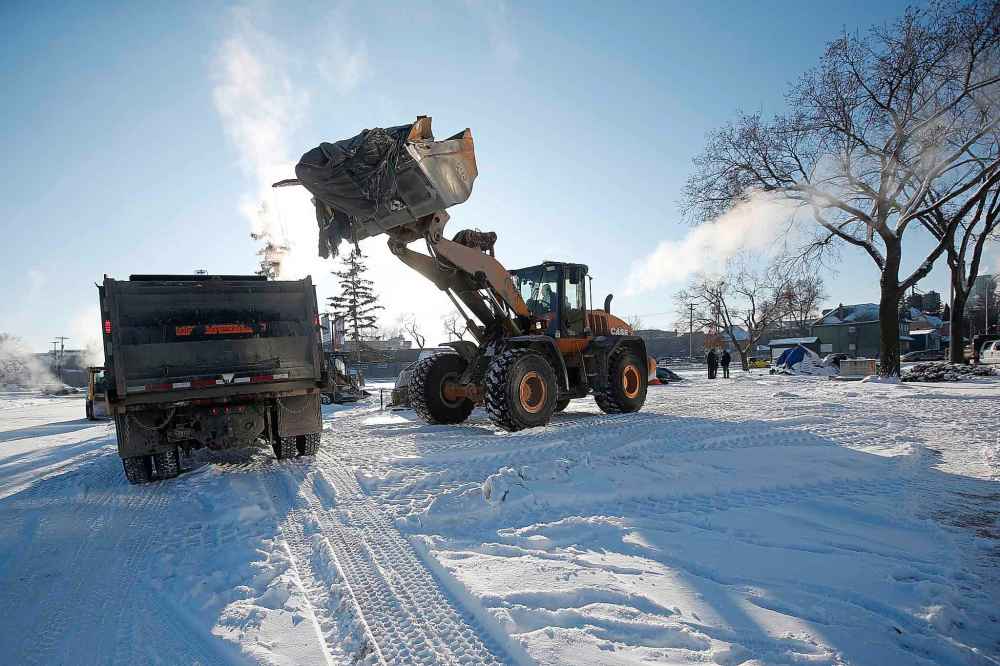
It continues for a long time. One by one, the tents are taken down. The community has been broken up.
● ● ●
The sky grows dark as evening conquers afternoon.
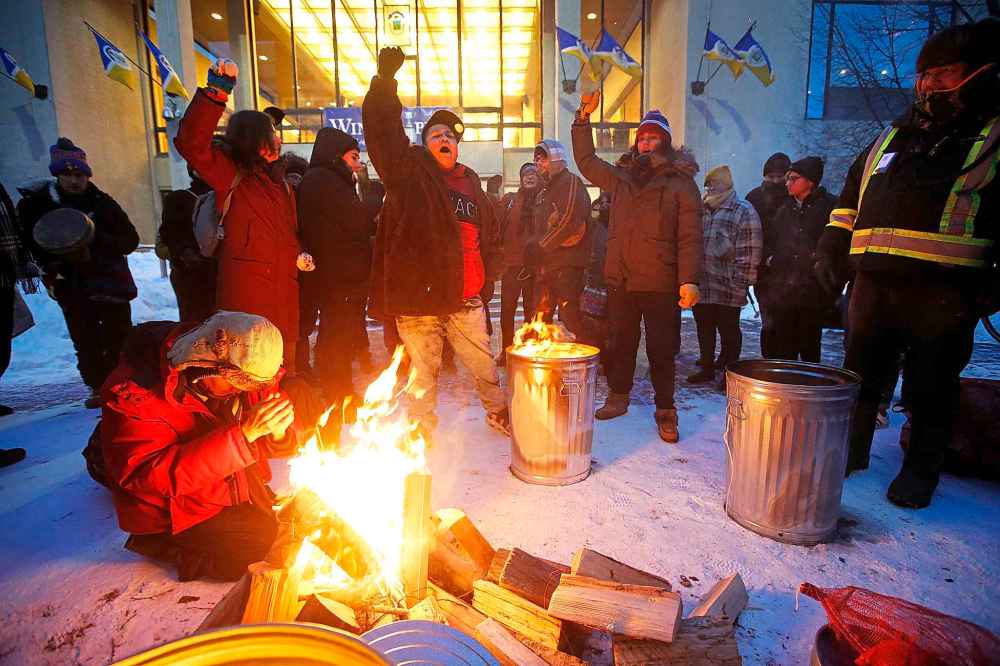
On the front steps of city hall, 40 or so people have gathered to protest the dismantling of the camp earlier in the day. They fill the courtyard under the watchful eye of police officers monitoring the protest.
The air fills with the sound of a drum pumping steady and quick like a heartbeat, mixed with the wailing cries of traditional Indigenous singing, as flames flicker from a steel bin at the centre of the mass.
The situation grows tense, with some protesters hurling insults at the police. But soon the demonstration breaks up and disperses without incident. People slowly peel away from the warmth of the fire and scatter into the cold of night.
Back at the camp, only three tents remain standing. Officials agreed to give a few residents more time to plot their next move. They’ve been told police will be back in three days to finish the job. They have until then to pack up.
One of them is Kyle, who lingers outside his tent smoking a cigarette, observing the empty scene around him. The community he’s called home for the past few months, and the people Desirae calls her street family, are gone.
“I’ll pack up and leave, but then I’ll just come right f–king back,” he says defiantly. “I don’t know where the f–k they want me to go.”
Track marks from the front-end loader are visible in the snow, mixed with items dropped and discarded in the commotion. It is the only evidence of what transpired.
And not far from where Mathew’s Place once stood, next to charred wood and ash from the blaze, a replica teepee, less than a metre tall, has been erected.
The symbolism is like a punch to the face; it stands in testament to all that’s been lost, and all that’s been taken away.
It stands as a small act of resistance.
ryan.thorpe@freepress.mb.ca

Ryan Thorpe likes the pace of daily news, the feeling of a broadsheet in his hands and the stress of never-ending deadlines hanging over his head.
Our newsroom depends on a growing audience of readers to power our journalism. If you are not a paid reader, please consider becoming a subscriber.
Our newsroom depends on its audience of readers to power our journalism. Thank you for your support.