Ducks were once a conservation bright spot. Now they’re declining in the US, new report shows

Advertisement

Advertise with us

WASHINGTON (AP) — At least 112 North American bird species have lost more than half their populations in the past 50 years, according to a new report published Thursday.

Read this article for free:


or

Already have an account? Log in here »

To continue reading, please subscribe:

Subscribe and receive a limited-edition Free Press branded hat or tote.

Digital Subscription

One year of digital access for only $205*

  • Enjoy unlimited reading on winnipegfreepress.com
  • Read the E-Edition, our digital replica newspaper
  • Access News Break, our award-winning app
  • Play interactive puzzles

*First annual payment billed as $205.00 + GST for one year. This annual subscription will automatically renew at $233.00 + GST every 52 weeks (10% off the regular annual price of $259.35). Offer available to new and qualified returning subscribers only. Cancel any time.

To continue reading, please subscribe:

Add Free Press access to your Brandon Sun subscription for only an additional

$1 for the first 4 weeks*

  • Enjoy unlimited reading on winnipegfreepress.com
  • Read the E-Edition, our digital replica newspaper
  • Access News Break, our award-winning app
  • Play interactive puzzles
Start now

*Your next Brandon Sun subscription payment will increase by $1.00 and you will be charged $17.95 plus GST for four weeks. After four weeks, your payment will increase to $24.95 plus GST every four weeks.

Hey there, time traveller!
This article was published 13/03/2025 (557 days ago), so information in it may no longer be current.

WASHINGTON (AP) — At least 112 North American bird species have lost more than half their populations in the past 50 years, according to a new report published Thursday.

Among the birds showing the steepest declines are Allen’s hummingbirds, Florida scrub jays, golden-cheeked warblers, tricolored blackbirds and yellow-billed magpies.

“These are the very real consequences if we are unable to conserve and protect the crucial habitats that birds need,” said study co-author Mike Brasher, a senior scientist at the nonprofit Ducks Unlimited.
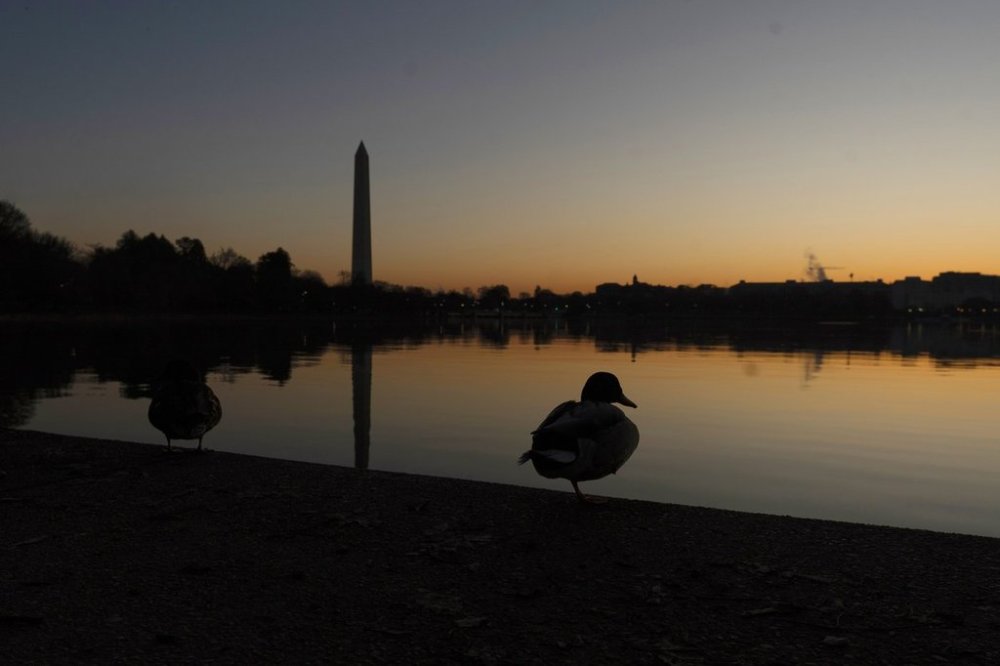
FILE - A mallard duck rests on the edge of a path around the Tidal Basin as the sun rises in Washington, Sunday, March 5, 2023, with the Washington Monument in the background. (AP Photo/Manuel Balce Ceneta, File)

For several decades, waterfowl stood out as a conservation bright spot with duck populations growing nationwide even as many other groups of birds declined in the U.S. But that trend has reversed, the new data shows.

The total number of dabbling and diving ducks is down about 30% from 2017, said Brasher. Loss of grasslands habitat and a prolonged drought affecting the wetlands of the Great Plains’ prairie pothole region have taken a toll. Among all waterfowl, numbers are down 20% since 2014, the report found.

The latest report is a collaboration between several groups including Cornell University, Ducks Unlimited, American Bird Conservancy, National Audubon Society and the American Ornithological Society.

The work draws on survey data from the U.S. Geological Survey, U.S. Fish and Wildlife Service and citizen projects such as Cornell’s eBird. There are some 2,000 bird species in North America. A third of the species examined are rated as high or moderate concern for conservation due to declining numbers, habitat loss or other threats.

These birds “need urgent conservation attention,” said Amanda Rodewald, a study co-author from Cornell, adding that bird survey trends also reveal the health of their habitats.

The report focuses on birds that must breed and feed in specific habitats such as forests, grasslands and coastal regions. Grassland birds including the Bobolink are most at risk.

“For each species that we’re in danger of losing, it’s like pulling an individual thread out of the complex tapestry of life,” said Georgetown University biologist Peter Marra, who was not involved in the new report.

Marra pointed to key past conservation successes in the U.S. – such as the comebacks of bald eagles, egrets and osprey.

“We know that we can bend the curve back with targeted conservation plans. But we can’t just close our eyes and hope,” he said.

___

The Associated Press Health and Science Department receives support from the Howard Hughes Medical Institute’s Science and Educational Media Group and the Robert Wood Johnson Foundation. The AP is solely responsible for all content.


Report Error Submit a Tip

More Stories

No more playing around, make 30 km/h school zones permanent

Tom Brodbeck 5 minute read Preview

No more playing around, make 30 km/h school zones permanent

Tom Brodbeck 5 minute read Thursday, Sep. 3, 2026

Winnipeg has already decided that 30 kilometres per hour is the right speed around schools.

It’s time to stop pretending that decision should expire every summer.

The city’s reduced school-zone speed limits returned Tuesday, a full week before the 2026-27 school year begins. They apply on weekdays from 7 a.m. to 5:30 p.m., from Sept. 1 until July 1.

Then, for two months, they disappear.

Read
Thursday, Sep. 3, 2026

Canada must not accept another Iranian autocracy

David Matas 5 minute read Saturday, Sep. 19, 2026

Iran is a state run by a radical government victimizing its citizens and its neighbours. How do we change that? Any regime change that repeats the mistakes of the past is not a solution.

What went wrong in the past which led to the current regime? One answer is the U.K. and American aided coup which led to the ouster in 1953 of a democratically elected government headed at the time by Mohammad Mossadegh and its replacement with an American friendly autocrat, the Shah of Iran, Mohammad Reza Pahlavi.

The Shah imposed his rule through the Iranian National Intelligence and Security Organization — SAVAK, the acronym of its Persian name. SAVAK systematically inflicted torture, arbitrary killings and extra-judicial killings on perceived opponents of the regime. It was only a matter of time before repression of a regime directed to serving foreign interests would be overthrown.

What replaced the regime of the Shah, in 1979, the current regime of the mullahs, is a regime as intolerant and violent as the regime of the Shah and then some. That was not inevitable. But neither was it surprising. The vicious nature of the current regime, following the example set by the Shah, and its hatred for the United States, reacting to the U.S. aided imposition of the Shah, both echoes and reacts to the past. In 1979, the U.S. reaped what it sowed in 1953.

Severe weather preparedness not one-time exercise for businesses

Abiola Odutola 3 minute read 2:00 AM CDT

BRANDON — Local business owners should prepare for the possibility that severe weather could disrupt their operations — even when their facilities escape major damage, a climate resilience expert told the Brandon Chamber of Commerce last week.

Emilia Cameron of the Institute for Catastrophic Loss Reduction told attendees at a September luncheon the recent flooding and heavy rainfall across southern Manitoba affected several businesses.

“Businesses need to prepare not just for direct damages to buildings, but for wide disruptions that can prevent them from operating,” she said. “Road closures, power outages, damaged infrastructure, internet failures and employees being unable to reach work can all bring operations to a standstill.”

Supply chains can also be affected when suppliers cannot reach their customers, she said.

Five takeaways from Thursday's Bombers win

Jeff Hamilton 6 minute read Preview

Five takeaways from Thursday's Bombers win

Jeff Hamilton 6 minute read Friday, Aug. 6, 2021

There was no shortage of unknowns heading into Thursday's CFL season-opener — and 2019 Grey Cup rematch — between the Winnipeg Blue Bombers and Hamilton Tiger-Cats.

After all, it had been 620 days since either team had played, and nearly two years away from the field can leave its mark. How would players perform after such a long layoff? Can you believe we've made it to this point? How long might this last?

Rust be damned. What transpired was four quarters of quality football, resulting in a hard-fought defensive battle and a 19-6 victory for the Blue and Gold. The CFL is officially back.

There was a lot to like from the Bombers, who are now a perfect 1-0 on the year, and some areas that need to be further discussed before next week's battle with the visiting Toronto Argonauts Friday night. Here are your five takeaways from Week 1.

Read
Friday, Aug. 6, 2021

From footnote to martyr: execution altered Scott’s place in history

Tom Brodbeck 5 minute read Preview

From footnote to martyr: execution altered Scott’s place in history

Tom Brodbeck 5 minute read Friday, Feb. 14, 2020

When Thomas Scott was marched outside the walls of Upper Fort Garry and executed by firing squad, it forever changed how history would treat Louis Riel and the Red River Resistance. The killing of Scott, whether a misguided error by Riel or an unavoidable step to prevent further bloodshed, would turn out to be one of the most pivotal events of the resistance.

Only a month after the Irish-born Canadian was condemned to death in March 1870, Riel opponents in Ontario used Scott’s execution to whip up anti-Métis sentiment in an effort to sabotage negotiations between Ottawa and the Red River Settlement. It nearly worked. Two of three Red River delegates sent to Ottawa to negotiate the terms of Manitoba’s entry into confederation were arrested on arrival (but later released) for Scott’s death. At the same time, Prime Minister John A. Macdonald was under increasing political pressure to send military troops to quell the resistance in Red River, rather than engage in peaceful negotiations.

Scott’s death didn’t just complicate matters for the Red River delegates. It undermined their efforts to bargain with Ottawa.

Scott was tried and convicted by a “military council” on March 3 for rebelling against the provisional government and attacking a Métis guard at Upper Fort Garry, where he and other political prisoners were held. The trial wasn’t conducted under normal court rules, even by 1870 Red River standards. Scott had no defence counsel and wasn’t present for much of the proceedings, which were conducted in French (a language he didn’t understand). Riel, one of the chief witnesses in the case, had to act as translator. The military council was not unanimous in its decision to sentence Scott to death. Some felt the penalty was too harsh.

Read
Friday, Feb. 14, 2020

Finding new markets — across an ocean

Editorial 4 minute read Preview

Finding new markets — across an ocean

Editorial 4 minute read 2:00 AM CDT

Prime Minister Mark Carney’s barnstorming trade mission to the European Union has created a ton of discussion and debate about cultivating new trade opportunities for Canadian exporters. What is hasn’t created, however, is very much certainty.

At first blush, opening up new trade relationships with the EU seems like a no-brainer as Canada is confronted with an increasing number of tariffs and restrictions from an increasingly unhinged Trump White House. And the possibilities are tantalizing; the EU and United Kingdom represent a market of more than 519 million people, which is larger than North America.

Canada is one of few nations to push back against Trump’s irrational trade demands. The result is an almost daily escalation of punitive measures and threatening rhetoric. Our trade relationship with the U.S. has been deeply wounded; in short order, it may become fatally so.

However, it is our courage in the face of American trade threats that has made us a coveted trading partner for many European nations. So much so that the EU created an entirely new category of “associate member” to give Canada an incentive to strengthen trading relationships.

Read
2:00 AM CDT