Developed countries called on to provide meaningful financial support at COP15

Advertisement

Advertise with us

MONTREAL - Hard talks on hard targets for saving the world's biodiversity began Wednesday at an international conference in Montreal, with calls for rich nations to pony up to save functioning ecosystems where most of them exist — in poor nations.

Read this article for free:


or

Already have an account? Log in here »

To continue reading, please subscribe:

Subscribe and receive a limited-edition Free Press branded hat or tote.

Digital Subscription

One year of digital access for only $205*

  • Enjoy unlimited reading on winnipegfreepress.com
  • Read the E-Edition, our digital replica newspaper
  • Access News Break, our award-winning app
  • Play interactive puzzles

*First annual payment billed as $205.00 + GST for one year. This annual subscription will automatically renew at $233.00 + GST every 52 weeks (10% off the regular annual price of $259.35). Offer available to new and qualified returning subscribers only. Cancel any time.

To continue reading, please subscribe:

Add Free Press access to your Brandon Sun subscription for only an additional

$1 for the first 4 weeks*

  • Enjoy unlimited reading on winnipegfreepress.com
  • Read the E-Edition, our digital replica newspaper
  • Access News Break, our award-winning app
  • Play interactive puzzles
Start now

*Your next Brandon Sun subscription payment will increase by $1.00 and you will be charged $17.95 plus GST for four weeks. After four weeks, your payment will increase to $24.95 plus GST every four weeks.

Hey there, time traveller!
This article was published 07/12/2022 (1391 days ago), so information in it may no longer be current.

MONTREAL – Hard talks on hard targets for saving the world’s biodiversity began Wednesday at an international conference in Montreal, with calls for rich nations to pony up to save functioning ecosystems where most of them exist — in poor nations.

“We need developed countries to provide meaningful financial support for the countries of the global south as custodians of the world’s natural wealth following centuries of exploitation and loss,” said United Nations Secretary-General Antonio Guterres as the COP15 conference began.

Delegates from more than 190 countries will try over the next two weeks to thrash out what they call a framework for preserving biodiversity with timed, measurable targets.
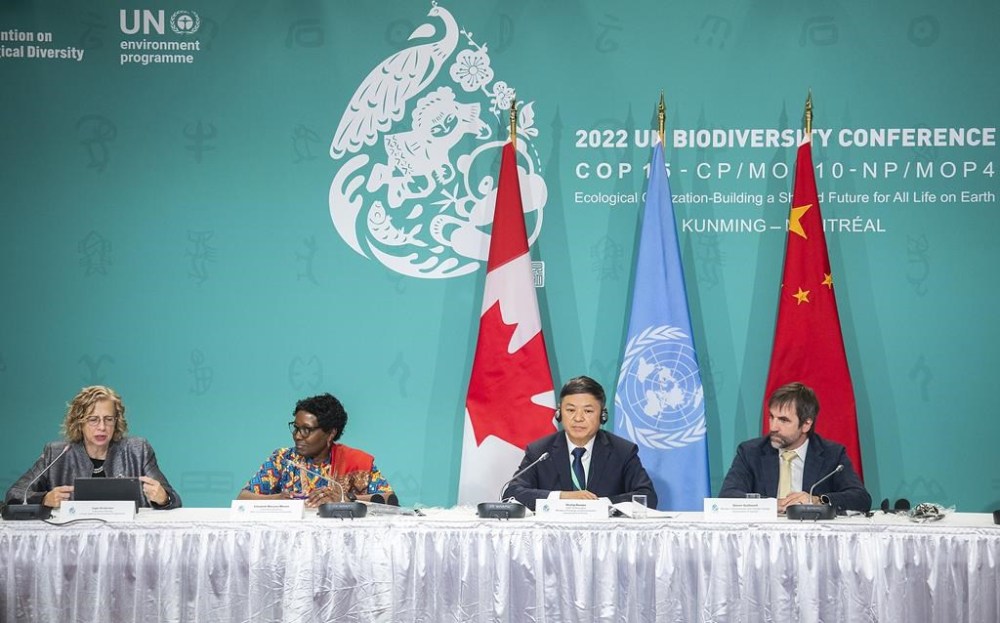
From left, Inger Andersen, Executive Director, UN Environment Programme, Elizabeth Maruma Mrema, Executive Secretary, UN Convention on Biological Diversity, Huang Runqiu, President, COP15 and Minister of Ecology and Environment of China and Steven Guilbeault, Minister of Environment and Climate Change, Canada, attend the opening news conference of COP15 the UN Biodiversity Conference in Montreal, Tuesday, Dec. 6, 2022. THE CANADIAN PRESS/Graham Hughes

Prominent among them is a proposal that nearly a third of Earth’s land and water should be protected by 2030. Advocates say more than 100 countries support the idea, but the draft text on conservation targets still has more brackets in it than agreed wording.

“We’ve made some progress,” said Stephen Woodley of the International Union for Conservation of Nature, a high-profile group of governments and civil society organizations advising conference delegates. “It’s tough sledding.”

But funding — known in COP-speak as “mobilization of resources” — is considered just as central to success.

The rationale is simple. Most remaining biodiversity is in the developing nations of the global south, while most of the money — much of which has been generated at the expense of that biodiversity — is in the rich countries of the north.

That’s where the simplicity ends.

“It is one of the tricky issues of this process,” said Eddy Perez of Climate Action Network Canada.

Estimates of the possible tab vary wildly.

Perez said a group of African countries is looking for about $100 billion a year. The International Union for Conservation of Nature — an influential group of scientists and non-governmental organizations — says the figure should be twice that.

“The total need is very difficult to assess,” said Florian Titze of the World Wildlife Fund. “The only thing they have in common is it’s in the hundreds of billions.”

Negotiators haven’t even agreed on how the tab should be tallied.

There’s money for biodiversity from governments, spent both internationally and domestically. There’s money from private finance that does the same.

And there’s funding from public and private sources that works against it. The UN says in 2019 major investment banks provided an estimated $2.6 trillion to sectors that governments and scientists agree are driving ecosystem destruction.

On Tuesday, Canada announced it would earmark an additional $350 million for biodiversity projects in developing countries. On Wednesday, the European Union sounded skeptical about upping its contribution from its pledge of $7 billion by 2025.

Hugo-Maria Schally, the European Commission’s Directorate General for the Environment, told the conference that the current amounts being discussed are “not realistic.”

Dollar amounts aren’t even the whole story.

“It is capacity building,” said Perez. “It is technology transfer.

“It can’t just be a number issue.”

As well, mobilization of resources must be accompanied by disclosure standards, so both investors and voters can assess how their money is being used.

“That is one of the important elements of reform of the financial system,” Titze said. “We don’t even have the data that tells us, for example, how a financial institution is contributing to the destruction of nature.”

Both he and Perez agree that talks on the financial side of preserving biodiversity aren’t as advanced as those on conservation areas.

The conservation side has a defined target. Finance has a 10-point plan signed on to by a scant 16 countries.

But one can’t move forward without the other, said Titze.

“If we’re not setting the right ambition for the (conservation) measures that need to be taken, it’s almost impossible to set the level of ambition in finance. One side of the room is waiting for the other.”

Titze said one thing is certain.

“Now is the time to make progress.”

This report by The Canadian Press was first published Dec. 7, 2020.

— By Bob Weber in Edmonton and Jacob Serebrin in Montreal

Report Error Submit a Tip

More Stories

Ledohowski among new entrants to Manitoba Business Hall of Fame

Gabrielle Piché 3 minute read Preview

Ledohowski among new entrants to Manitoba Business Hall of Fame

Gabrielle Piché 3 minute read Friday, Sep. 25, 2026

The late Canad Inns founder will join the ranks of Manitoba Business Hall of Fame members next year.

Leo Ledohowski is one of three honourees to receive the prestigious title. Mark Evans, the executive chair of Conquest Planning, and Michael Pyle, Exchange Income Corporation’s chief executive, are also slated to be inducted next year.

“Each of their stories is very unique,” said Greg Leipsic, president of JA Manitoba.

The non-profit oversees the hall of fame; its board chooses new faces annually. The incoming businessmen will be honoured at an April 6 gala at the Victoria Inn Hotel.

Read
Friday, Sep. 25, 2026

Flop wedge needed at Phantom Lake Golf Club

Ryan Desjarlais 5 minute read Preview

Flop wedge needed at Phantom Lake Golf Club

Ryan Desjarlais 5 minute read Friday, Sep. 25, 2026

In a remote land of spruce, ptarmigan and rock, Flintabbatey Flonatin — an adventurer exploring the depths of Phantom Lake with his little submarine — discovered an underwater treasure trove of minerals. Once word spread among the prospecting community, the miners came, and the head frame of Flin Flon was born.

Now, that’s not exactly how The Sunless City novel reads, and Phantom Lake is actually in Saskatchewan, but my re-interpretation connects the dots enough to introducing Flin Flon’s links.

Phantom Lake Golf Club does not technically reside in Flin Flon, but rather in its twin community, Creighton, Sask. Indeed, as soon as you cross the border, you immediately turn south for a couple of clicks to the shores of Phantom Lake.

The very old river-stone clubhouse is up the hill from the parking lot. Folks with movement challenges might want to send the young bucks ahead to get the rental cart and bring it back to the parking lot to collect you and your sticks.

Read
Friday, Sep. 25, 2026

Pronounced need in this season of giving

Editorial 4 minute read Preview

Pronounced need in this season of giving

Editorial 4 minute read Thursday, Dec. 1, 2022

As we flip to the final page of the 2022 calendar, our thoughts turn to what’s commonly referred to as the season of giving.

Read
Thursday, Dec. 1, 2022

Bujold fighting for Olympic berth outside ring

Lori Ewing, The Canadian Press 5 minute read Preview

Bujold fighting for Olympic berth outside ring

Lori Ewing, The Canadian Press 5 minute read Wednesday, May. 5, 2021

I wanted nothing more than to tell Star readers I tried the Tim Hortons Cold Brew on Wednesday and it was indeed ‘a bold and delightful coffee experience.’ Is a gag reflex considered bold? Is it delightful to get a mouthful of bland joe that’s colder than the Pfizer vaccine but not as yummy? writes Vinay Menon.

Read
Wednesday, May. 5, 2021

COVID-19 vaccine Q-and-A: What you need to know

Melissa Couto Zuber, The Canadian Press 5 minute read Preview

COVID-19 vaccine Q-and-A: What you need to know

Melissa Couto Zuber, The Canadian Press 5 minute read Wednesday, Jan. 13, 2021

Canada's COVID-19 vaccine rollout hits its one-month mark on Thursday, but questions remain about the inoculations themselves, how they're being distributed and what happens next.

The Canadian Press recently spoke with experts in infectious disease, immunology and public health to help get some clarity on popular queries.

WHO'S NEXT IN LINE TO GET THE VACCINE?

Canada's provinces seem to mostly be adhering to recommendations put forward by the National Advisory Committee on Immunization (NACI), which suggests first vaccinating those most vulnerable to severe COVID outcomes, as well as those who care for them.

Read
Wednesday, Jan. 13, 2021

Bauer ‘better and better every year’

Ken Wiebe 8 minute read Preview

Bauer ‘better and better every year’

Ken Wiebe 8 minute read Updated: 1:57 PM CDT

Tyrel Bauer makes no apologies for the pugilistic piece of his path.

The Winnipeg Jets defenceman is ready to drop the gloves and throw down when the situation calls for it and he takes great pride in protecting his teammates.

It’s a big part of the reason Bauer will be among the 23 players submitted by the Jets on the opening-day roster on Monday.

“I’ve fought and clawed, both metaphorically and literally and now I just want to show that I can play as well,” Bauer said during a chat with the Free Press during training camp. “(Toughness) is always something that I have, it’s always something in my back pocket and something that I take a lot of pride in doing, for my teammates, for the city and the people who invest in this hockey club. That will never change.

Read
Updated: 1:57 PM CDT