Monster wildfire tests years of forest management efforts

Advertisement

Advertise with us

PORTLAND, Ore. (AP) — Ecologists in a vast region of wetlands and forest in remote Oregon have spent the past decade thinning young trees and using planned fires to try to restore the thick stands of ponderosa to a less fire-prone state.

Read this article for free:


or

Already have an account? Log in here »

To continue reading, please subscribe:

Subscribe and receive a limited-edition Free Press branded hat or tote.

Digital Subscription

One year of digital access for only $205*

  • Enjoy unlimited reading on winnipegfreepress.com
  • Read the E-Edition, our digital replica newspaper
  • Access News Break, our award-winning app
  • Play interactive puzzles

*First annual payment billed as $205.00 + GST for one year. This annual subscription will automatically renew at $233.00 + GST every 52 weeks (10% off the regular annual price of $259.35). Offer available to new and qualified returning subscribers only. Cancel any time.

To continue reading, please subscribe:

Add Free Press access to your Brandon Sun subscription for only an additional

$1 for the first 4 weeks*

  • Enjoy unlimited reading on winnipegfreepress.com
  • Read the E-Edition, our digital replica newspaper
  • Access News Break, our award-winning app
  • Play interactive puzzles
Start now

*Your next Brandon Sun subscription payment will increase by $1.00 and you will be charged $17.95 plus GST for four weeks. After four weeks, your payment will increase to $24.95 plus GST every four weeks.

Hey there, time traveller!
This article was published 20/07/2021 (1850 days ago), so information in it may no longer be current.

PORTLAND, Ore. (AP) — Ecologists in a vast region of wetlands and forest in remote Oregon have spent the past decade thinning young trees and using planned fires to try to restore the thick stands of ponderosa to a less fire-prone state.

This week, the nation’s biggest burning wildfire provided them with an unexpected, real-world experiment. As the massive inferno half the size of Rhode Island roared into the Sycan Marsh Preserve, firefighters said the flames jumped less from treetop to treetop and instead returned to the ground, where they were easier to fight, moved more slowly and did less damage to the overall forest.

The initial assessment suggests that the many years of forest treatments worked, said Pete Caligiuri, Oregon forest program director for The Nature Conservancy, which runs the research at the preserve.
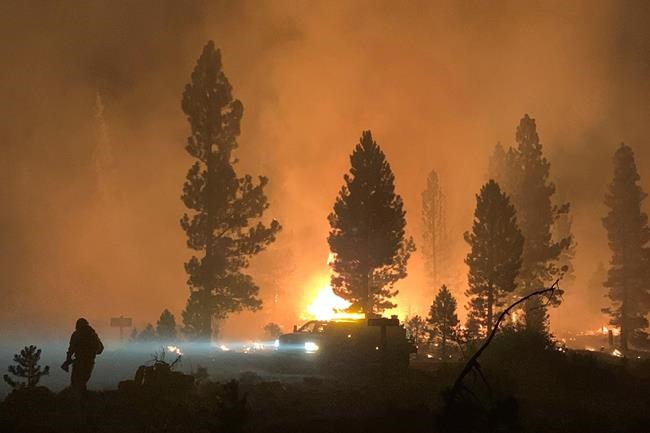
In this photo provided by the Bootleg Fire Incident Command, the Bootleg Fire burns at night in southern Oregon on Saturday, July 17, 2021. The destructive Bootleg Fire, one of the largest in modern Oregon history, has already burned more than 476 square miles (1,210 square kilometers), an area about the size of Los Angeles. The Bootleg Fire is among dozens burning in the parched West. (Bootleg Fire Incident Command via AP)

“Generally speaking, what firefighters were reporting on the ground is that when the fire came into those areas that had been thinned … it had significantly less impact.”

The reports were bittersweet for researchers, who still saw nearly 20 square miles of the preserve burn, but the findings add to a growing body of research about how to make wildfires less explosive by thinning undergrowth and allowing forests to burn periodically — as they naturally would do — instead of snuffing out every flame.

The Bootleg Fire, now 606 square miles (1,569 square kilometers) in size, has ravaged southern Oregon and is the fourth-largest fire in the state’s modern history. It’s been expanding by up to 4 miles (6 kilometers) a day, pushed by gusting winds and critically dry weather that’s turned trees and undergrowth into a tinderbox.

Fire crews have had to retreat from the flames for 10 consecutive days as fireballs jump from treetop to treetop, trees explode, embers fly ahead of the fire to start new blazes and, in some cases, the inferno’s heat creates its own weather of shifting winds and dry lightning. Monstrous clouds of smoke and ash have risen up to 6 miles into the sky and are visible for more than 100 air miles.

The fire in the Fremont-Winema National Forest merged with a smaller nearby blaze Tuesday, and it has repeatedly breached a perimeter of treeless dirt and fire retardant meant to stop its advance.

More evacuations were ordered Monday night, and a red flag weather warning signifying dangerous fire conditions was in effect through Tuesday. The fire is 30% contained.

“We’re in this for as long as it takes to safely confine this monster,” Incident Commander Rob Allen said Tuesday.

At least 2,000 homes have been evacuated at some point during the fire and another 5,000 threatened. At least 70 homes and more than 100 outbuildings have gone up in flames. Thick smoke chokes the area where residents and wildlife alike have already been dealing with months of drought and extreme heat. No one has died.

The Bootleg Fire was one of many fires burning in a dozen states, most of them in the West. Sixteen large uncontained fires burned in Oregon and Washington state alone on Monday.

On Tuesday, officials temporarily closed all recreational and public access to state-managed lands in eastern Washington due to fire danger, starting Friday.

Historically, wildfires in Oregon and elsewhere in the West burned an area as big or bigger than the current blaze more frequently but much less explosively. Periodic, naturally occurring fire cleared out the undergrowth and smaller trees that cause today’s fires to burn so dangerously.
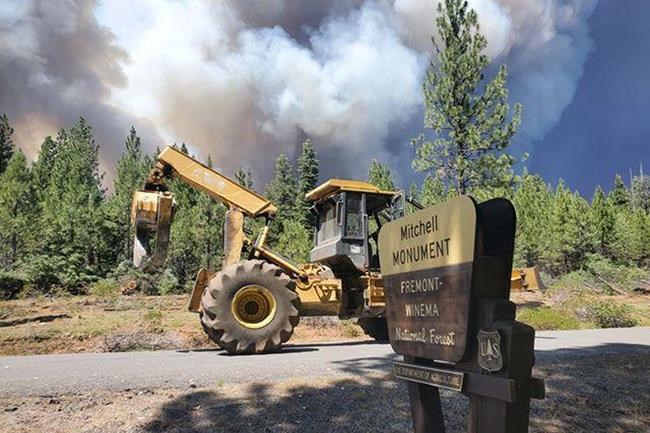
In this photo provided by the Bootleg Fire Incident Command, the Bootleg Fire burns behind heavy equipment at the Mitchell Monument in southern Oregon on Saturday, July 17, 2021. The 569-square-mile (1,474 square kilometers) Bootleg Fire is burning 300 miles (483 kilometers) southeast of Portland in and around the Fremont-Winema National Forest, a vast expanse of old-growth forest, lakes and wildlife refuges. (Bootleg Fire Incident Command via AP)

Those fires have not been allowed to burn for the past 120 years, said James Johnston, a researcher with Oregon State University’s College of Forestry who studies historical wildfires.

The area on the northeastern flank of the Bootleg Fire is in the ancestral homeland of the Klamath Tribes, which have used intentional, managed fire to keep the fuel load low and prevent such explosive blazes. Scientists at the Sycan Marsh research station now work with the tribe and draw on that knowledge.

Climate change is the catalyst for the worsening wildfire seasons in the West, Johnston said, but poor forest management and a policy of decades of fire suppression have made a bad situation even worse.

“My colleagues and I have been predicting a massive fire in that area for years. It’s an area that’s exceptionally prone to catastrophic fire,” said Johnston, who is not affiliated with Sycan Marsh. “It’s dry. It’s fire-prone and always has been. But what’s changed over the past 100 years is an extraordinary amount of fuel buildup.”

Elsewhere, fire crews were engaged in other daunting battles.

In Northern California, authorities expanded evacuations for the Tamarack Fire in Alpine County in the Sierra Nevada to include the mountain town of Mesa Vista late Monday. That fire, which exploded over the weekend was 61 square miles (158 square kilometers) with no containment.

Tony Galvez fled with his daughter at the last minute and found out the family’s home is gone.

“I lost my whole life, everything I’ve ever had. The kids are what’s going to matter,” he said as he fielded calls from relatives. “I got three teenagers. They’re going to go home to a moonscape.”

On the western side of the Sierra, the Dixie Fire has scorched more than 90 square miles (163 square kilometers), threatening tiny communities in the Feather River Valley region.

Meteorologist Julia Ruthford told a briefing that a surge of monsoonal moisture from the Southwest had created plumes topping 6 miles — so big that the fire generated a thunderstorm over itself with lightning and gusty winds.
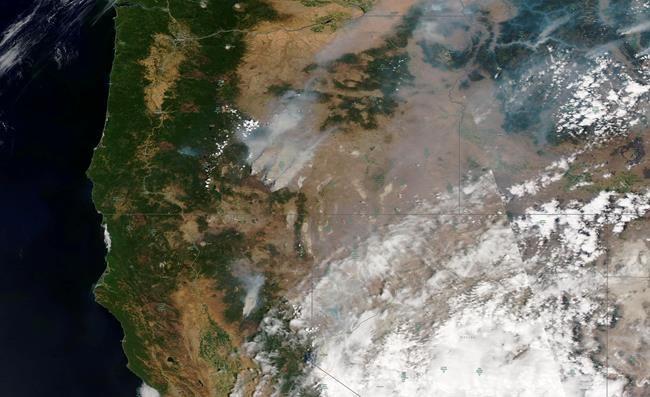
This satellite image provided by Satellite image ©2021 Maxar Technologies shows overview of wildfires from Oregon, Idaho, and Northern California on Sunday, July 18, 2021. Extremely dry conditions and heat waves tied to climate change have made wildfires harder to fight. Climate change has made the West much warmer and drier in the past 30 years and will continue to make weather more extreme and wildfires more frequent and destructive. (Satellite image ©2021 Maxar Technologies via AP)

For the past two days in Oregon, the fire has danced around Sycan Marsh, where researchers raced to protect buildings with sprinklers and fire lines. The 47-square-mile habitat attracts migrating and nesting birds and offers a unique location to research forest and fire ecology.

The nonprofit operates its own fire engines and now has three engines and seven firefighters on the blaze and more people are arriving.

“It’s an amazing place,” Caligiuri said. “It’s very hard to watch it all happening, and seeing all of that work being threatened by this fire is a lot to process.”

___

Associated Press Writer John Antczak in Los Angeles and AP Video Journalist Haven Daley in Alpine County, California, contributed to this report.

___

Follow Flaccus on Twitter at http://www.twitter.com/gflaccus

Report Error Submit a Tip

More Stories

IOC president Bach discusses ‘challenges’ for 2026 Games

Andrew Dampf, The Associated Press 6 minute read Preview

IOC president Bach discusses ‘challenges’ for 2026 Games

Andrew Dampf, The Associated Press 6 minute read Friday, Sep. 16, 2022

ROME (AP) — Costly construction delays, a leadership vacancy linked to a volatile political climate and a lack of sponsors amid a spreading financial crisis has prompted International Olympic Committee president Thomas Bach to acknowledge the “challenges” facing organizers of the 2026 Winter Games in Milan and Cortina d’Ampezzo.

With the IOC’s coordination commission visit to the Milan and Cortina venues postponed by three months to December because of national elections in Italy slated for later this month, it was left to Bach to handle matters during a visit with outgoing premier Mario Draghi before receiving an award from the Italian Olympic Committee.

“As always before Olympic Games, there are challenges — in particular light of this new emerging world order and the financial and economic crisis,” Bach said Friday.

“But we have overcome some challenges in the last couple of years," Bach added, referring to games held in Tokyo and Beijing amid the coronavirus pandemic. “So I’m not too worried because we know about the enthusiasm, efficiency and the dedication of our Italian friends.”

Read
Friday, Sep. 16, 2022

Democracy is a civic election issue

Erna Buffie 5 minute read Preview

Democracy is a civic election issue

Erna Buffie 5 minute read 2:00 AM CDT

Scott Gillingham should be worried — very, very worried. Not just because he’ll likely win the upcoming mayoral race for no better reason than the lack of a tenable, progressive alternative, but because longtime, and in some cases, progressive councillors are currently quitting his administration.

And they’re not going quietly.

Just take Coun. Sherri Rollins’ (Fort Rouge – East Fort Garry) recent announcement that she would not be seeking re-election. When she cited the reasons she won’t be running again, she dropped a bit of a bombshell.

In addition to citing the mayor’s lack of transparency on issues such as homelessness, she also observed that he and his advisers “increasingly sideline the public service.”

Read
2:00 AM CDT

Drop in staffed hospital beds driving longer ER waits

Tom Brodbeck 4 minute read Preview

Drop in staffed hospital beds driving longer ER waits

Tom Brodbeck 4 minute read Wednesday, Nov. 30, 2022

Emergency room wait times in Winnipeg have doubled since the Progressive Conservative government launched its hospital consolidation plan five years ago. But it’s not because more people are showing up at ERs.

Read
Wednesday, Nov. 30, 2022

Rural Canada sees uneven population change: census

Adina Bresge, The Canadian Press 6 minute read Preview

Rural Canada sees uneven population change: census

Adina Bresge, The Canadian Press 6 minute read Wednesday, Feb. 9, 2022

Kelly Rae, the administrator of Arran, Sask., says the denizens of dwindling rural communities like her own are clinging to a vanishing way of life in Canada.

Between 2011 and 2021, the village west of the Manitoba border saw its population slashed in half to just 20 people,Statistics Canada reported on Wednesday, as it released the first tranche of data from last year's census.

The share of Canadians living in rural areas has declined for the ninth census in a row, the agency said, dropping from 18.7 per cent in 2016 to 17.8 per cent in 2021.

However, the count showed that Canada's rural population grew faster than any other G7 country, ticking up 0.4 per cent over the five-year period to 6.6 million people in May 2021.

Read
Wednesday, Feb. 9, 2022

Jets hold first practice since Covid-19 shutdown

Mike McIntyre 7 minute read Preview

Jets hold first practice since Covid-19 shutdown

Mike McIntyre 7 minute read Monday, Jul. 13, 2020

Walking out of Rogers Place in the wee hours of March 12, I had no idea when the Winnipeg Jets might skate again — or what it might look like when they did. After all, the world was changing due to COVID-19, and a big win over the Edmonton Oilers earlier that night was quickly rendered meaningless in the grand scheme of things.

Now, 124 days later, we finally have some answers, along with a whole host of new questions. What went down Monday morning inside Bell MTS Iceplex, as the most unique training camp in club history got underway, was like nothing anyone associated with the sport has ever experienced before.

There were mandatory nasal swabs up the noses of all Jets players, along with health questionnaires and digital temperature checks for those of us entering the facility. Masks were required at all times. The rink lobby, normally a hub of activity whenever the hometown team hits the ice, was a ghost town and closed to the public. Handshakes among colleagues I haven't seen for four months were replaced by distant waves and muffled, socially distant pleasantries, just as hugs and high-fives among players were a no-no.

A workspace was created in the Press Box Restaurant, with tables spaced out against against glass that fogged up every few minutes. It didn't take long to remember why hockey and hot summer weather don't typically work well together. Forget the wind chill, does anyone know the humidex?

Read
Monday, Jul. 13, 2020

Winnipeg Chamber moves home to Portage and Main

Martin Cash 5 minute read Preview

Winnipeg Chamber moves home to Portage and Main

Martin Cash 5 minute read Wednesday, Sep. 25, 2024

The Winnipeg Chamber of Commerce has been in existence for 151 years and all that time it’s offices have always been very close to Portage and Main.

Earlier this summer the Chamber moved into new digs at 200 Portage Ave. in the former ScotiaBank offices, just down the street from the Paris Building at 259 Portage Ave. where it had been for 20 years.

It’s only the fourth location in the organization’s history and, in some respects, it’s like it’s finally come home.

As Loren Remillard, the chamber’s long-time CEO put it, “We used to just be on Portage, now we’re on Portage AND Main.”

Read
Wednesday, Sep. 25, 2024