COVID expected to kill thousands just in Ontario even with stiff restrictions

Advertisement

Advertise with us

TORONTO - As known COVID-19 cases rose nationally and almost all construction in the country's economic heartland was idled on Friday, health authorities in Ontario said the death toll in that province alone could be kept below a still-staggering 15,000 — if stringent isolation measures prove effective in curbing the pandemic.

Read this article for free:


By clicking the button above, an account will be created and you will begin to receive some of our recommended newsletters. You may opt out of any newsletter by visiting your Email and Communication Preferences page or by clicking "unsubscribe" at the bottom of any email.

or

Already have an account? Log in here »

To continue reading, please subscribe:

Digital Subscription

One year of digital access for only $1.44 a week*

  • Enjoy unlimited reading on winnipegfreepress.com
  • Read the E-Edition, our digital replica newspaper
  • Access News Break, our award-winning app
  • Play interactive puzzles

*Billed as $5.77 plus GST every four weeks. After 52 weeks, price increases to the regular rate of $19.95 plus GST every four weeks. Offer available to new and qualified returning subscribers only. Cancel any time.

To continue reading, please subscribe:

Add Free Press access to your Brandon Sun subscription for only an additional

$1 for the first 4 weeks*

  • Enjoy unlimited reading on winnipegfreepress.com
  • Read the E-Edition, our digital replica newspaper
  • Access News Break, our award-winning app
  • Play interactive puzzles
Start now

*Your next Brandon Sun subscription payment will increase by $1.00 and you will be charged $17.95 plus GST for four weeks. After four weeks, your payment will increase to $24.95 plus GST every four weeks.

Hey there, time traveller!
This article was published 03/04/2020 (2386 days ago), so information in it may no longer be current.

TORONTO – As known COVID-19 cases rose nationally and almost all construction in the country’s economic heartland was idled on Friday, health authorities in Ontario said the death toll in that province alone could be kept below a still-staggering 15,000 — if stringent isolation measures prove effective in curbing the pandemic.

In a sobering presentation, a top health official said the coronavirus might have killed as many as 100,000 people in Ontario had economy-crushing restrictions not been imposed.

“If we do everything that we can think of — everything that already has been done stays in place (and) all of the other measures which are being considered (are) put in place — I think we could reduce the death toll in Ontario to somewhere between 3,000 and 15,000,” said Dr. Peter Donnelly, head of Public Health Ontario.
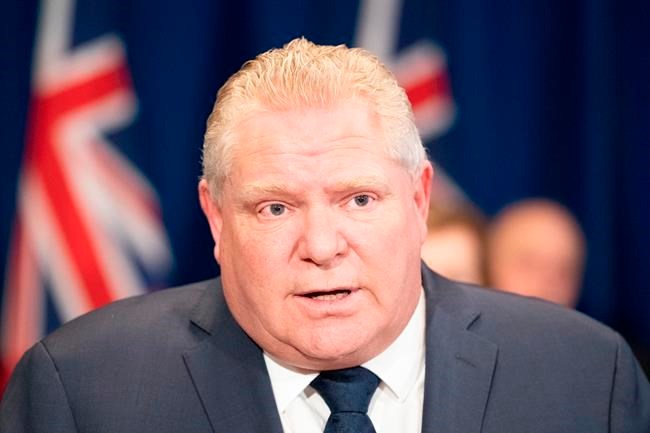
Ontario Premier Doug Ford answers questions during the daily briefing on the COVID-19 pandemic at Queen's Park in Toronto on Thursday April 2, 2020. THE CANADIAN PRESS/Frank Gunn

The latest data indicate more than 12,000 Canadians have contracted the virus. Of those, about 180 have died, but the numbers could be higher given gaps in reporting.

Ontario released its worst-case projections for the COVID-19 as its known caseload — and those of other provinces — climbed again. The province has now seen 3,255 cases and 67 deaths.

Given the “extremely serious” situation, Premier Doug Ford announced a halt to almost all industrial construction.

“We’ve told the vast majority of Ontario’s work force to stay home,” a grim Ford said. “Lives are on the line.”

The pandemic and the unprecedented stay-at-home measures to fight it have taken a brutal toll on the economy and jobs, with no sign of near-term improvement.

Prime Minister Justin Trudeau announced the latest in a string of federal measures to cushion the blow: More aid to low-income people will flow through the GST credit this month, rather than in May. Qualifying adults will receive up to $300, plus $150 for each child.

Trudeau also said the military would move into northern Quebec, at the province’s request, to help remote communities cope.

Canada’s top public health official, Dr. Theresa Tam, noted a sharp increase in deaths but said the health-care system was coping. The national death rate stands at about one per cent of those testing positive.

British Columbia, with 31 deaths, had previously projected its worst case would see a shortage of about 182 intensive care beds and at least 38 ventilators. But it also said distancing measures appeared to have mitigated that threat. Donnelly said Ontario was more closely tracking the hard-hit United States than B.C.

Quebec, which reported 25 more deaths on Friday for a total of 61 and a caseload of more than 6,000, said medical authorities would present COVID projections on Tuesday. New Brunswick, Nova Scotia and Prince Edward Island said they would also do so next week.

Overall mortality among those 80 years and older in Ontario has reached 20 per cent in coronavirus cases. A hard-hit nursing home in Bobcaygeon, Ont., reported four more resident deaths on Friday, bringing the toll to 20 at the 65-bed facility.

Experts advise frequent hand-washing and staying at least two metres from others to save the health-care system from overload. Front-line doctors have expressed worry about having to choose who lives and who dies if crucial ventilators run short.

In a tribute to health-care personnel, all ships in B.C. waters planned to sound their horns at 7 p.m. local time. Toronto’s CN Tower has been lighting up blue in a similar show of solidarity.

Health Minister Patty Hajdu late Thursday stood by her earlier estimate that between 30 per cent and 70 per cent of Canadians will likely become infected.

“Having 70 per cent of people get COVID is not the end of the world,” Hajdu said. “It is, though, if it all happens at once. And that’s what we’re trying to prevent.”

Globally, the pandemic has infected more than one million people and killed more than 58,000, according to the latest official figures. Italy, with almost 15,000 deaths and Spain with about 11,000, have been hit hardest. The United States, however, leads the world in cases — a quarter of a million to date — and has reported more than 6,000 deaths.

—with files from Canadian Press reporters across the country.

This report by The Canadian Press was first published April 3, 2020.
Report Error Submit a Tip

More Stories

Free Press Head Start for Dec. 19

1 minute read Thursday, Jan. 16, 2025

Hit the brakes on driving lessons from mate

Maureen Scurfield 5 minute read 2:00 AM CDT

DEAR MISS LONELYHEARTS: I’ve been trying to learn to drive in busy traffic. My boyfriend said he would teach me, but he gets too playfully amorous while I’m trying to drive his new car in busier areas like downtown. He thinks it’s a big joke, but when I yelled that he was distracting me, he said, “Good.”

So I pulled over, slammed on the brakes and got out, thinking he would get back into the driver’s seat and drive us home, but he didn’t budge. He was being a real jerk.

I got back in, drove us to my place in silence, left the keys in the ignition and went inside and locked my door. Now we’re not talking and neither one of us is apologizing. What do you think?

— Still Mad, St. James

Law will curb e-scooter enthusiasts

Editorial 4 minute read Preview

Law will curb e-scooter enthusiasts

Editorial 4 minute read 2:00 AM CDT

For people concerned about safety on Manitoba’s sidewalks and roadways, the province’s announcement that new rules will be introduced next year regarding the use of e-scooters and other personal electric vehicles (PEVs) was no doubt met with an enthusiastic “It’s about time.”

As their popularity and their presence among pedestrians on sidewalks and/or motor vehicles on the road has increased steadily, so have reports of close calls or, even worse, collisions involving e-scooters or other PEVs — including electric skateboards, hoverboards and unicycles — being operated imprudently and at unsafe speeds.

Traffic laws urgently need to be updated to govern the use of these conveyances, which up until now have remained in a regulatory grey area that has allowed PEVs to operate largely without guidelines and outside conventional avenues of traffic-safety enforcement. Accordingly, updates regarding PEV use will be included in the Highway Traffic Act in 2027.

The new legislation will govern such areas as mandatory helmet use, age restrictions, where PEVs can lawfully operate and the maximum speed at which they can travel (25 km/h). The aim of the new law, according to the province’s website, is “to help keep Manitobans safe when sharing roads, paths, and other public spaces.”

Read
2:00 AM CDT

MPI still lacking brain injury expert

Nicole Buffie 5 minute read Preview

MPI still lacking brain injury expert

Nicole Buffie 5 minute read 2:00 AM CDT

Manitoba Public Insurance has failed to hire an independent brain injury expert to probe how personal injury claims are handled, nearly two years after it was recommended.

Several speakers shared their stories about experiences with MPI in relation to brain injury claims on the opening day of the Public Utilities Board hearing into the auto insurer’s general rate application for a 2.38 per cent increase.

Jean-Marc Christophe said he had a concussion after a collision in September 2025. He said he’s had little help from the Crown corporation and it has left him confused and frustrated.

“Before the collision, I worked about 55 to 60 hours a week, worked every day as a courier. I delivered groceries,” he told the board Tuesday. “Trying to navigate this has been very difficult. I don’t have anybody to help me. I have to do it on my own.”

Read
2:00 AM CDT

Moderation, boundaries can mend things with mom

Maureen Scurfield 5 minute read Friday, May. 12, 2023

DEAR MISS LONELYHEARTS: My recently widowed mother, who’s a former advertising exec from Toronto, invited herself to visit me for a whole month recently — a 28-day sentence. I left Toronto to get away from her, because she befriended all my friends in high school and college.

Anyway, I gamely staged a little party for her at a restaurant, so she’d meet a few people. My friends loved her! She got them playing a mixer game, and everybody had fun.

But then, she went too far. She actually took down some of my girlfriends’ phone numbers on a little list and jotted a couple words on what they liked to do — like the super saleswoman she is. The next day she made lunch and touristy dates, for when I was at work.

A few days later one of them called me and finally spoke the words I didn’t want to hear: “Your mother is more fun than you are!” I blew up! I said back to her, “Well then, how come she had to leave Toronto and come way out here to Winnipeg to steal my friends?”

Messi, Mbappe give Qatar the perfect World Cup ending

James Robson, The Associated Press 7 minute read Preview

Messi, Mbappe give Qatar the perfect World Cup ending

James Robson, The Associated Press 7 minute read Monday, Dec. 19, 2022

DOHA, Qatar (AP) — When it comes to soccer, money can buy the world.

It can pay for the World Cup. And the world’s best players. And it can bundle them all up into a perfect package and present it to a global audience of millions.

The power of money was on full display in the Qatari city of Lusail on Sunday as Argentina beat France 4-2 on penalties to become world champion for the third time and end Lionel Messi's pursuit of the one major trophy that had eluded him in his storied career.

One of the most thrilling finals in the tournament's 92-year history finished 3-3 through extra time, with Messi scoring twice and Kylian Mbappé completing a hat trick.

Read
Monday, Dec. 19, 2022