Border measures start easing in July for fully vaccinated Canadians

Advertisement

Advertise with us

OTTAWA - Fully vaccinated Canadians returning to Canada will soon be able to avoid a mandatory quarantine as long as they still test negative for COVID-19.

Read this article for free:


or

Already have an account? Log in here »

To continue reading, please subscribe:

Subscribe and receive a limited-edition Free Press branded hat or tote.

Digital Subscription

One year of digital access for only $205*

  • Enjoy unlimited reading on winnipegfreepress.com
  • Read the E-Edition, our digital replica newspaper
  • Access News Break, our award-winning app
  • Play interactive puzzles

*First annual payment billed as $205.00 + GST for one year. This annual subscription will automatically renew at $233.00 + GST every 52 weeks (10% off the regular annual price of $259.35). Offer available to new and qualified returning subscribers only. Cancel any time.

To continue reading, please subscribe:

Add Free Press access to your Brandon Sun subscription for only an additional

$1 for the first 4 weeks*

  • Enjoy unlimited reading on winnipegfreepress.com
  • Read the E-Edition, our digital replica newspaper
  • Access News Break, our award-winning app
  • Play interactive puzzles
Start now

*Your next Brandon Sun subscription payment will increase by $1.00 and you will be charged $17.95 plus GST for four weeks. After four weeks, your payment will increase to $24.95 plus GST every four weeks.

Hey there, time traveller!
This article was published 21/06/2021 (1902 days ago), so information in it may no longer be current.

OTTAWA – Fully vaccinated Canadians returning to Canada will soon be able to avoid a mandatory quarantine as long as they still test negative for COVID-19.

Public Safety Minister Bill Blair said Monday the government is still urging people not to travel internationally right now, but noted the border restrictions that began more than 15 months ago “were never intended to be permanent.”

“We recognize that people are anxiously awaiting to reopen the border and as Canada reaches high levels of vaccination coverage and the COVID-19 severity trends continue to decline, the risks associated with international travel will decrease,” said Blair, at a virtual news conference.
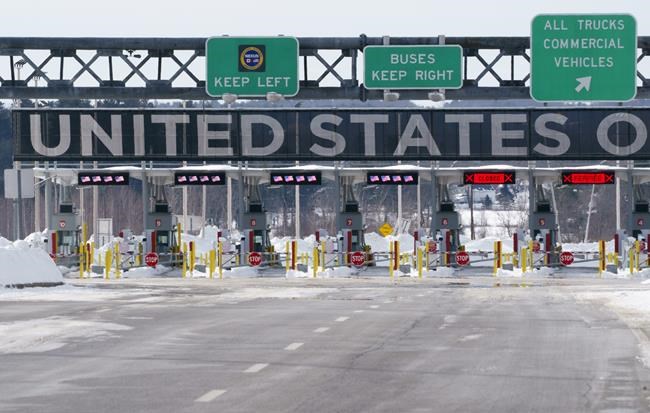
The border crossing into the United States is seen during the COVID-19 pandemic in Lacolle, Que. on February 12, 2021. THE CANADIAN PRESS/Paul Chiasson

Canada’s border was closed in March 2020 to non-Canadians, with limited exemptions for foreign nationals entering for essential purposes such as truck drivers or health-care workers. Canadians, permanent residents and people registered under the Indian Act, have always been allowed to return to Canada but were required to quarantine at home for two weeks. In February, air travellers were required to start spending up to three days at the start of that quarantine at a government-approved hotel, until a COVID-19 test came back negative.

Starting at 11:59 p.m. eastern time on July 5, both air and land travellers who are currently allowed to return to Canada, and who have been fully vaccinated for at least two weeks, and show negative tests before and after arriving, won’t have to quarantine at all.

They must upload their pre-arrival test and vaccination status to the ArriveCAN app, and carry digital or paper proof of their vaccination status to show border agents.

Unvaccinated travellers will see no change to the re-entry rules. Most foreign nationals will also remain barred from entry to Canada entirely except for essential work purposes, to reunite with family, or receive medical treatment.

For now the new rules only recognize the four vaccines Canada has authorized, and will not apply to most foreign nationals. The federal government would not provide any specific metrics for when the border closure will lift for anyone else, though test results from vaccinated travellers returning will help guide decisions about when to nudge the border open even further.

“As we’ve told Canadians all along, easing measures at the border will happen as we see our communities increasingly become safe,” Health Minister Patty Hajdu said.

She said further adjustments will be made based on infection rates and health-care capacity in Canada, as well as international infection rates and the impact of new variants of the virus that causes COVID-19.

Several Conservative MPs expressed dismay at the lack of clarity on when further restrictions will be lifted at the border.

“Yet again, today’s announcement from the Liberal government falls short when it comes to supporting critical industries like aviation and tourism in Canada,” said transport critic Stephanie Kusie.

“These sectors need more than announcements and photo ops — they deserve a clear, comprehensive plan that outlines evidence-based benchmarks and time frames.”

Canada hit its first national vaccination targets over the weekend, with more than three in four eligible Canadians at least partly vaccinated, and more than one in five fully vaccinated. Canada expects to have enough vaccine delivered to fully vaccinate every Canadian over the age of 12 by the end of July.

The seven-day average of new daily cases fell below 1,000 Sunday for the first time since the start of the second wave of the pandemic in Canada last September.

Falsifying vaccination documents can result in a $750,000 fine, up to six months in jail, or both.

“We’re very confident that the ArriveCAN app will do the job for us, for all travellers coming to Canada, to be able to verify the vaccine documentation,” said Blair.

Children who aren’t fully vaccinated, arriving by air with fully vaccinated parents won’t have to go to quarantine hotels but, along with unvaccinated children arriving by land, will have to quarantine at home for two weeks, and take a second test on the eighth day.

For now Canada will only recognize the four vaccines authorized by Health Canada — Pfizer-BioNTech, Moderna, AstraZeneca and Johnson & Johnson — but will recognize mixed dose schedules. A single dose of J&J’s vaccine is considered a full vaccination.

Transport Minister Omar Alghabra said the government is also ending the ban on incoming flights from Pakistan but is extending the flight ban for flights from India for at least another month.

The ban was enacted in April when too many people arriving from those countries were testing positive for COVID-19.

Health Canada data shows between June 6 and June 17, 73 flights landed in Canada carrying at least one passenger positive for COVID-19. There is no public data on the vaccination status of those passengers.

This report by The Canadian Press was first published June 21, 2021

Note to readers: This is a corrected story. A previous version said all other travellers who have not been fully vaccinated will still have to stay in hotel quarantine, instead of just those arriving by air.

Report Error Submit a Tip

More Stories

Remove barriers, coalition says

Dan Lett 6 minute read Preview

Remove barriers, coalition says

Dan Lett 6 minute read Monday, Jul. 30, 2018

Game on.

Just two weeks after city council approved a referendum on whether to open Winnipeg’s landmark intersection, an official ‘Yes’ campaign in support of tearing down the barriers has formed.

A coalition of downtown business and land owners, planners, architects and advertising and marketing firms — with the support of organizations such as the Exchange District and Downtown BIZ organizations — has taken up the challenge to defend Mayor Brian Bowman’s vision of a barrier-free Portage and Main.

Organizers said the campaign in favour of re-opening the intersection will be funded by an online crowd-sourcing campaign and will open a storefront headquarters in the shadow of the historic intersection. Lawn signs, promotional videos and mass mail will all be part of the drive to remove pedestrian barriers once and for all.

Read
Monday, Jul. 30, 2018

Back to school means increased costs for parents, post-secondary students

Joel Schlesinger 6 minute read Preview

Back to school means increased costs for parents, post-secondary students

Joel Schlesinger 6 minute read 2:02 AM CDT

In the words of advice for students from Thornton Melon: “It’s rough out there. Move back in with your parents.”

As comedian Rodney Dangerfield’s character alluded to in the 1986 comedy Back to School, it is indeed a tough financial environment as students head back to the classroom in 2026.

A Capital One Canada survey found families are struggling with costs, with nearly six in 10 parents surveyed stating back-to-school expenses are higher than expected.

It’s not just tuition, new clothes and supplies. Extracurricular activities — like hockey, figure skating, ringette, soccer, dance, etc. — also ramp up, involving tuition-sized payments.

Read
2:02 AM CDT

Explaining Canada’s superior employment rate

Wayne Simpson 5 minute read Preview

Explaining Canada’s superior employment rate

Wayne Simpson 5 minute read Yesterday at 2:00 AM CDT

Donald Trump regularly makes outrageous claims. Fentanyl was pouring across the northern border from Canada and had to be stopped. Canada is nasty to deal with and has the highest tariffs in the world. Canada needs the U.S. but the U.S. doesn’t need Canada. Canadians want to become the 51st state. And so on.

In the latest trade dispute, after Mark Carney walked away from negotiations, Trump made a new claim that Canada’s unemployment rate was 10 per cent and climbing rapidly. Insofar as the unemployment rate is closely monitored, reported monthly, and given similar attention to the rates of inflation and economic growth, the comment was likely intended to signal Canada’s weakness. It fits Trump’s narrative that Canada needs the U.S. for its livelihood and protection and would be better off more directly under U.S. influence as a 51st state, or perhaps a protectorate like the Philippines or Panama in the past.

Fact checkers quickly reported that Canada’s unemployment rate is really 6.4 per cent for July, not 10 per cent, has fallen from 6.9 per cent in April, and is at its lowest rate since May 2024. Some astute observers pointed out that Canada’s method for the calculation of the unemployment rate leads to a higher rate than the U.S. by about one per cent. Under the American methodology, then, our unemployment rate would be 5.4 per cent, not that far off the U.S. July rate of 4.1 per cent.

Detection of unemployment is less straightforward that might appear, as it is sandwiched between the labour force statuses of employment and inactivity at a particular point in time. The internationally established standard for determination of unemployment is the notion of searching for work — you are unemployed if you do not have paid employment and you are looking for work without success. Surveys have been developed to categorize respondents as employed, unemployed or inactive, including the labour force survey (LFS) in Canada and the current population survey (CPS) in the U.S.

Read
Yesterday at 2:00 AM CDT

Meth-fighting HQ pitched for vacant building

Tessa Vanderhart 7 minute read Preview

Meth-fighting HQ pitched for vacant building

Tessa Vanderhart 7 minute read Tuesday, Jul. 30, 2019

A vacant building that’s costing the province a half-million dollars a year could be ideally suited to be a headquarters in the fight against methamphetamine.

Marion Willis, executive director of St. Boniface Street Links, wants to turn the former Southern Authority Child and Family Services centre at 800 Adele Ave. into a detox facility to help stabilize people getting off meth.

“It’s time to come together to do the right thing,” Willis said Tuesday. “It would be a shame to know that the right thing... exists and is turnkey. But we choose to keep it empty."

There's two connected buildings on the site, including a newer addition, with 10 secure beds and triage units, which Willis wants to turn into a temporary stabilization unit to hold people under the Intoxicated Persons Detention Act.

Read
Tuesday, Jul. 30, 2019

Boler sales and rentals happening as soon as they pop up

Ben Waldman  8 minute read Preview

Boler sales and rentals happening as soon as they pop up

Ben Waldman  8 minute read Friday, Aug. 6, 2021

In January, Jorge Torres bought a Boler trailer — a little fiberglass egg on wheels — and brought it to his fiancée’s house to surprise her.

“The opposite of a good surprise is what she had,” laughs Torres, a 30-year-old contractor. “She says, ‘What is this garbage?’”

That garbage, Torres calmly explained, was a cult classic, a lightweight, ovoid escape pod first designed in Winnipeg in 1968, of which only 10,000 were manufactured, making it a valuable commodity and a retro, futuristic objet d’art with room for four sleepers. It was in pretty rough shape: scuffed up, beat up, used. It looked as though it needed a fresh coat of everything.

So to ease his fiancée’s worry, Torres, who had a rough year business-wise owing to the pandemic, found some images of refurbished models. “I’m telling you, I can fix it up and make it look really cool, even nicer than this,” he said, saying they could rent it out. There was a market, and a growing one at that, for camping and seeing the great outdoors after a year-plus spent indoors. She started to come around.

Read
Friday, Aug. 6, 2021

Brewers question province’s plan for trade missions to open markets

Gabrielle Piché 5 minute read Preview

Brewers question province’s plan for trade missions to open markets

Gabrielle Piché 5 minute read 2:02 AM CDT

INSTEAD of a travel itch, confusion and frustration have emerged among some Manitoba brewers while the province plans interprovincial trade missions for the sector.

The government has slated $500,000 for its initiative.

Work is just beginning. The Manitoba Chambers of Commerce and Manitoba Liquor and Lotteries have been tapped to assist.

Delegations may land in Saskatchewan, Alberta, British Columbia or Ontario, a government spokesperson said.

Read
2:02 AM CDT